
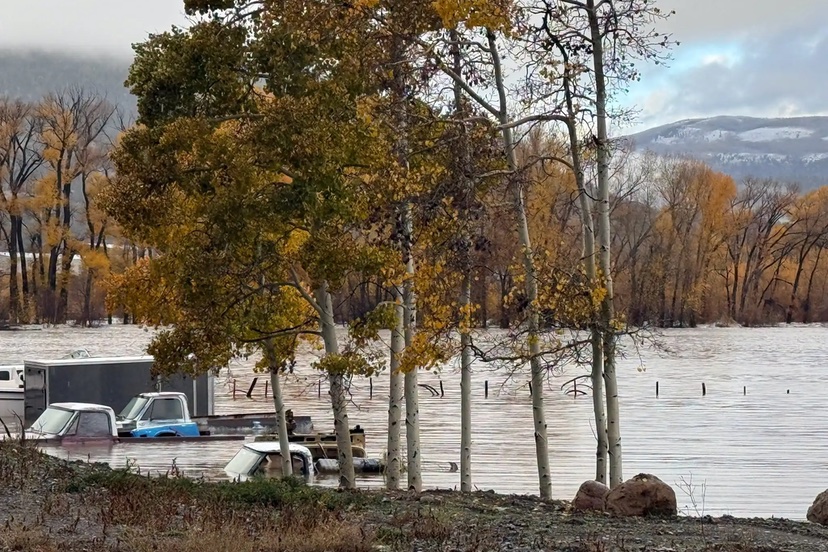
Emergency crews in the South Fork area began assessing damage on Friday, October 23, following significant flooding from ongoing storms. At least one bridge in the area is missing. (Courtesy of South Fork Fire Rescue’s Facebook page)
The full impact of the October 23 flooding event — which affected communities throughout southern Colorado, Utah and New Mexico — will not be known for weeks, perhaps months. Two of the areas hardest hit were South Fork where some homes took on 4 to 5 feet of water, and certain homes along the Conejos River, hit by up to 7 feet of floodwater.
One immediate problem appears to be natural gas. From Sheriff Mike Le Roux:
“We received a Fire Hawk [helicopter] on Friday, and we learned, during that, that Xcel Energy had a catastrophic failure of their gas pipeline that supplies Pagosa Springs; it comes via Ignacio and Bayfield, through Pagosa and over Elwood Pass.
“That is still compromised through the Hwy 151 corridor where it crosses the Piedar River. It was registering zero pressure. On the Xcel side, they isolated so that… the issue with that is, if we lost pressure in Pagosa, there was the potential that we would likely have to evacuate and get Black Hills Energy to relight everyone’s pilot lights. Worst case.
“So we wanted to maintain pressure. They isolated that at the base of Capote Hill, to stop it dead.”

With the Fire Hawk helicopter, the County was able to fly a technician up to the East Fork gauging station, and he was able to effectively redirect natural gas from the east.
“So we haven’t lost natural gas to Pagosa. That was a mission-critical. We got through that…”
Later in the meeting, a representative from Black Hills Energy, Jason Auslander, provided some additional details, and it sounded like the problem is not solved. Black Hills has been bringing in tanker trucks to augment the pressure in the community’s gas lines, but with some roads and highways damaged, there’s a question as to how necessary additional trucks will be able to reach Pagosa.
Black Hills sent out a press release on October 26, urging Pagosa residents and businesses to limit their use of natural gas whenever possible.
Some things you can do to conserve gas at this time are:
Lower your thermostat as much you can comfortably manage.
Minimize hot water usage.
Turn off natural gas fireplaces, garage heaters and any other nonessential appliances that use natural gas heat.
If your gas service is interrupted, we’ll be in contact with you to coordinate a necessary re-light of your service. For safety reasons, we ask that you do not attempt to re-light the pilot.
As Sheriff Mike Le Roux wrapped up his presentation to the joint Town Council-Board of County Commissioners meeting on Monday evening, he made one thing clear.
Life safety is the primary issue to deal with at the moment. Finding and helping people who are stranded and in need.
Next comes a prioritized list to guide the community’s recovery. What’s top on the list? What comes later? And then, cooperatively working down the list with governments, businesses and non-profits.
Presumably, restoration of damaged roads will come high on the list. (A ‘Yes” vote on Ballot Measure 1A would help address that need, by asking tourists to kick in a few more Lodging Tax dollars when they visit.)
We heard from Shawn Prochazka, co-owner of the non-profit weather information website called Pagosa Weather. Sheriff Le Roux had relied on Shawn and his wife Arleen for accurate weather information as the threatening October storm approached. Arleen and Shawn are the National Weather Service (NWS) Archuleta County Weather Ready Nation (WRN) Ambassadors. They were recognized by National Oceanic and Atmospheric Administration (NOAA) at the national level as 2022 WRN Ambassadors of Excellence.
Shawn noted some additional rain likely, this coming weekend, but nothing — he thought — to be worried about. He said the next big weather event will likely take place around November 13.
We also heard, from Colorado Department of Transportation public information manager Meredith Greene, about new problems caused by the rain and flooding, related to the Highway 160 reconstruction project. Some of the new problems were outside the scope of the planned work, but CDOT and WWClyde have agree to tackle them anyway, she said.
When asked if the reconstruction will likely be completed in 2026 as scheduled, in spite of the flooding and rain, Ms. Greene was non-committal. Maybe, maybe not.
I took that to mean, “maybe not.”
County manager Longinos Gonzalez spoke about ongoing negotiations with the state government to possibly waive some of the fees involved in developing a local gravel pit. The County currently trucks in all its road gravel from distant gravel pits. Clearly, with roads getting damaged and washed out, access to gravel will be a critical need. (The County Manager did not mention the location of any proposed local gravel pits, but his comments hinted at their possible existence.)
From Commissioner Veronica Medina:
“I mentioned mental health earlier, and I did receive an email. It’s called Disaster Behavioral Health Response, and we do have that available to us…”
From the Colorado Department of Public Health and Environment website:
The Disaster Behavioral Health team exists to promote the behavioral health and well-being of individuals and communities at every stage of disaster preparedness, response, and recovery. We support coordination between state, local, and federal partners, facilitate connections and capacity-building opportunities, and provide subject matter expertise in topics such as disaster behavioral health field response readiness, pediatric disaster behavioral health considerations, and community recovery, among others.
Commissioner Medina:
“I will be sharing more information about that, to help get that organized, because that is something that is available through our health partners.”
This was an interesting comment, I thought. The first phase of any disaster response is typically about life safety. The next phase is typically about repairing damaged property and infrastructure.
The damage to mental health, I suspect, is often ignored. We assume people will get the help they need, on their own. But when people have mental health issues, they might not make the best decisions about getting the help they need.
Mental health was not discussed, for instance, at the community meeting at the Archuleta County Fairgrounds on Tuesday…
Read Part Three… tomorrow…
Bill Hudson began sharing his opinions in the Pagosa Daily Post in 2004 and can't seem to break the habit. He claims that, in Pagosa Springs, opinions are like pickup trucks: everybody has one.