
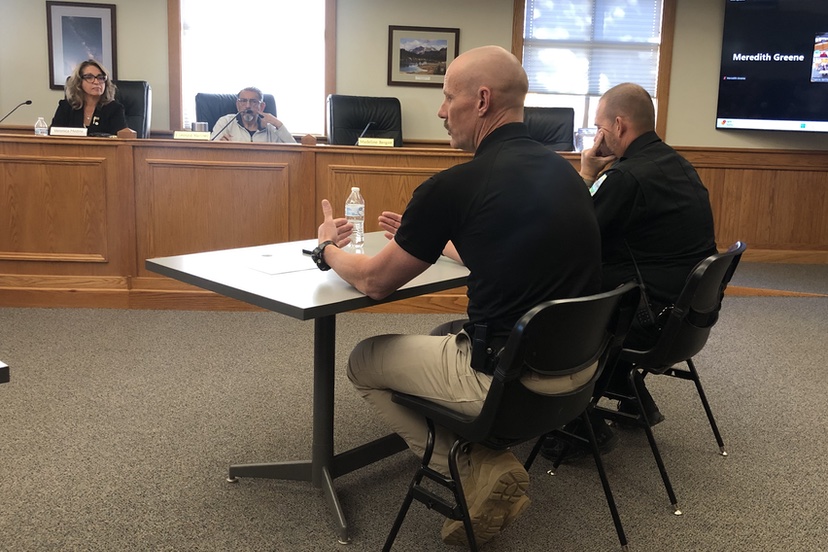
Archuleta County Sheriff Mike Le Roux and Pagosa Springs Police Chief Bill Rockensock sharing information, on October 26, about the response to the recent flood event, as Commissioner Veronica Medina and Council member Leonard Martinez listen.
First, we’re going to hear from Archuleta County Commissioner John Ranson, sharing some thoughts with the legislative aides to Colorado Senators Michael Bennet, John Hickenlooper and Representative Jeff Hurd… the three legislative aides who had attended — via Zoom — the Tuesday, October 26 joint meeting of the Pagosa Springs Town Council and Board of County Commissioners.
The meeting focused, as we might understand, on the disastrous flooding that took place the morning of October 23. We had heard from Archuleta County Sheriff Mike Le Roux, Pagosa Springs Police Chief William Rockensock, and numerous others, and we were about halfway through the two-hour meeting when Commissioner Ranson offered his comments.
The Commissioner had just pulled up, on his phone, a dictionary definition.
“I just pulled up what ‘bipartisan’ means.
“Involving, supported by, or representing two political parties, especially especially two opposing parties that normally disagree, working together to reach a compromise or a consensus.
“Over the past four or five days, it’s been amazing to watch this community, and thank you to Chief and Sheriff and all of you guys. What you see go on down there… we’ve had three opportunities now, between the two floods and the fire. I can’t imagine anybody doing a better job.
“And we didn’t get any help last year.”
When he said we didn’t get any help, Commissioner Ranson was not referring to the State of Colorado. The state government has consistently offered assistance — personnel and financial assistance — during recent disasters in Archuleta County.
Instead, Commissioner Ranson is referring to President Donald Trump and FEMA, the Federal Emergency Management Agency.
Commissioner Ranson addressed his next comments to the aides of our elected federal representatives attending by Zoom.
“So I know he’s not listening, or any of his crew, but for the three of you who are listening, if you can pass this on to Mr. President…”
This catastrophic event will be a long road back for everyone in the Four Corners, and particularly Archuleta County, where we all live. We are a resilient community and we will bounce back stronger than ever. Last year, we had zero help — no dollars — and had to dig out of a 100-year flood.
I plead with you, sir, to sign the Local Disaster Declaration as soon as possible.
“That’s it.”
The estimated cost of the flood event last year, fort damaged public infrastructure, has been pegged at about $6 million. FEMA did not provide any funding for recovery.
Some financial help from FEMA would no doubt be welcome in Pagosa Springs this time around — if it arrives, this time around. Our local governments have been putting dollar estimates to the damage to public infrastructure since the peak flood event last Thursday and Friday, and according to Town Manager David Harris, the rough estimate is “$80 million to $90 million for our community”.
The estimate for damage within the town limits: perhaps $40 million.
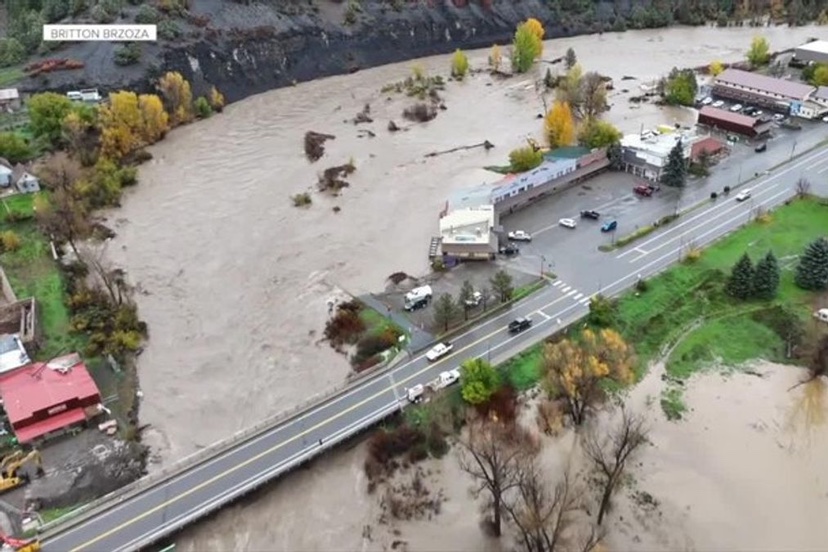
A few minutes later, the Council and BOCC were hearing a report on the problems faced by the Colorado Department of Transportation (CDOT) and their contractor, WW Clyde, related to the Highway 160 reconstruction through downtown Pagosa, from public information manager Meredith Greene…
…when Sheriff Le Roux interrupted the presentation to share a text message he’d just received.
“I just want to read you something I just found out.
“President Donald Trump approved federal disaster relief for the Four Corners region following severe flood, with a cost estimate upwards of $300 million…”
“So that just happened today. And it talks about southwest Colorado and mandatory evacuations along the rivers, including the San Juan River through Pagosa Springs.
“So that just came out…”
Mayor Shari Pierce thanked the Sheriff for the report — as the meeting audience burst into applause.
The elation was dampened a bit later in the meeting, however, when Wyatt Bair — aide to U.S. Senator Bennet — asked to speak via Zoom, and clarified for the gathered officials and audience that, in fact, the disaster relief mentioned by the Sheriff applied only to counties in New Mexico, and that so far, no relief has been promised to any Colorado counties.
But, for a few moments at least, we’d had the pleasant impression that Donald Trump was willing to help us.
Help had arrived, however, from another source. According to Sheriff Le Roux’s lengthy report at the start of the meeting, Governor Polis had dispatched the National Guard to Pagosa Springs on Friday and Saturday — 84 guardsmen, three helicopters, and 31 ‘high-clearance’ vehicles — to help with search and rescue efforts.
Although numerous people had been stranded at their homes due to washed out and damaged roads, the Sheriff reported that there have been no known fatalities or injuries from the flood.
Sheriff Le Roux noted that an ‘incident management team’ has arrived in Pagosa, including subject matter experts in disaster planning, logistics, operations and finance.
“That has taken a huge load off, certainly, the Sheriff’s Office and the County, and hopefully the Town. We are now feeding everything through the incident management team, to help manage the risk and what that looks like, as we’re procuring assets and resources from the Front Range and other counties, potentially. And we’re planning for what that recovery looks like…
“Up until now, we’ve had 11 ground missions — the delivery of supplies to people who are stranded. No ground rescues associated with that. And we’ve had 18 air missions with 11 rescues, and those rescues are all evacuations.
“Our road system is severely damaged, starting with San Juan River Village. I mean, we have residential damage up there, but we definitely have infrastructure damage…
“By far, County Road 500 [Trujillo Road] is the longest and most severely impacted stretch of infrastructure. There are parts of CR 500 that are non-existent at this point, and we have communities and people in areas with no access out from either end. So that’s what these aerial assets are doing, is identifying… it’s an accountability exercise. We’re seeing who wasn’t able to evacuate at all, and who stayed, and what that level of support looks like…”
Read Part Two… tomorrow…
Bill Hudson began sharing his opinions in the Pagosa Daily Post in 2004 and can't seem to break the habit. He claims that, in Pagosa Springs, opinions are like pickup trucks: everybody has one.