
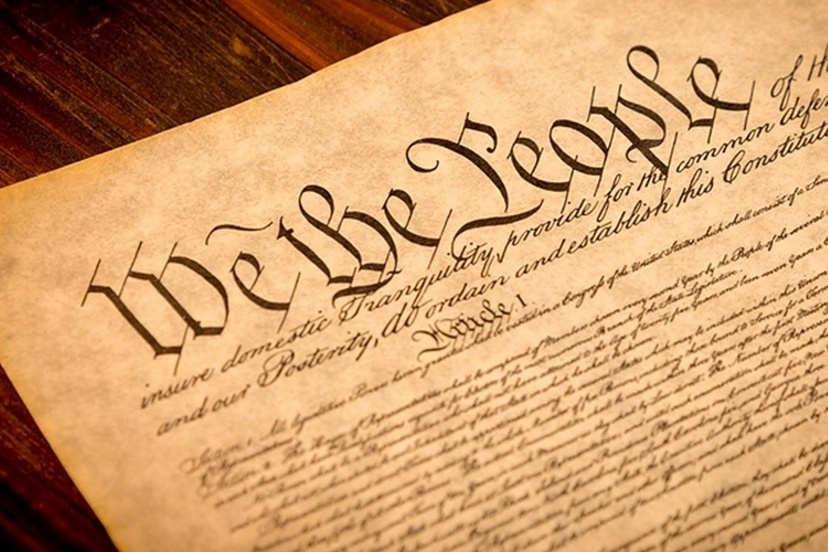
For the Constitutional Convention delegates to adopt the following language in the Preamble of a document…
“We the People of the United States, in Order to form a more perfect Union, establish Justice, insure domestic Tranquility, provide for the common defence, promote the general Welfare, and secure the Blessings of Liberty to ourselves and our Posterity, do ordain and establish this Constitution for the United States of America…”
…was a revolutionary act.
The preamble was mainly written by Gouverneur Morris, a Pennsylvania delegate to the 1787 Constitutional Convention held at Independence Hall in Philadelphia. When he wrote it, “the United States of America” did not technically exist. Only if the separate States agreed to ratify this design for a shared federal government would “the United States” exist.
That ratification required nine of the formerly-British colonies — now “States” — to approve the Constitution, which took place on June 21, 1788 when the New Hampshire legislature signed on the dotted line. The last of the original 13 colonies to ratify the agreement was Rhode Island, on May 29, 1790.
As the Preamble indicates, the authority to create a shared federal government came, not from a king or aristocracy or oligarchy, but from “We the People” — from the citizens themselves.
But in another sense, the authority actually came from the State legislatures, the former British subjects who had been elected to represent “We the People”. This was to be a ‘republican’ form of government: elected representatives authorized to make decisions that theoretically reflected the interests of the “People” they represented.
A thoughtful reading of the original document makes it very clear that the State legislatures wanted to severely limit the power of the federal government. Most of the document is in fact aimed at carefully defining what the federal government was authorized to do and what it was not authorized to do, and at splitting the government into separate departments that could accomplish very little unless they were able to come to agreement.
For example, the President was Commander in Chief of the federal army and navy, but only the Congress could declare war.
The laws could be made only by Congress, but needed the President’s signature.
Violations of federal laws would be judged by a separate and supposedly non-political Supreme Court.
And so on.
A few months after the New Hampshire legislature became the ninth to ratify the Constitution, twelve Amendments were circulated among the States, and ten of them were eventually ratified on December 15, 1791. (The eleventh was ratified in 1992. The twelfth is still pending ratification.). We’re familiar with those ten Amendments as “The Bill of Rights”, but maybe most familiar with three of them, in particular.
The First Amendment guarantees freedom of religion, speech, the press, assembly, and the right to petition the federal government.
The Second Amendment guarantees the right of the States to maintain armed militias. It has also been interpreted as a general “right to bear arms.”
The Fifth Amendment prohibits the federal government from forcing anyone accused of a crime to testify against themselves.
I suspect many people are unfamiliar with the other seven Amendments.
But the Tenth Amendment may be of special interest lately, considering the growth of the federal government over the past 250 years. It consists of one sentence.
The powers not delegated to the United States by the Constitution, nor prohibited by it to the States, are reserved to the States respectively, or to the people.
We might find it obvious, when reading this Amendment, that only the powers specifically written into the Constitution accrue to the federal government.
Even after the ratification of 27 Amendments, I can find no clear language in the Constitution giving the federal government the power to regulate — for example — education, housing, medical practices, pollution, land use, occupational safety, communications, elections, law enforcement, drug use, or a plethora of other social and cultural concerns that the federal government has since assumed the right to regulate or influence.
Yet the current Trump administration has issued, over the past 18 months, over 250 executive orders, asserting the power of the federal executive to regulate the very citizens’ rights and States rights that the Constitution was designed to protect from federal overreach.
This helps explain why state attorneys general and watchdog organizations have filed over 350 lawsuits challenging the ‘executive orders’ or actions taken by the current administration. About half the legal challenges have resulted in administration actions being legally blocked; a quarter of the lawsuits still await a ruling.
As we enter 2026, the stakes feel as high as ever. In coming months, the courts will make decisions that affect civil rights and civil liberties and determine whether marginalized communities can fully participate in public life for years to come. This year also marks the 250th anniversary of the Declaration of Independence — a moment that reminds us of the centrality of liberty and equality to the founding of our nation…
This is because democracy doesn’t defend itself — people do. And together, we will keep showing up.
— From the ACLU website.
Numerous websites and books are available, providing analyses of the U.S. Constitution — “America’s most important document” — including this annotated version available at the Library of Congress.
Because democracy doesn’t defend itself. We the People do.