
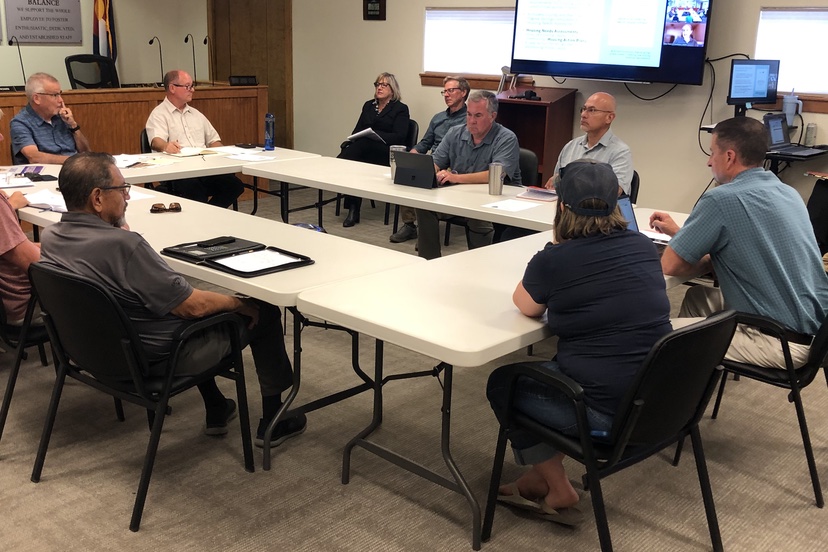
The Archuleta Board of County Commissioners — Warren Brown, Veronica Medina and John Ranson — have been attending monthly joint meetings with the Pagosa Springs Town Council — Shari Pierce, Maddy Bergon, Brooks Lindner, Gary Williams, Mat deGraaf, Leonard Martinez, and newly appointed member Vahid Shabro — to discuss shared concerns. (Mr. deGraaf. Mr. Shabro, and Mr. Williams were not able to attend.)
The conversations have sometimes been surprisingly contentious.
Last night, Monday August 24, was a case in point.
I say “surprisingly” because — at least in this instance — I didn’t think there was anything particularly contentious on the agenda.
I. US 160 Construction Briefing
II. Country Center Drive Update
III. Hill Top Cemetery Bench Seating
IV. Housing Action Plan
V. Other Items of Mutual Interest
The presentation about US Highway 160 was pretty much as expected. We will continue dealing with inconvenient access downtown until around Christmas. Assuming we don’t have an inconveniently early winter, in which case — who knows?
The potholes on Country Center Drive are not likely to be repaired anytime soon, because Country Center Drive is a private road and the shopping center businesses can’t agree on who will pay for the repairs. Commissioner Brown would like to simply close those road to traffic, until the business owners fix the problem. No one else seemed too excited about that solution.
Local veterans would like some additional park benches installed at Hill Top Cemetery, because the folks who attend military events there tend to be older folks, who have difficulty standing for long ceremonies. An obvious alternative would be to have shorter ceremonies, but our local government leaders seemed to prefer the idea of more benches.
Then we came to the draft Housing Action Plan — a specific document the state of Colorado now requires cities, towns and counties to adopt if they wish to apply for state housing grants.
Indeed, our Town and County have applied for various housing grants in recent years, and plan to continue that practice, as part of the ongoing effort to address the serious housing crisis in Pagosa Springs.
As mentioned, I didn’t expect this discussion to become contentious. It’s just another housing action plan, like other action housing plans adopted by the Town and County in previous years.
Yes, the crisis has worsened, and the first part of the Monday presentation by ECOnorthwest consultant Mary Chase highlighted some of the elements of the crisis. But the basic problem remains the same. Workers can’t find housing they can afford, and everyone is seeing their property taxes and utility costs and insurance costs steadily increasing.
Theoretically, the crisis could be partly resolved by the individuals who own property in Archuleta County. Property owners who rent to local workers could simply set their rental rates at the level they were in 1999 or earlier. Back then, you could rent a two bedroom house for less than $900 a month.
But the rental market completely changed, here, just prior to and during the COVID crisis. Local investors and out-of-town investors began buying up anything they could get their hands on, and converting the houses into Short-Term Rentals. For a while — especially during COVID — a clever investor could make $5000 a month renting a house to various visiting tourists, at least during the summer tourist season and around the Christmas holidays.
The Town government realized the problem and placed a cap on how many STRs were allowed in certain neighborhoods. But the County leadership refused to place any limits on the number of STRs that could operate in the unincorporated county. Some county neighborhoods and condominium complexes became overrun with STRs.
Rentals that had previously been available to workers and families now became mini-motels. And as long-term rentals became more scarce, landlords upped the rents.
And thanks to the influx of monied investors, the asking prices for homes more than doubled. In 2012, the average Pagosa Lakes home sold for around $200,000. That same house now sells for $500,000 or more.
As Ms. Chase noted during her Monday evening presentation, our rental vacancy rate has dropped to about 0.5%. A “healthy” rental market in America typically has a rental vacancy rate of around 7%. (That means, “healthy” for the local economy and its workforce.) As a result, the rents charged are double what they were prior to COVID.
Theoretically, there are enough houses in Pagosa Springs to accommodate our workforce. But everything is overpriced, in a community that runs on low-wage tourist industry jobs.
Theoretically, our local landlords could reduce their rental rates. Theoretically, sellers could lower the asking prices on their homes. But no one expects that to happen, unless the community spirals into an economic recession. And that, of course, would bring about a whole different set of issues.
Since individual property owners are unlikely to address the housing crisis, the problem lands in the lap of local governments. Enter, stage left, the state-required Housing Action Plan.
You can download the draft here.
After sketching out the problems, Ms. Chase began to outline the various solutions that the consulting team had picked as action items — working with ideas contributed by various local leaders and concerned citizens. Increase taxes. Apply for grants. Allow ADUs in backyards. Preserve existing ‘naturally affordable’ units. Take a look at possible zoning changes. Increase the fees charged to STRs. Do a better job of educating the public.
In other words, line up the usual suspects.
But one of the suggested action items did not sit well with Commissioner Veronica Medina.
4.2 Create a multi-jurisdictional housing authority and fund a formal housing coordinator.
The Town of Pagosa Springs currently employs a “multi-jurisdictional housing coordinator” — Jeff Sams — who also works closely with the staff of the non-profit Pagosa Springs Community Development Corporation. I believe Mr. Sams is currently funded mainly by grant funds, which will expire at some point, thus the phrase “fund a formal housing coordinator.”
Commissioner Medina:
“I just don’t think we need a multi-jurisdictional housing authority. I think we already have one.”
Ms. Medina is here referring — not to Mr. Sams — but to the Archuleta County Housing Authority, which is run by former County Commissioner Clifford Lucero and his daughter Anissa Griego. ACHA is certainly a housing authority.
But is it “multi-jurisdictional”?
Bill Hudson began sharing his opinions in the Pagosa Daily Post in 2004 and can't seem to break the habit. He claims that, in Pagosa Springs, opinions are like pickup trucks: everybody has one.