
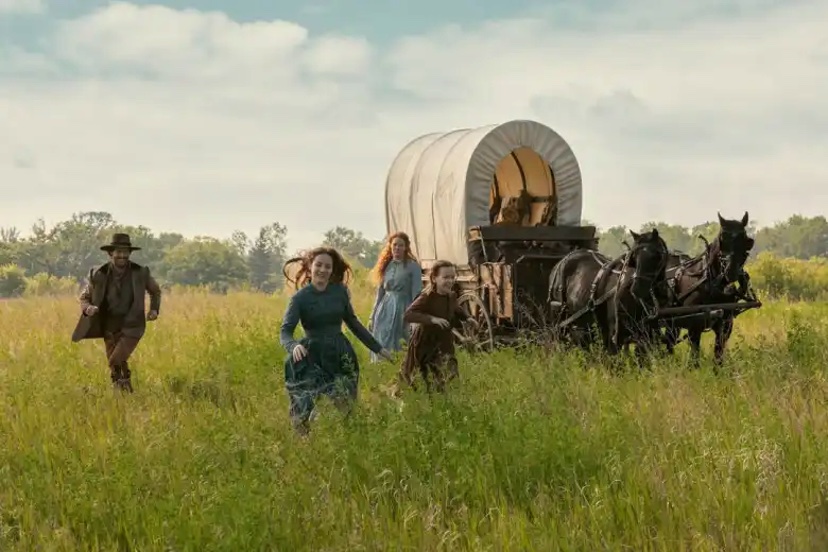
Photo: The Ingalls family heads west to the Kansas prairie in the first season of Netflix’s adaptation of the “Little House on the Prairie” book series. (Credit: Netflix via IMDb)
This review by Caroline Carlson appeared on The Daily Yonder on August 20, 2026.
Of all the stories about the American frontier, you would be hard-pressed to come up with any more beloved than Laura Ingalls Wilder’s “Little House on the Prairie.” It’s been nearly a century since America’s favorite pioneer woman published the first book in her semi-autobiographical series, but if Netflix’s newest adaptation is any indication, the allure of covered wagons, wide-open prairies, one-room log cabins, and the promise of the West endures.
The new TV series released in July 2026, based on the third – and arguably most iconic – book, details the Ingalls family’s journey from the “big woods” of Wisconsin to a fresh start on the Kansas prairie. Just as the Ingalls struck out into the unknown, the woman responsible for the show, Rebecca Sonnenshire (developer, writer, showrunner, and executive producer), has taken a leap of faith alongside them. She’s best known for her work on Emmy-nominated Amazon Prime show, “The Boys,” a satirical and raunchy reimagining of classic superheroes, and last year’s erotic psychological thriller film “The Housemaid” (2025). So an adaptation of the most wholesome book series around wasn’t exactly on my bingo card for Sonnenshire.
But, with a second season already guaranteed, and a seat in Netflix’s #1 spot during “Little House on the Prairie’s” second week streaming, Sonnenshire appears to be just as successful working with cherished childhood reading material as with irreverent adult comic books. And by building on the legacy of the Little House series and its three previous adaptations for the screen, her interpretation manages to update the story with a wider historical context, all while preserving its essence.
New Characters and Complexity in Independence, Kansas
Over the course of eight episodes and seemingly inexhaustible (but breathtaking!) shots of the Kansas prairie, we come to know a family of four living off – and at the whims of – the land. Beyond just surviving, they find a profound sense of community (and a profound sense of everyone-knows-everyone-else’s-business), in small-town Independence, Kansas.
Upon arrival, Caroline ‘Ma’ Ingalls (Crosby Fitzgerald) is taken aback by the lack of civic infrastructure: the town has no church, post office, or school. But these things come with time, and after some inner turmoil, Caroline embraces her role as a pioneer woman, right alongside the man whose idea it was to head west in the first place: Charles ‘Pa’ Ingalls (Luke Bracey). This time around, Netflix saw fit to give Pa a dash of complexity he hasn’t enjoyed before by layering a tragic motivation to leave Wisconsin under the promise of opportunity and adventure on the frontier. In this retelling, Charles isn’t just striking out to settle “unclaimed” land, he says he had to go, and it is revealed that a tragedy and the strained relationships left in its wake incentivized the move as much as any misguided subscription to the idea of Manifest Destiny.
These kinds of reframes and complications are central to Netflix’s 2026 update, and Pa’s backstory is just one of the more subtle ways the Ingalls’ narrative has been nuanced for today’s audiences.
In the very first episode, our plucky young protagonist Laura Ingalls (Alice Halsey), finds a lost handmade doll on the banks of the river near the land her father has claimed as their own. The doll’s owner is revealed to be Good Eagle (Wren Zhawenim Gotts), a Native Osage girl Laura’s own age. After initial misunderstandings, the return of the doll, and several episodes of mutual distrust between the girls’ mothers, an “intermittent fever” (malaria, although it is never named as such) sweeps the town. The sickness spares almost no one, but leaves the two women with a shared respect and recognition of what it takes to be a mother on the prairie.
With pesky parental prejudices handled, Laura and Good Eagle are free to enjoy the cross-cultural friendship they have been yearning for since episode one, a friendship which blossoms into best-friendship over the course of the series. Good Eagle, her Osage mother, and half-Osage father are characters created for this Little House retelling as a way of bringing Indigenous perspectives into the story.
Admittedly, the last time I read the Little House books was in elementary school (and in fact, I didn’t read them – my mom read them to me). But a little SparkNotes and some googling confirmed my suspicion that the original source material didn’t include Native voices and perspectives, only details of encounters with them through a white settler lens. Netflix tries to improve on this extremely one-sided depiction by introducing Native characters and furthering the plot with a key detail that the books miss: when the Ingalls build a log cabin on the Kansas prairie, they are illegally squatting on sovereign Osage land. And while the Osage ultimately cede this land to the U.S. Government (in the 1870 Drum Creek Treaty, for all you history buffs), the show explores the consequences of the Ingalls, and then the U.S. government, claiming land that was never theirs for the taking.
Beloved Stories Endure
While perhaps not always a perfect balance, this latest adaptation of “Little House on the Prairie” does its best to preserve the magic of the story, even as it broadens its scope. Inherently, it contains themes that we often highlight as rural tropes. But the thing is, “Little House on the Prairie” makes an honest story out of the homesteader lifestyle in a way that no trad-wife ever could. And, at the risk of joining many in idealizing the frontier, I’ll say that it does retain the warmth, charm, and emphasis on gratitude for life’s simple pleasures that has captivated people from the beginning.
In the final episode of the series, Independence celebrates Founder’s Day and Laura’s older sister, Mary Ingalls (Skywalker Hughes), is set to participate in an essay competition about what the town of Independence is and what it stands for. When Mary doesn’t show, Laura takes her place and delivers an impassioned improvised speech. Her thesis statement is that “Independence isn’t really a place, it’s the people you carry around in your heart,” which proves particularly bittersweet when it is revealed that the Ingalls are going to be forced to head out across the prairie again. And while I find the sentiment of Laura’s speech to be a little bit cliche, it reminds me that cliches are, in fact, predicated on truth.
Almost a century of unrelenting “Little House” fandom suggests that many people have carried Laura and Mary and Ma and Pa Ingalls around in their hearts. Netflix’s latest remake only furthers their legacy.
Season one of “Little House on the Prairie” is streaming on Netflix.
This article first appeared in The Good, the Bad, and the Elegy, an email newsletter from the Daily Yonder focused on the best, and worst, in rural media, entertainment, and culture. Every other Thursday, it features reviews, recommendations, retrospectives, and more. Join the mailing list today to have future editions delivered straight to your inbox.
This article first appeared on The Daily Yonder and is republished here under a Creative Commons Attribution-NoDerivatives 4.0 International License.
The Daily Yonder provides news, commentary, and analysis about and for rural America. They welcome photos, tips, observations, and links to stories about rural America. Reach them at news@dailyyonder.com