
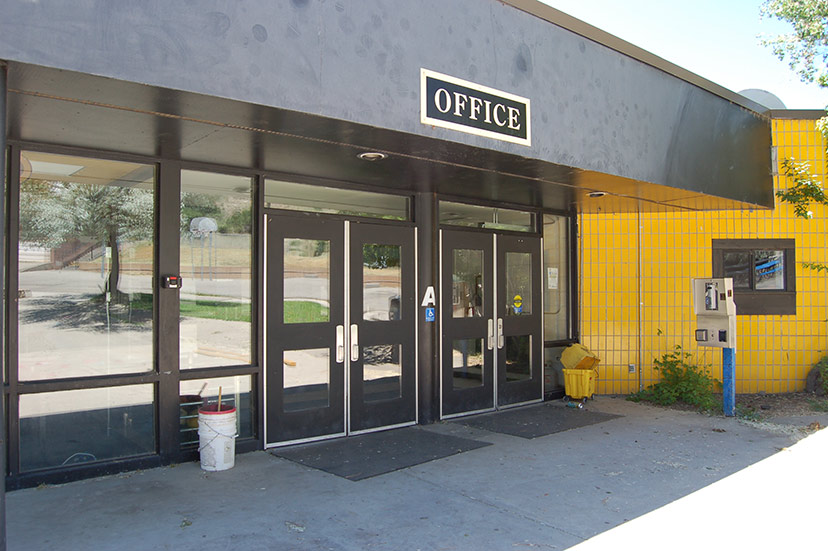
Photo: The entrance to Pagosa Springs Middle School, with recently-added security features.
Colorado’s student count continues to fall in many parts of the state, with overall enrollment in public schools plummeting by more than 10,000 this school year to 870,793 kids in preschool through 12th grade classrooms…
Declining enrollment is a trend that’s happening beyond Colorado, with schools across the country also seeing fewer kids showing up to classrooms. The National Center for Education Statistics projects that by 2032, enrollment will drop to 46.9 million kids from 50.8 million in 2019…
— from a February 2026 article by on the ColoradoSun.com
Historically speaking, public education wasn’t always a popular choice here in America.
Reportedly, the first compulsory public education laws were passed in Massachusetts in 1852, and were resisted by an estimated 80% of the population. Apparently, parents preferred to teach their own children, and also lived a rural lifestyle where homeschooling was more convenient than it is today for two-income families.
The Colorado Sun article noted above, about the state’s declining public school enrollment, offered a link to a map showing the approximate decline (or growth) in school enrollment in each Colorado county. Archuleta School District had reportedly lost about 7% of its enrollment between 2019 and 2023.
In neighboring Bayfield and Durango, the drop is more like 21%. The biggest loss was in Edison School District, where enrollment dropped by 69%.
About a quarter of the state’s 178 school districts, however, saw increased enrollment — notably, Byers School district (160% increase), Agate School District (85% increase) and Bennett School District (67% increase). Those districts are located east of Denver.
Whether the enrollment decreases or increases in certain communities are related to the availability of reasonably-priced housing for young families, the Colorado Sun article does not spell out.
Presumably, Daily Post readers are most interested in our own local school district — Archuleta School District — and perhaps especially as it relates to a School Board proposal to abandon two functioning school facilities in downtown Pagosa and to construct a new PreK-8 facility on Vista Boulevard, west of town.
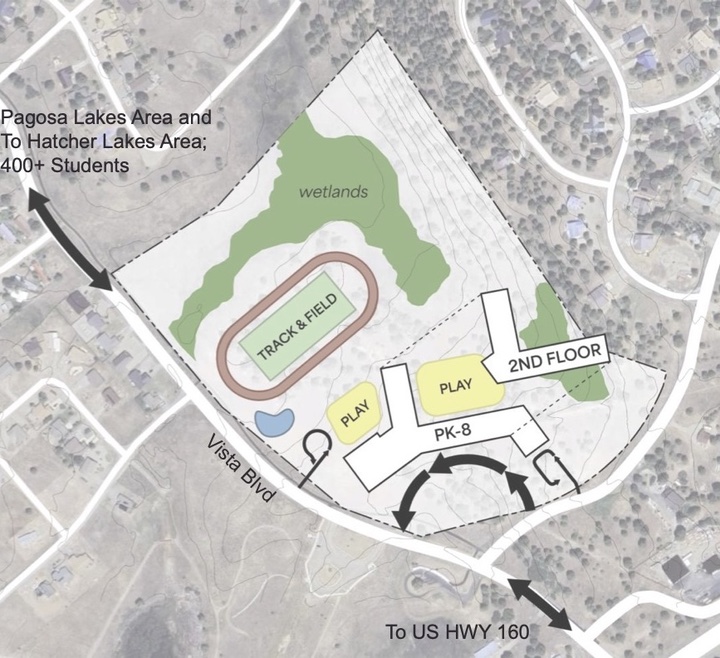
A survey conducted by ASD last summer indicated that a slight majority of voters were willing to increase their property tax burden to help fund this new campus.
But this new school project is also in some ways similar to a K-8 project proposed in 2012. When those votes were counted, the proposed school bond had been rejected by a 3-to-1 margin.
The economic situation in Pagosa Springs might also be somewhat similar to 2012, when Pagosa was slowly digging itself out of the Great Recession… and key local industries — construction, real estate and tourism — were struggling. (As they appear to be doing again in 2026?)
The news reports I’ve come across lately suggest that Americans are feeling anxious about the national economy. From an April 28 report by Matthew Lynch in The Tech Advocate:
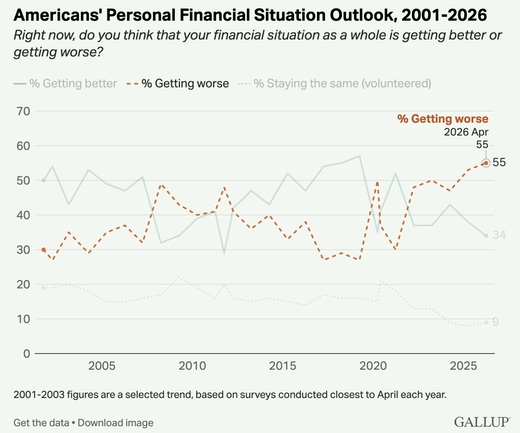
In April 2026, Americans faced an unprecedented level of financial anxiety, as reflected in Gallup’s Economic Confidence Index, which plummeted 11 points to a dismal -38.
This decline highlights a growing sense of unease among the populace regarding their economic stability and future prospects.
Notably, a staggering 55% of individuals reported that their financial situation was worsening, signaling a concerning trend that points to the pervasive issue of affordability…
That “55%” figure appears to come from a recent Gallup survey. And it appears to be the worst “Getting worse” report of the past 25 years. Worse than during the COVID crisis.
The right thing at the wrong time is the wrong thing.
— Author Joshua Harris
I confess to agreeing with this quote from Joshua Harris. As we are reminded constantly, “Timing is everything.” In comedy, in tennis, in business, in golf, in politics, in cooking, in romance…
…and in proposed property tax increase ballot measures.
I’ve expressed my belief — that timing is everything — to the ASD Board of Education, several times over the past year. As one of the founders of Pagosa Peak Open School, our ASD-authorized K-8 charter school, I can state with some confidence that our application for charter approval, back in 2016, was well-timed. Despite public opposition to the PPOS charter coming from ASD staff and parents, the ASD School Board — at that particular moment in time — supported our proposal and signed the necessary contract to allow PPOS to operate in Archuleta County.
For that, I am thankful.
Disclosure: I currently serve as a volunteer on the Pagosa Peak Open School board of directors, but this editorial reflects only my own personal opinions and not necessarily the opinions of the PPOS board or staff.
Ours was not the first charter school to be proposed to the ASD School Board. But it was the first one — and so far, the only one — to be authorized by ASD.
Considering the generally conservative voter base in Archuleta County, our school district voters have been reasonably supportive of public education — increasing their property taxes on numerous occasions, over the past 50 years, for new facilities, expansions, and safety and security upgrades. We have also willingly taxed ourselves to increase teacher salaries.
It’s possible that we, the voters, would once again step up and increase our property taxes for a new $126 million PreK-8 facility on Vista Boulevard.
But… if timing is everything… is 2026 the year to ask?
The year when 55% of Americans report that their economic situation is “getting worse”?