

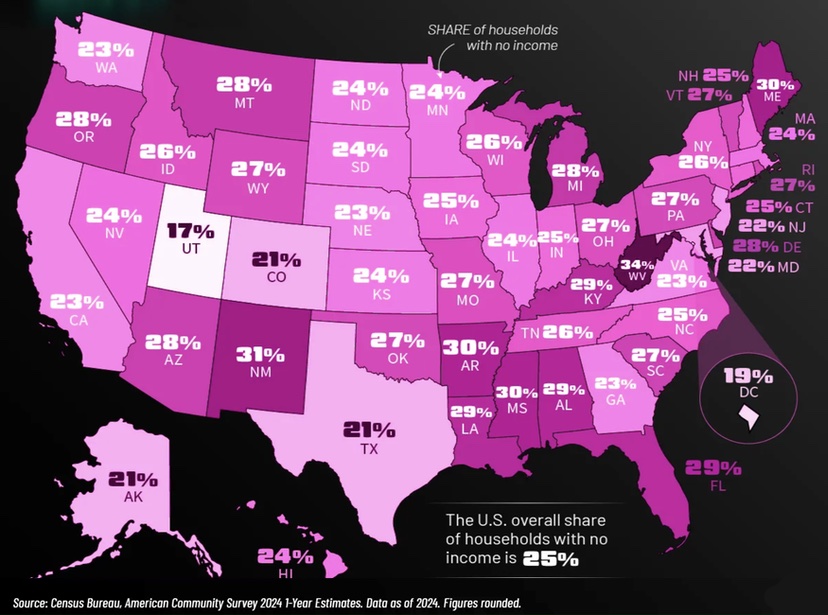
At a time when things should be going really well for the United States, roughly one in every four American households have no income. While there is some variation across America, there’s not much variation from state to state. Nor can we say it’s blue states or red states most likely to be on the top ten or bottom ten list. That’s why it will require Republicans and Democrats working together to stop this crisis.
According to Visual Capitalist who measured the data, “West Virginia stands out with the highest share of households reporting no income at 34%, three percentage points ahead of New Mexico at 31%. The top five states by share of no-income households are rounded out with Maine, Arkansas, and Mississippi each at 30%. These states tend to have older populations, higher rates of disability, and lower median incomes overall. In such contexts, a larger portion of households rely on non-earned income sources or report no income during the survey period.” Utah has the lowest percentage of households with no income (17 percent), followed by D.C. (19 percent), Alaska, Colorado and Texas (all three being at 21 percent).
Could the recent good economic news help? Just recently, the administration released numbers claiming that the economy grew at the highest rate in two years, at 4.3 percent, as reported by The Wall Street Journal.
But there are reasons for skepticism at the unexpected numbers. That’s because the government has been repeatedly missing issuing regular required reports, including the GDP, inflation and unemployment data. Some of this is due to government workers who work on those reports were DOGE’d, and not all of them have been hired now that Elon Musk has taken that chainsaw to those departments. And the current administration claimed that some of these missing reports may never be released, according to Yahoo Finance.
It has become dangerous to issue economic data that doesn’t look good. The Bureau of Labor Statistics Commissioner who reported the poor jobs report back in July of 2025 was fired, as PBS reported. That’s why Moody’s Analytics Chief Economist Mark Zandi is being cautious about anyone reading the tea leaves of this current report, as it seems to be built more by consumer spending than job growth, The Hill noted in their news article.
“Businesses still aren’t hiring, and, as a result, there is no job growth. Job growth, at best, is flat, and, I suspect, is even down after revision,” Zandi said. “So fortunately, businesses aren’t laying off. That’s the key to keeping the economy moving forward and avoiding a recession.”
Zandi said even Tuesday’s report showing 4.3 percent GDP growth in the third quarter — which spans the three months through the end of September — is not worth celebrating without seeing meaningful job growth.
There are some silver linings ahead. If the Supreme Court follows their earlier logic and strikes down a second attempt at executive branch tariffs, that could help the economy, as The Hill noted. And with Congressional Republicans worried about how the party has struggled in the 2025 elections across blue, red and purple states, they may be willing to cut a deal with Democrats on affordability issues, like health care coverage.
But the most important thing to note: “affordability” can no longer be considered a hoax.
A small tariff check rebate isn’t going to replace “jobless growth.” We should do more to help these households.
John A. Tures is Professor of Political Science and Coordinator of the Political Science Program at LaGrange College, in LaGrange, Georgia. His first book, “Branded”, is available on Amazon. He can be reached at jtures@lagrange.edu.