
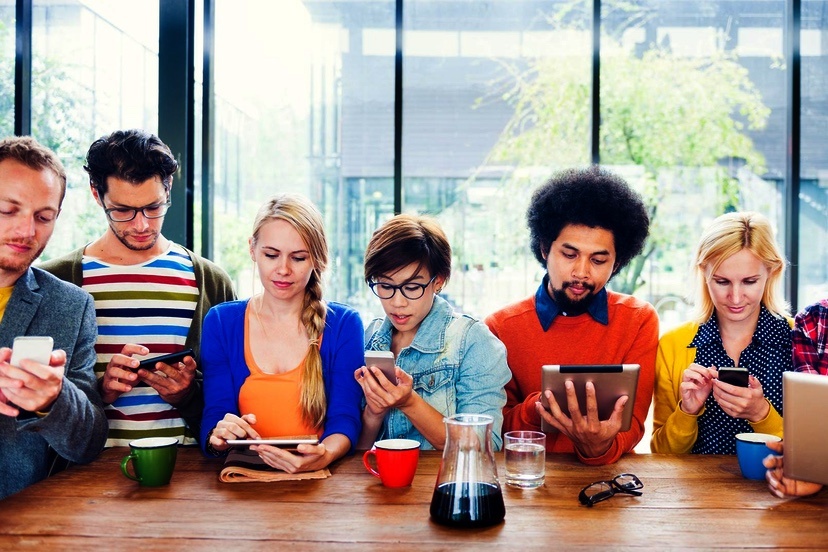
cant keep it lit
Selina Bartels, who describes herself as “a science education professor with a yearning for travel”, says she wakes up in the morning and — first thing — checks her phone.
…Right before I go to sleep, I look at my phone. While I am at the dinner table, during class or my commute, I am looking at my phone. When I am a little bored, I look at my phone to pass the time. I do not think my cell phone habit is much different from most other adult Americans. A typical American reports spending an average of five hours a day on a cell phone.
She wrote this on her Substack account, with the article title: “Are cell phones the new cigarettes?”
She notes that cigarettes were commonplace and smoking in public was quite socially acceptable… in restaurants, bars, college, workplaces and even on airplanes. I can personally attest to this fact, because I used to sit in the smoking section on airplanes, just to enjoy the second-hand smoke. I had given up smoking right out of college, but there’s just something soothing about second-hand smoke.
But in 1990, smoking was banned on U.S. domestic planes, even in the restroom. Then, California banned smoking in the workplace, in 1995. By the late 2000s smoking indoors was almost completely banned here in America. These days, I have to be riding with one of my friends in a private vehicle, to enjoy second-hand smoke.
Ms. Bartels wrote:
I can’t help but wonder, are cell phones the new cigarettes?
Not exactly. Anyone who has tried smoking their cell phone know how hard it is to keep it lit.
Also, if cell phones were the new cigarettes, we would see cell phones in ashtrays and littering the sidewalks.

But maybe Ms. Bartels has a point. Because cell phones are highly addictive, just like cigarettes. And also, highly annoying to be around, if you don’t have one of your own.
Another young commentator — a computer science and molecular biology major at MIT named Vivian Hir — addressed the same issue, but she didn’t bother with asking a question. She simply stated it as an established fact, by using the headline:
Smartphone are the New Cigarettes
Like Ms. Bartels, Ms. Hir found herself checking her phone repeatedly throughout the day, dozens of times a day, even though she rarely had a new text message or any real reason to check her phone.
Over the last year I’ve started noticing similarities between scrolling and smoking. I had a lot of unscheduled time in the lab last summer, so I decided to check my phone for a short stretch once every hour or two. Then, since I was supposed to be focused on research, I turned it off so I wouldn’t pick it up until my next break.
This may not sound like a big deal. A few weeks into working in the lab, however, I realized that my phone breaks were like the smoke breaks some workers feel compelled to take every hour. Though different on the surface, the two behaviors are similar psychologically.
What makes smoking enjoyable is that nicotine affects brain chemistry by releasing dopamine, a neurotransmitter that gives us pleasure…
I’ve had the same experience. Not doing research in the lab, of course… but checking my phone and getting a hit of dopamine. I actually do very little research in the lab. Maybe once a week? But I can still get a hit of dopamine, regardless, when I check my phone. I’ve found that even looking up the weather predictions several times a day can provide a dopamine rush.
Ms. Hir eventually came up with personal phone guidelines: limiting herself to checking her phone no more than 10 times a day. Sort of like a smoker limiting themselves to a pack a day. It’s still going to kill you, but maybe more slowly.
Phone don’t kill you in quite the same way, unless you are checking the weather while driving. I don’t do that, by the way.
Ms. Hir found that her “10 times a day limit” had an overall positive benefit, in spite of the dopamine shortages that resulted.
Using handheld devices may not seem as dangerous as smoking, which directly causes lung cancer and air pollution. But the similar element of addictiveness is why website-blocking apps such as Freedom exist. Ironically, it is by imposing more limits on our use of these devices that we gain more freedom in the end.
I think we all want more freedom. Especially considering the current administration in Washington. I can remember a time, not too long ago, when I could vote without presenting my passport and birth certificate.
I now have those documents stored on my phone, because I need them regularly. So there’s no way I can completely give up my phone.
And, like, the dopamine.