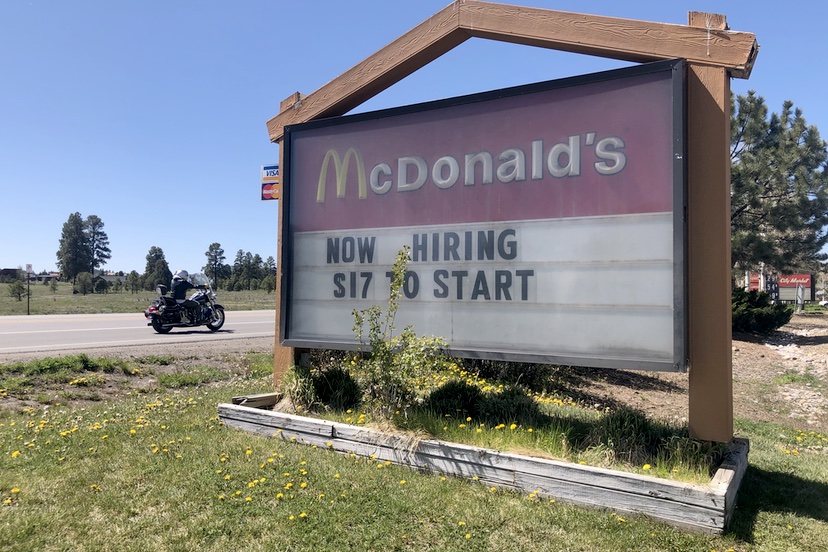
Photo: For the past five years, the McDonald’s drive-in in Pagosa Springs has been using its outdoor reader board, not to promote its menu, but to advertise for employees…
In Part Seven yesterday, I quoted a comment made by Pagosa Springs Town Council member Brooks Lindner at an April 7 work session focused on a potential purchase of 300 acres of forested hilltop, just south of the Town’s existing Reservoir Hill Park, at a cost of perhaps $8 million.
“I would argue that this opportunity is so valuable that it justifies a trade-off of foregoing other identified and unidentified initiatives, to secure the funding to ensure we acquire Res Hill…”
What were those other identified and unidentified Town initiatives, that Council member Lindner feels are less important than a potential 300-acre wilderness park, added to the Town’s existing 245 acres of downtown parks and trails?
Street repairs, perhaps? The Town’s slowly-failing geothermal heating system? Child care support for working mothers? Housing for our workforce?
The other five Council members who participated in the April 7 work session — Maddie Bergon, Mat deGraaf, Gary Williams, Leonard Martinez and Mayor Shari Pierce — all expressed support for the potential 300-acre land purchase. Some expressed a desire to purchase the entire 491 acres owned by the Fairway Land Trust.
Five years ago, the Town purchased several acres of vacant residential-zoned property, but to date no housing has been built on those vacant parcels. During that same period of time, the Town and County have spent well over $10 million subsidizing the tourism industry and expanding local recreation amenities. Was this the best way to enhance the Pagosa economy?
According to the Colorado State Demographer, Archuleta County’s population growth came to a halt in 2024. The school district is has been watching its student enrollment drop.
For the past five years, the McDonald’s drive-in has been using its outdoor reader board, not to promote its menu, but to advertise for employees. Starting at $17 an hour.
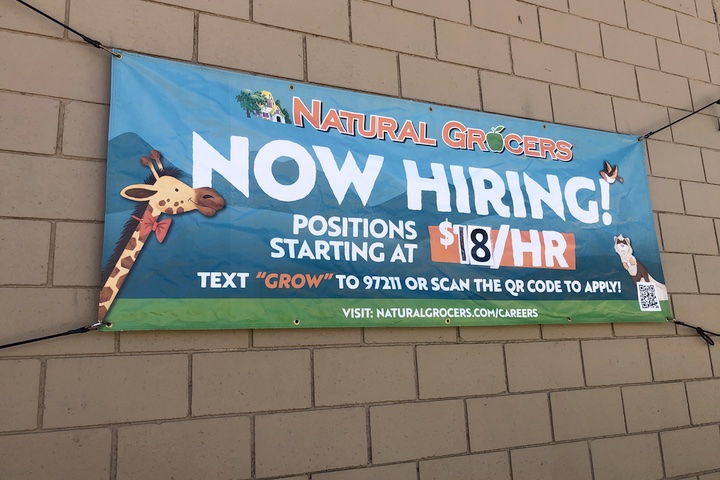
Natural Grocers, downtown, is offering $18 an hour.
That’s the same starting salary for the 11 open positions at our local Walmart store, which is also offering to help pay for your college education.

One of the more unfortunate things that occurred in Archuleta County, in terms of a financially-functional community, was the appearance of thousands of residential suburban parcels located miles away from the urban core, between the late 1960s and the late 1980s. Although these parcels were attractive to many people seeking a scenic rural retreat, and although these parcels generated a thriving real estate and construction industry, they also resulted in the ultimately unsustainable land use pattern known as “suburban sprawl” — a pattern where the maintenance roads and other infrastructure eventually becomes too expensive for the community to afford.
Especially, too expensive for young working families to afford.
In 2017, the Town of Pagosa Springs was one of three small towns in the U.S. to qualify for a financial analysis of future development patterns, courtesy of the consultants at Smart Growth America. The final report revealed that, if the Town continues to embrace suburban sprawl — larger parcels spread over a vast area — the Town will ultimately bankrupt itself.
But a land use pattern that focuses residential neighborhoods and businesses within the core urban area will ultimately lead to a financially-solvent government. From the 2017 report:
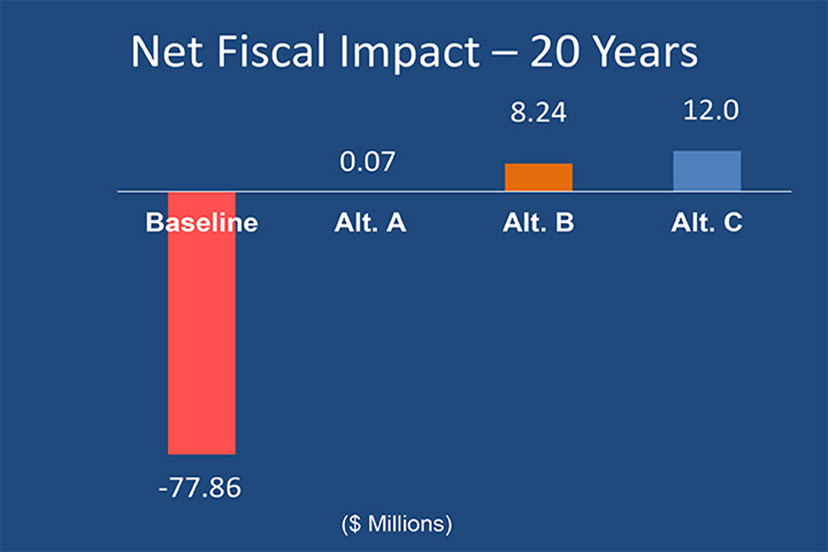
If the Town of Pagosa Springs continues to build out at current density of 0.23 units per acre, wrote the Smart Growth consultants, the municipal government could end up in 2036 with nearly $78 million in deferred maintenance. By adopting a target of 5 units per acre as its land use pattern, the Town could meet all its maintenance needs and have $12 million in the bank.
I’m not sure if any of our Council members have read the Smart Growth America studies pertaining to Pagosa Springs. If not, they can find them on the SGA website, here.
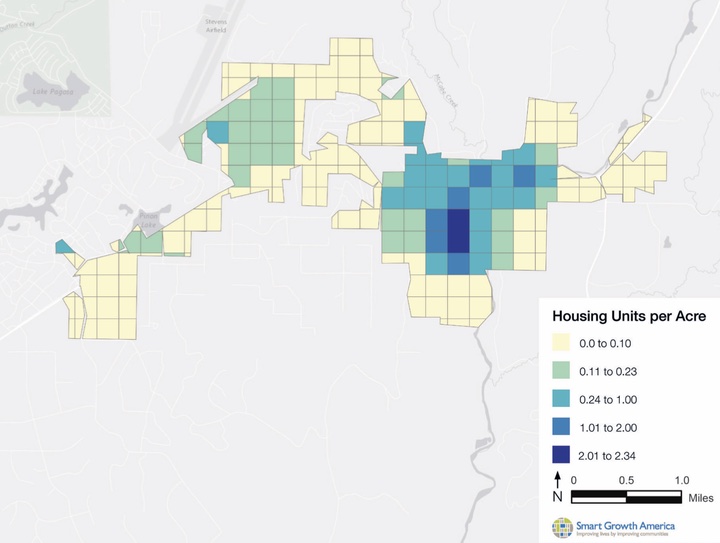
The Smart Growth consultants concluded that, if smart land use policies were adopted, all of the Town’s new housing needs through 2036 could be met with just 120 acres of land. Ideally, that land would be close to existing infrastructure and streets, instead of appearing as expensive urban sprawl distant from our existing downtown. A Smart Growth map showed that, currently, the only reasonably dense — and thus, economically sound —development in Pagosa Springs is in the core downtown neighborhoods. The pale yellow areas in the map have “zero to 0.1” units per acre, indicating financially-unsustainable land use.
Here’s that quote, again, from Council member Brooks Lindner, on April 7:
If the Town does not buy the [Fairway Land Trust] property, it may lose the chance to preserve it permanently. The land could be developed… or become acquired by someone else. And in that case, the opportunity cost of inaction is the lost public benefit of conservation and outdoor recreation, trail connectivity, community character, and future recreational access.
The Fairway Land Trust property could, in fact, be developed to help meet the housing needs of our workforce. It’s adjacent to our downtown infrastructure and could help combat the “suburban sprawl” land use pattern that has the potential to bankrupt our town and county.
About half of the Trust’s 491 acres appear to be non-forested land and suitable for the type of development recommended by the Smart Growth America report.
For example, the 70-acre meadow just west of the award-winning Fairway forest could accommodate at least 350 new dwelling units within walking distance of downtown retail, services and parks, if the Town were to embrace the 5-units-per-acre density proposed by the Smart Growth America experts.
The parcels in my own downtown neighborhood are zoned for 22 units per acre. Applied to the 70-acre Fairway Land Trust’s meadow, that’s room for 1,550 dwellings. That will be a real game changer… at a time when the game desperately needs to change.
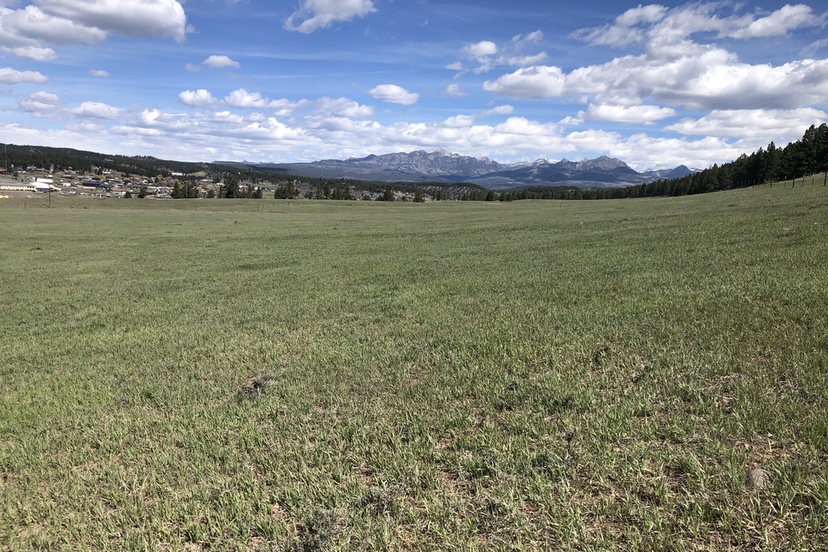
Our Town Council could easily survey the community and learn what the taxpayers are most concerned about in 2026.
Does our community care deeply about a thriving town and a thriving economy? Or are we, like the Town Council, obsessed with recreation?
That type of survey has never been done. Seems like a great time to do it.