
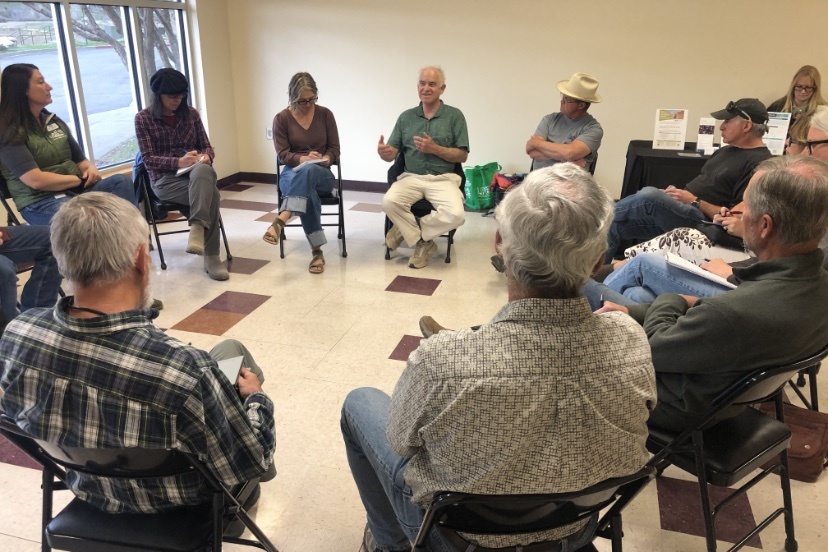
Photo: Will Toor, Executive Director of the Colorado Energy Office — center, in the green shirt — gives an overview of Colorado renewable energy achievements and challenges at the ‘Rural Energy Resiliency’ forum at the Ross Aragon Community Center, April 6, 2026.
Our electric future, here in Pagosa Springs, will be determined in part by forces beyond our control. For instance, the governing board for our electricity provider, La Plata Electric Association, is dominated by representation from La Plata County — a county with a somewhat different political leaning from what I perceive in Archuleta County.
Then we have the general direction of the energy industry, and the general direction of the federal government, working to determine our future. And wars in various places, causing even more changes.
And last but not least, we have the Colorado Energy Office. As I mentioned before in Part One, I attended the April 6 “Rural Energy Resiliency” forum hosted by the Colorado Energy Office and the Four Corners Office for Resource Efficiency, more affectionately known as 4CORE. One of the main topics at that forum was Colorado’s ongoing transition — away from fossil fuels and towards electrical energy. The conversation was led by the Office’s executive director Will Toor.
The current CEO Mission Statement:
Reduce greenhouse gas emissions and consumer energy costs by advancing clean energy, energy efficiency, and accessibility of zero emission vehicles to benefit all Coloradans.
Mr. Toor took about half an hour to introduce some energy issues. He noted that his office works with academics, folks in the energy industry, and community stakeholders “to develop a greenhouse gas roadmap, really focused on our five largest sources of pollution…”
Electricity generation. Transportation. Methane emissions from the oil and gas industry. Industrial emissions. Emissions from buildings.
Mr. Toor did not mention the sixth largest source of GHG. Agriculture.
The attempts to lower emissions has involved incentives, infrastructure investments and new regulations.
“It’s been surprisingly successful, even with the dynamics at the federal level. Starting with electricity generation… which has been the largest source of greenhouse gas pollution, but it’s also the area where it’s coming down the fastest. And where we’ve seen remarkable changes happen to our electric mix. To go back 20 years ago, we were 70% coal-fired generation in the state. We’re now about 44% renewables, and the rest is about 50-50 between coal and natural gas.
“We’re on a trajectory to be at 70%-80% renewables by the end of the decade.”
The end of the decade being roughly four years away.
“Pretty much all of the coal will be out of the system by 2030. Natural gas will be playing a key role for reliability and capacity, to essentially integrate with the renewables which will be providing a majority of the energy for the state.
“For the first time in a long time, we’re starting to see a significant growth in electricity demand. Historically, electricity demand grew pretty quickly from the end of World War II until the mid-1990s… but over the past 25 years, we’ve been in a place where essentially efficiency had advanced so much that it had the effect of leveling out electricity demand even though the population was growing, and the economy was growing. Largely driven by lighting efficiency. Switching to fluorescents and then LEDs largely kept electricity flat…
“But now we’re starting to see faster growth. And the projections are that we’re going to see much more, due to a combination of factors. Some of it is electric vehicles and electric heat pumps, but in Colorado, a surprisingly large part of it is the oil and gas industry switching from gas-fired equipment to electrical equipment…”
That comment struck me as interesting. One might think the oil and gas industry would remain loyal to fossil fuels. But I guess not.
“And then, data centers.
“Data centers… there’s a huge amount of uncertainty about what we’re actually going to see in the way of data centers. And this is something the Public Utilities Commission has been spending time grappling with, for regulated utilities like Xcel and Black Hills Energy. We often have the utilities coming in and saying, ‘We need to build a whole bunch of new infrastructure for the data centers.’ But we don’t know how much of that is real, and how much isn’t…”
Certainly, we’ve seen a growth in the number of American data centers. The U.S. data center market is experiencing significant growth, with nearly 3,000 new data centers under construction or planned, adding to over 4,000 already operational. This expansion has been driven by the increasing demand for digital services and artificial intelligence, with Virginia and Texas leading in the number of data centers.
But will future data centers necessarily be located in the U.S.?
I ran across a lengthy article in New Yorker magazine this week, discussing the history of OpenAI and its controversial CEO: “Sam Altman May Control Our Future — Can He Be Trusted?” A fascinating, and somewhat frightening story by Ronan Farrow and Andrew Marantz.
A short excerpt:
[By 2019], Altman was already eying another source of cash: the United Arab Emirates. The country was in the midst of a fifteen-year effort to transform itself from an oil state to a tech hub. The project was overseen by Sheikh Tahnoon bin Zayed al-Nahyan, the President’s brother and the nation’s spymaster. Tahnoon runs the state-controlled A.I. conglomerate G42, and controls $1.5 trillion in sovereign wealth. In June, 2023, Altman visited Abu Dhabi, meeting with Olama and other officials. In remarks at a government-backed function, he said that the country had “been talking about A.I. since before it was cool,” and outlined a vision for the future of A.I. with the Middle East in a “central role.”
A.I. capacity may soon displace oil or enriched uranium as the resource that dictates the global balance of power. Altman has said that computing power is “the currency of the future.” Normally, it might not matter where a data center was situated. But many American national-security officials were anxious about concentrating advanced A.I. infrastructure in Gulf autocracies. The U.A.E.’s telecommunications infrastructure is heavily dependent on hardware from Huawei, a Chinese tech giant linked to the government, and the U.A.E. has reportedly leaked American technology to Beijing in the past. Intelligence agencies worried that advanced U.S. microchips sent to the Emiratis could be used by Chinese engineers.