

Photo: World leaders gathered in Davos for the World Economic Forum convention, January 2026… and checked their phones.
Some readers may have been paying attention to the 2026 World Economic Forum convention, which took place in Davos, Switzerland from January 19 to 23. The numerous speakers — including Canadian Prime Minister Mark Carney, President of the European Commission Ursula von der Leyen, and U.S. President Donald Trump — focused in general on heightened tensions between the United States and its NATO allies, especially related to Greenland.
While powerful world leaders were discussing strategic moves, a 90-minute interview was taking place at the Davos conference center between a couple of intellectuals: historian and author Yuval Noah Harari, and Nikhil Kamath, co-founder of Zerodha, “India’s leading brokerage platform and trading community”. They engaged in a wide-ranging conversation about where the world might be heading, and Dr. Harari made an interesting observation about the current moment. He belongs to a school of historians who hold that human society is held together primarily by shared stories. It’s less important whether the stories are “true”, than that the stories are “shared”. But social media and algorithms and AI are busy creating a world where stories are actually less likely to be shared.
“Don’t let non-humans control the human conversation. Our big mistake is that, over the last ten years, we gave one of the most important jobs in the world to algorithms, and they did a terrible, terrible job.
“Human society is essentially a conversation between humans, especially in democracies. We come together, we discuss what to do, foreign policy, economic policy — and for that you need media. How do you manage a conversation between millions of people? And we built institutions, over the centuries, to manage the public conversation…”
Not that the institutions managing human conversations were always truthful. But at least, there was a shared story.
Of course, this particular conversation at Davos last month was focused on big, global issues. Here in a small mountain resort town — Pagosa Springs — the conversation is not between millions of people, but between a few thousand.
Or, more realistically, between a few dozen.
In Part One and Two of this editorial series, I mentioned a Pagosa-centric social media conversation involving a dozen or so local residents, mainly around the question of ever-escalating water fees, and whether an increased Lodging Tax rate could help address those fee increases.
The County’s 1.9% Lodging Tax, paid by visitors, can currently be used only for tourism marketing. It amounts to about $500,000 annually.
My personal opinion: A County Lodging Tax increase could, if approved by the voters, be boosted from 1.9% to 6% — the maximum allowed by state law — but the additional $1 million (estimated) in County revenues could not be used to reduce water bills.
It could, however, be used for road repairs, emergency services, tourism marketing, and to support housing and child care.
Housing and child care are essential to maintaining the low-wage workforce that underpins our tourism industry.
Safe, well-maintained roads will also help to keep a tourism industry feasible.
Last night, Archuleta County Manager Longinos Gonzalez Jr. and our three County commissioners, Warren Brown, Veronica Medina and John Ranson hosted an “Interactive Community Forum” that the Coutny admin offices on Lewis Street.
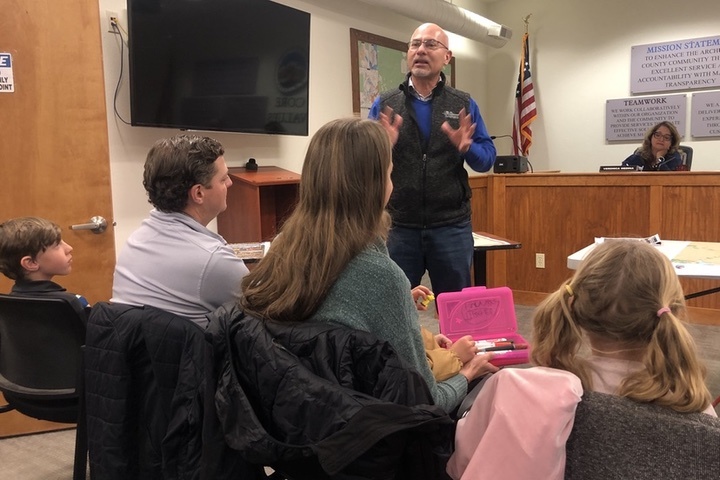
About three dozen local activists and interested citizens showed up to what we were told was the first on many planned monthly meetings with the general community, to collect ideas, and answer citizen questions, about — basically — three issues.
Road maintenance.
An update to the County Community Plan.
A possible ballot measure this coming November to increase the Lodging Tax, and designate expanded uses beyond tourism marketing.
The evening could be described as “the opposite of an informational black hole.” This event sought to provide the participants with trustworthy information, and to allow the audience to not only ask questions, but to offer ideas and insights that the County commissioners and staff might find useful. That is to say, to come together, and discuss what to do. Face to face.
I recognized about 80% of the participants, because they’ve been involved in various community issues over the past several years and have, like me, attended political meetings on a regular (or irregular) basis. Three dozen people who make the time to attend government meetings, and who are relatively fearless about expressing their opinions. The type of people you might see circulating a petition in the City Market parking lot. The type of people who don’t necessarily accept the status quo as the best option.
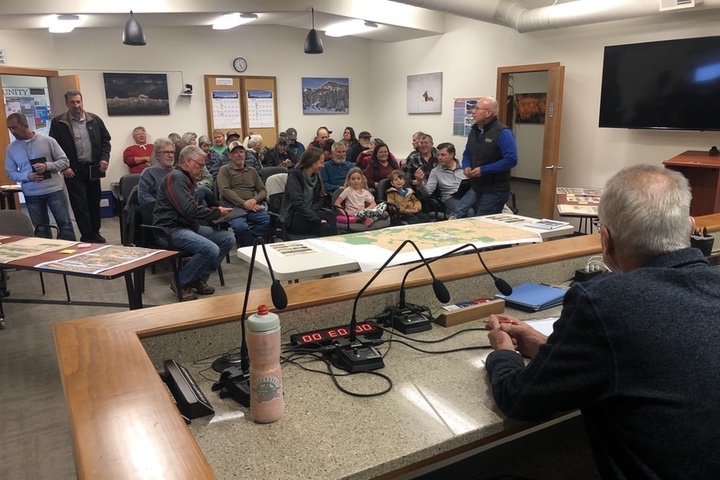
Which is not to say that everyone in the room agreed on the best direction for the County government. They were, however, willing to listen politely to a wide range of viewpoints.
We’ll get back to the community forum later in this editorial series, because — as suggested — it illustrates the reverse of the informational black hole typically found on social media.
In Parts One and Two, we considered a conversation on a members-only Pagosa-focused social media account that attracted about 43 comments in response to a posted question. Given that our water fees have ramped up in Pagosa Springs, could an increased Lodgers Tax be used to reduce the fees? About six of the 43 comments made a real effort to answer that question, and three of those responses contained misinformation (in my opinion) mixed with accurate information.
The rest of the comments were — essentially — noise. And whining.
I need to point out something. Our local governments and businesses and families are facing a number of important, but different, issues. Those of us who live comfortably in Pagosa — and that’s probably most of us — can wonder about whether we can tax tourists more heavily and use the money to reduce our monthly water bill by a few bucks.
But some of us — not most of us — are wondering how they will stay warm this winter, and have enough to eat.
Where does that conversation happen?