
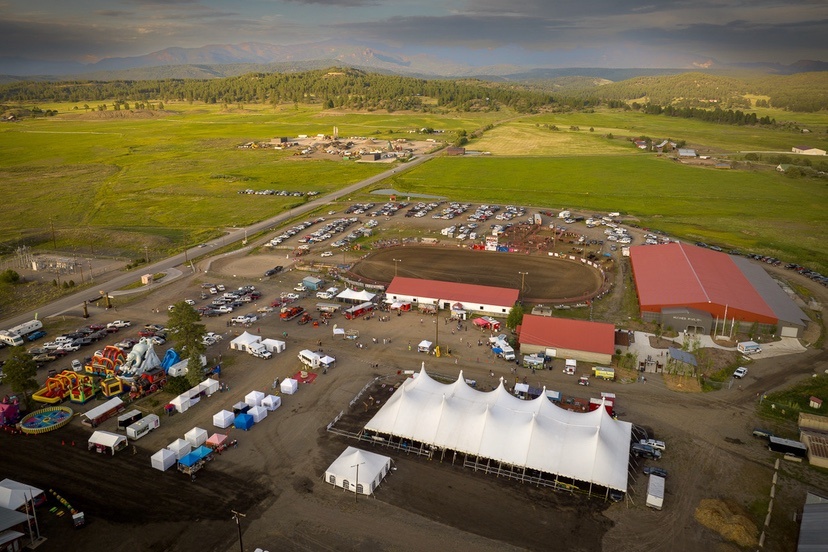
Photo: The 2024 Archuleta County Fair. Photo by Allen Cline.
Goal: The scenic beauty of Archuleta County remains intact. The dramatic mountain backdrop with vistas of agricultural buildings, ranches, and open space in the foreground is preserved. The air is clean, rivers run free and clear, and wildlife populations remain healthy through preservation of habitat and migration corridors on public as well as private land…
— from the 2017 Archuleta County Community Plan.
I mentioned some local issues yesterday in Part Two, and noted that the Archuleta County government will be making an attempt to quantify and address those issues in an upcoming update to Archuleta County’s Community Plan. Such an update is required by the state government, through SB24-174, for communities that hope to win grant funding in the future from certain state agencies, including: the Department of Local Affairs, the Colorado Energy Office, the Office of Economic Development, the Department of Transportation, the Department of Natural Resources, the Department of Public Health and Environment, and the Department of Personnel and Administration.
No qualifying plan? No grants.
From the Colorado Legislature web page for SB24-174:
…the act requires the awarding entity to prioritize awarding grants to a local government that:
- Has completed and filed a housing needs assessment;
- Has adopted a housing action plan that has been accepted by the department;
- Has reported progress to the department regarding the adoption of any strategies or changes to local laws identified in the housing action plan; and
- Is the subject of a master plan that includes a water supply element and a strategic growth element.
All of the items mentioned above are of interest to me, as a taxpayer and as a journalist. But as a member of the Pagosa Area Water and Sanitation District board of directors, the “water supply element” and the “strategic growth element” are of particular interest. Neither the Town of Pagosa Springs nor the Archuleta County government provide drinking water to our citizens. But the state of Colorado is demanding that Archuleta County include a “water supply element” in future plan updates.
Disclosure: I currently serve on the Pagosa Area Water and Sanitation District (PAWSD) Board of Directors, but this editorial series reflects only my own opinions, and not necessarily the options of the PAWSD Board as a whole or the PAWSD staff.
As discussed recently here in the Daily Post, PAWSD is involved in a lawsuit concerning the district’s right to sell a 660-acre ranch north of downtown Pagosa that was jointly purchased in 2008 by PAWSD (that is, by a previous PAWSD board) and the San Juan Water Conservancy District (that is, a previous SJWCD board.)
SJWCD contends that the planned Dry Gulch Reservoir, proposed for the 660-acre Running Iron Ranch and surrounding properties, is essential for meeting the long-range water needs of Archuleta County.
Mediation between SJWCD and PAWSD is scheduled for the middle of March, in an attempt to reach a ‘settlement’ without going to trial.
An aspect of the required Community Plan update directly related to the “water supply element” is, of course, the “strategic growth element.” If the Archuleta County population does not increase… well, then, maybe we don’t need a $200 million reservoir.
An assumption common to most community leaders — and ordinary citizens, too, I suppose — is that Pagosa Springs cannot help but grow, and grow, and grow.
I paid a quick visit to the Colorado State Demographer’s website last week, and noticed something surprising.
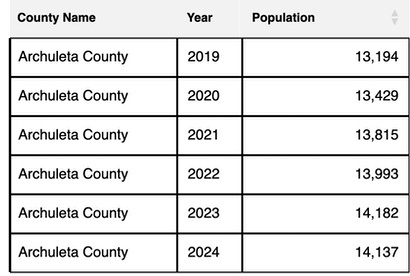
According to the State Demographer, Archuleta County’s population growth — contrary to almost everyone’s expectations — gradually slipped into “reverse gear” over the past few years.
Does that give some of us hope?
Does it feel frightening to some of us?
I wish I had a nickel for every time I’ve heard someone claim, “If you’re not growing, you’re dying.” Speaking for myself, I haven’t grown an inch since age 20, but I’ve somehow lasted another 54 years.
If Archuleta County is now settling into a “holding pattern” where our population remains about the same for whatever period of time, this would not be unprecedented. At the 1910 census, the population of Archuleta County was 3,302. At the 1970 census, the population of Archuleta County was 2,733. But as we all know, the community didn’t die. Not by a long shot. In fact, the community population quintupled in size from 2,733 in 1970 to an estimated 14,137 in 2024. Did this growth benefit the community? In some ways, yes. In other ways, no.
For one thing, the authors of the 2017 Archuleta County Community Plan update felt the need to establish a goal dedicated to preserving scenic beauty.
Goal: The scenic beauty of Archuleta County remains intact. The dramatic mountain backdrop with vistas of agricultural buildings, ranches, and open space in the foreground is preserved. The air is clean, rivers run free and clear, and wildlife populations remain healthy through preservation of habitat and migration corridors on public as well as private land…
Something that’s impossible to predict accurately: how a community will grow, or not grow. Not only “how much it will grow” but also “in what ways it will grow.” But our local governments sometimes think it’s their responsibility to define “in what ways it will grow.” Thus, the 2001 Community Plan… updated in 2008, 2010, and 2017.
Archuleta County will be holding an “Interactive Community Forum” next Tuesday, February 17, with the following community issues on the agenda:
- Roads & infrastructure
- Community Plan update
- Lodgers Tax options & ideas
- Parks & trails
- Water resources
- Public safety
- Housing & land use
- Your ideas & concerns
That’s a lot of doggone issues for an single agenda.
I reached out to County Manager Longinos Gonzalez Jr, to find out whether this February 17 forum is specifically related to the upcoming Community Plan revisions required by SB24-174… and got a prompt response:
I do plan on using it to introduce the Community Plan Update and get feedback on issues related to the Strategic Plan, but also to get discussions started on the potential Lodgers Tax expansion and general public input on County issues. Our follow-on monthly meetings will begin to be more tailored to specific issues with the Community Plan and Lodgers Tax eventually getting their own focus.
Clearly, next Tuesday’s forum is just the first of additional planned community meetings…