
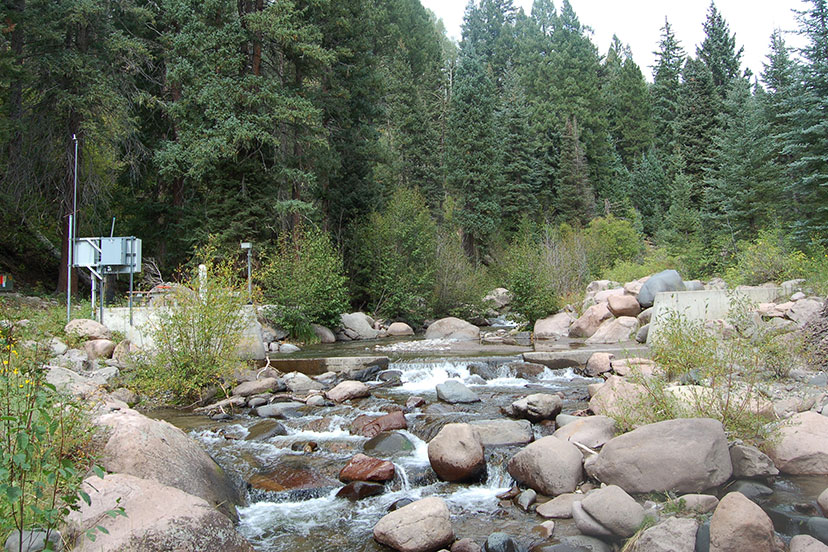
Photo: Site of the PAWSD drinking water diversion on Fourmile Creek.
Disclosure: I currently serve on the Pagosa Area Water and Sanitation District (PAWSD) Board of Directors, but this editorial series reflects only my own opinions, and not necessarily the options of the PAWSD Board as a whole, or the PAWSD staff. PAWSD is currently involved in a lawsuit with the San Juan Water Conservancy District (SJWCD), related to the Running Iron Ranch and the proposed Dry Gulch Reservoir.
I confessed yesterday, in Part Three, that I feel some sympathy for the SJWCD Board’s current situation, even though I’ve long been opposed to SJWCD’s decades-long quest to get the Dry Gulch Reservoir constructed. It’s not the first time SJWCD has been in a difficult position. In 2007 and 2009, the Colorado Supreme Court ruled that the planned Dry Gulch Reservoir — as proposed — violated Colorado’s water laws and constituted unreasonable and unjustifiable “water speculation”.
A stipulated settlement with sportsmen’s organization Trout Unlimited later reduced the maximum Dry Gulch water rights from 32,000 acre-feet of storage down to 11,000 acre-feet. But that was still more than six times the size of Pagosa’s largest existing reservoir, Stevens Lake.
Between 2003 and 2010, SJWCD had a committed tax-funded partner, to pay for planning efforts and to pay most of the bills: PAWSD. In fact, PAWSD (via its substantial customer fees and tax revenue) was providing SJWCD with shared staff, office space, and office equipment at the PAWSD offices on Lyn Avenue. The two water districts also shared the same legal counsel and some of the same Board members.
The PAWSD Board agreed to go into debt to purchase the Running Iron Ranch, and also agreed to be solely responsible for paying off the loan, while making SJWCD a minority owner of the property.
As an editor researching and writing about the Dry Gulch proposal, I felt compelled to publish my concerns. I considered the project a financial boondoggle in 2010 — the year that PAWSD assembled a citizen group called the Water Supply Community Work Group, apparently hoping that a thoughtful group of taxpayers would bestow the community’s blessing on the Dry Gulch proposal. Instead of endorsing Dry Gulch, however, the community group of two dozen business owners and activists wrote a final report declaring that the Dry Gulch Reservoir, as planned, was unjustified.
You can download the report here.
Shortly after the release of that report, the PAWSD Board removed the Dry Gulch project from its long-range planning documents, and informed SJWCD that they were no longer welcome to share staff and office space at the PAWSD offices.
The two districts still held the 660-acre Running Iron Ranch in joint ownership, however. While PAWSD focused on various upgrades to its water and sanitation systems, the SJWCD Board continued to dream that they could find a new, well-heeled partner to fund an 11,000 acre-foot reservoir project.
SJWCD’s budget was rather meager in those days, but the Board eventually hired their own Board President — Rod Proffitt — to make trips to Denver and promote the Dry Gulch project to anyone who would listen. Unfortunately, Mr. Proffitt had sworn an oath promising never to have a paid contract with his own Board. When the Pagosa Springs SUN revealed the corruption going on at SJWCD, Mr. Proffitt resigned from the Board.
Before he resigned, however, Mr. Proffitt convinced the PAWSD Board and the Colorado Water Conservation Board to grant SJWCD a 20-year planning period to find one or more partners and begin construction of the reservoir on the Running Iron Ranch. This planning period began in 2016 and would expire in 2036. In the agreement, SJWCD agreed to consult regularly with PAWSD — the co-owner of the property and the entity paying for the loan.
Ten years later, SJWCD had not found a partner, had no engineered plans, had no money to build the project, and had no clear idea who, exactly, would benefit from such a project. SJWCD had also failed to consult regularly with PAWSD.
In October 2024, PAWSD received two unsolicited offers to purchase the Running Iron Ranch. The offers would have allowed PAWSD to get its customers out from under a $10 million debt remaining on the Ranch loan.
Remarkably, one of the offers included an easement on the Ranch, for a smaller Dry Gulch Reservoir — at no cost to the taxpayers. This prospective buyer even offered to contribute financially towards the planning for the reservoir.
At last, the partner that SJWCD had been lacking for over 10 years, seemed to have arrived.
And the ability for PAWSD to get its customers out from under a $10 million debt had arrived in the same proposal. I personally found this possibility exciting.
SJWCD, however, refused to meet with the prospective buyer to discuss the proposal. SJWCD released a public statement disparaging this prospective partner and the PAWSD Board. Without ever meeting with the prospective partner to discuss a mutually-beneficial arrangement, SJWCD accused this person of being “a land developer.” From that public statement:
The San Juan Water Conservancy District opposes the Pagosa Area Water & Sanitation District’s sale of public property held as a future reservoir site in a private deal to a land developer. SJWCD will work to halt sale plans based on short-sighted and narrow views of current PAWSD board members… SJWCD also calls upon the public to demand from PAWSD an open and informed discussion of water needs and conditions that affect our future water supply.
It is simply wrong for PAWSD to sell public land vital to water storage without making every effort to retain the property as it agreed to do…
…SJWCD believes planning decisions are best made in open and transparent processes informed by current water conditions and a forward-looking perspective.
As noted in Part One of this editorial series, SJWCD has not been “open and transparent” with their planning processes around the reservoir project, and since October 2024, have convened over a dozen closed-door meetings related to Dry Gulch.
The SJWCD is now planning to submit a grant to the Bureau of Reclamation — for what purpose, and for what amount of funding, the public has not been told.
“Open and transparent”?