
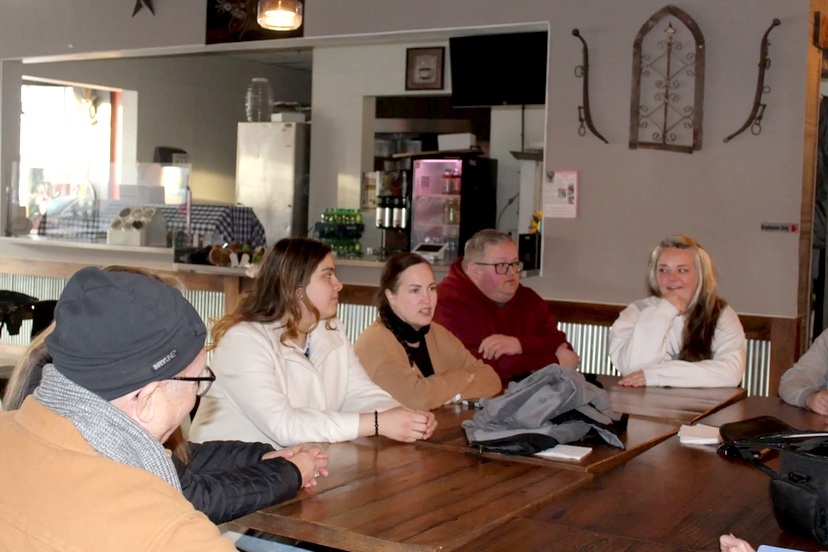
Photo: Christina Vander Pol speaks to a group of residents in Gonzalez’s restaurant in Willmar, Minnesota. (Photo by Betsy Froiland)
This story by Betsy Froiland appeared on The Daily Yonder on February 2, 2026. We are sharing it in two parts.
On a sub-zero day in Willmar, Minnesota, fifteen residents gathered around a table at a restaurant in town. It was the middle of the usual lunch rush on a Saturday, but the group sat alone. The restaurant was closed because ICE was in town.
Invited by the restaurant’s owner Willie Gonzalez, the residents pushed tables together and sat in a large circle.
They were there to talk about what was happening in their town. Thousands of ICE agents had descended upon Minnesota in recent weeks at the orders of the Trump administration – largely in Minneapolis and Saint Paul, but also in places like Willmar, a small town enriched by its residents of Somali and Latino descent.
That morning, ICE agents had shot and killed U.S. citizen Alex Pretti in Minneapolis.
As in urban hotspots, ICE presence was escalating in Willmar.
For his part, Gonzalez, a Mexican-American citizen, made sure to sit on the side of the table facing the window so he could watch the street for ICE.
The residents around the table were high school students and business owners, children and parents, white neighbors witnessing the terror in their community and neighbors of color living it. Some preferred not to share their full names in this article.
Shedding many tears, passing many tissues, but still managing to find moments to smile and laugh, the residents told their stories.
Christina Vander Pol spoke first. “Willmar is a very diverse community,” she said. “It’s one of the reasons I want to live in Willmar, because it makes my life rich.”
“You can see how much Willmar supports immigrants,” a young woman at the table said. The year prior, she had spoken at her high school graduation about how proud she was to be the daughter of immigrants, and how almost everyone in Willmar comes from an immigrant family in some way. After the speech, she said, she had feared the audience would be quiet. But the room erupted into boisterous clapping and yelling.
Home to people with roots all over the world, Willmar is a celebration of different foods and cultures. According to residents, there are nearly 20 ethnic-specific grocery stores in the town of just 21,000.

Vander Pol turned to the people sitting next to her – Juan, who owns a Mexican grocery store in town, and Lizbeth, his daughter who works at the store – and recounted what happened when she picked up a cactus fruit in their grocery many years ago. Juan noticed Vander Pol looking at the fruit like she had never seen it before. He then walked over to her, sliced the fruit in half, and handed it to her to try. “That’s not something that happens at a Walmart,” Vander Pol said.
These days, Juan said, his store is much emptier than usual. Many regular patrons are afraid to leave their homes to buy groceries. “They’re just grabbing people now,” Juan said, his daughter translating from Spanish.
Many people around the table had witnessed ICE agents arrest their neighbors in recent weeks.
Vander Pol was downtown when ICE agents violently arrested a 19-year-old Somali high schooler, in the country legally, dragging her out of her car, detaining her at the Whipple federal building in Minneapolis, and later releasing her in the freezing cold two hours from home.
“You see things in the news and you think, ‘that’s never going to happen here,’” said Myra, another resident who was at the scene. “And then you’re witnessing it firsthand.”
Gonzalez was eating lunch at El Tapatio, a Mexican restaurant in town, when he saw four ICE agents eating a couple tables away. He even talked to them, telling them plainly to “treat people with respect.” After they had finished dining, the agents returned to arrest the restaurant’s owners and dishwasher. “For [ICE] to do that, after they got fed and everything,” Gonzalez said.
A man at the table who knew the restaurant staff personally said, “these are people who have been here in the community for years, in the process of getting their citizenship.” It was horrible to see, he said, “especially [to do this to] a working person that’s feeding the people here in town.”
Another incident that looked to be more abduction than arrest took place outside the local Goodwill. Residents Allen Clark, Brielle Barrett and her 15-year-old daughter Adyssey Barrett were there when they noticed six ICE vehicles outside, with two agents in each.
“It looked like it was an FBI raid,” said Gonzalez, who came to the scene later.
While Clark and Brielle ran inside the store to alert everyone that ICE was there, Adyssey remained outside, under her mom’s instructions to stay in the car. “I didn’t,” she said, laughing through tears. When Adyssey saw ICE agents violently arresting a man, she approached them, recording on her phone, and asked to see a judicial warrant, at which point agents threatened to arrest her.
Clark, also watching and recording, said that ICE agents did not confirm the man’s identity, did not give him any time to show documentation, and did not even allow him to speak with the Spanish-speaking ICE agent on the scene.
ICE also arrested the man’s wife, all while yelling out confused questions about who she was. “If you don’t know their name,” resident Steve Vossen added, “what makes you think they’re the ‘worst of the worst?,’” citing the catchphrase the Trump administration has employed to justify their operations.
“But they still cuffed her, and in the van she went,” Clark said.
“It’s the faces,” Clark, Brielle, and Adyssey said, that stick with them the most. The faces of a father and his children inside the store when they were told ICE was outside. The faces of the people who were taken.
“And now they’re gone, and we don’t know where they are,” said Jennifer Lindquist, another resident at the table. “We have [so many] people being taken from this country, and how are we supposed to find them?”
Perla Ocampo, an 18-year-old college student, spoke up next. It wasn’t Ocampo’s first time speaking up that week. A few days prior, she took to the podium at the city council meeting, telling the room how ICE agents had followed her home from work on several occasions, even violently dragging her out of her car once.
“I was born here in Willmar,” Ocampo said. “But my color’s brown, so they think, ‘oh, she’s illegal.’”
“We can’t even be out in our own community without thinking we’re going to get brutalized,” said an employee of Gonzalez’s restaurant.
Gonzalez said he too had been personally terrorized by ICE: agents following his car, circling his restaurant, trying to record video of him, and even knocking on his mother’s apartment door.
“It’s like a cat and mouse now,” Gonzalez said. “It’s one of those strategic things to do for them to put fear in people.”
The feeling is familiar to Gonzalez, who was born and raised in a border town in Texas. Under perpetual surveillance by federal immigration officials, he said he grew up in a state of hypervigilance. He moved to Minnesota 20 years ago in part to get away from that. And now, he said, “to see it up north, it’s absurd.”