
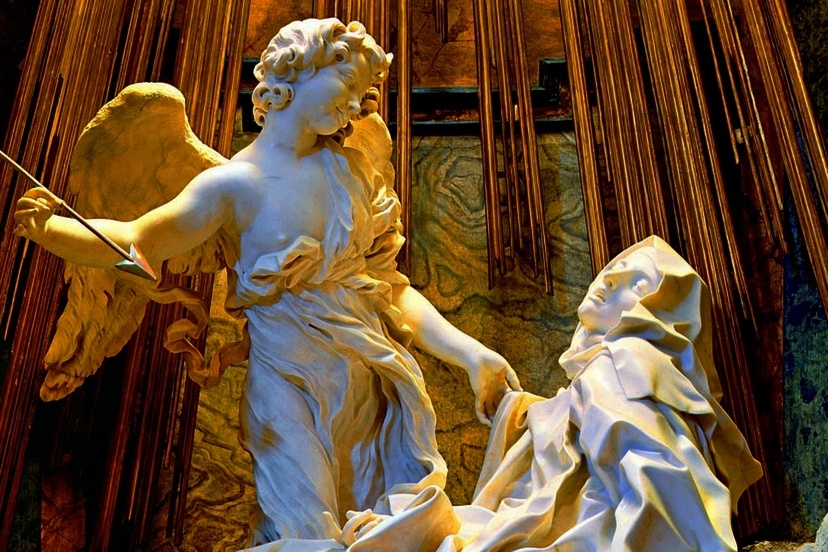
If we accept the vision of Italian sculptor Gian Lorenzo Bernini, a 16th century Spanish nun named Teresa swooned in a state of religious ecstasy as a heavenly angel repeatedly pierced her heart with a burning arrow.
He was a beautiful angel, according to Santa Teresa’s autobiography. But not too tall. Actually, rather short?
He was not large, but small of stature, and most beautiful – his face burning, as if he were one of the highest angels, who seem to be all of fire: they must be those whom we call cherubim. Their names they never tell me; but I see very well that there is in heaven so great a difference between one angel and another, and between these and the others, that I cannot explain it…
That’s from a translation by David Lewis, from the original El libro de la vida by Santa Teresa de Jesús, who was not yet a saint when she wrote her autobiography in 1565.
I saw in his hand a long spear of gold, and at the iron’s point there seemed to be a little fire. He appeared to me to be thrusting it at times into my heart, and to pierce my very entrails; when he drew it out, he seemed to draw them out also, and to leave me all on fire with a great love of God. The pain was so great, that it made me moan; and yet so surpassing was the sweetness of this excessive pain, that I could not wish to be rid of it…
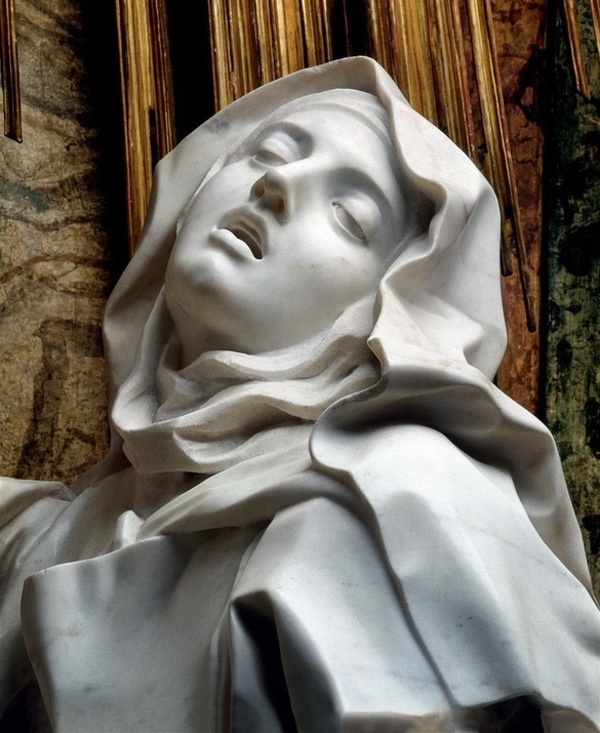
Santa Teresa had a number of ecstatic religious experiences, according to her autobiography, during which she had the opportunity chat with God about religious matters, and to meet Jesus.
I first came upon an image of Bernini’s sculpture — actually, a whole theatrical setting of sculptures, installed in 1652 in the church of Santa Maria della Vittoria in Rome — when I was researching human desire.
And why it’s so painful.
Who came up with this crazy arrangement, anyway? The sweetness of excessive pain?
Some short but beautiful angel, stabbing us repeatedly in the heart with a burning arrow, and we can’t get enough of it.
Forgive me for asking, but does this reminds anyone of “marriage”?
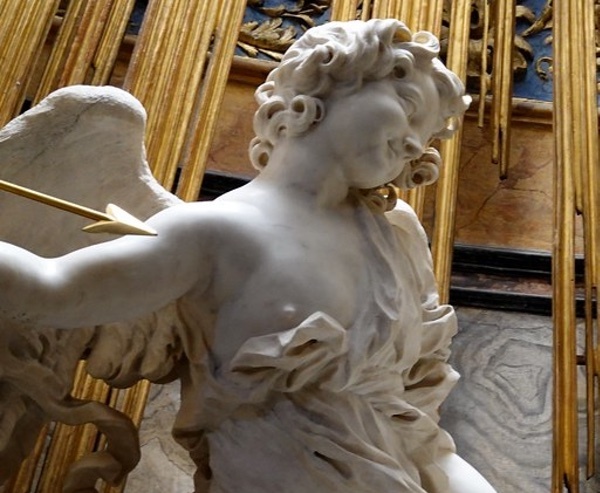
The sculptural installation L’Estasi di Santa Teresa (also known as ‘The Ecstasy of Saint Teresa’ if you’re researching it on Wikipedia) was designed by Gian Lorenzo Bernini, the leading Italian sculptor of his day, who also designed the overall setting in marble, stucco and paint. Back in those days, some of the wealthiest Italians tended to be Catholic bishops and cardinals, or good friends of Catholic bishops and cardinals, and the very best (and most expensive) art was installed in churches and chapels.
In the case of L’Estasi di Santa Teresa, the project was funded by the Cornaro family. Specifically, by Venetian Cardinal Federico Cornaro, who we might assume was a big fan of Santa Teresa de Jesús, a feisty reform-minded nun canonized in 1622 by Pope Gregory XV, 40 years after she departed for Heaven.
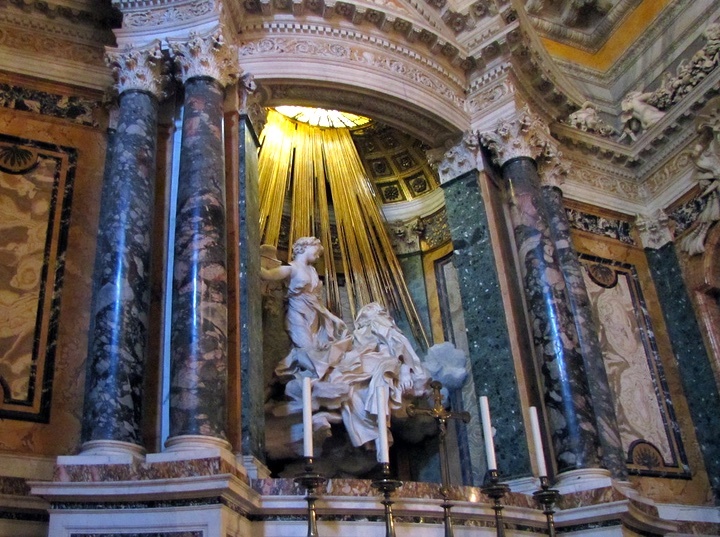
Sculptor Bernini (and his many apprentices) built the installation so that natural light from a skylight streamed down on the ecstatic event.
As our readers will remember, the Spanish Inquisition was established in 1478 by King Ferdinand II and Queen Isabella I to identify and punish heretics. In those days, anyone having mystical experiences was at risk of getting burned at the stake, because those experiences were naturally assumed to be Satanic, by the Inquisition’s prosecutors (who never had such experiences, of course.)
Especially, I suspect, the Inquisitors had serious doubts about God talking directly to women. (Satan talking directly to women? Happens all the time.)
Fortunately, Santa Teresa de Jesús had made friends with some people high up in government, and in the Church (the Church being essentially the same thing as the government in those days) and was actually supported in her efforts to create the Ordo Carmelitarum Discalceatorum (the Order of Discalced Carmelites) which still exists to this day and claims about 4,000 adherents.
“Discalced” means “barefoot”. The required vow of poverty was aptly illustrated by the lack of footwear. Nowadays, I guess they wear sandals? But that’s reasonably close to “barefoot”.
I wasn’t raised Catholic, but I almost wish I had been, after learning about Santa Teresa’s lifetime of mystical experiences and her conversations with God, who was apparently bilingual. (And probably still is.)
You can read an English translation of her 1565 autobiography on Gutenberg.org.
Not all of Santa Teresa’s experiences were pleasant. Far from it. But she found comfort in how badly things had gone for Job, and if he wasn’t cursing God…? Well, who was she to complain?
As I mentioned before, I came across photos of Bernini’s sculpture accidentally, when I was researching human desire.
I have occasionally thought about talking with God, but so far, haven’t gotten around to it. It’s just not a burning desire, I guess.
But I’m going to take a ‘pass’ on the burning arrow in the heart, thank you. I’ve already been married.
Underrated writer Louis Cannon grew up in the vast American West, although his ex-wife, given the slightest opportunity, will deny that he ever grew up at all. You can read more stories on his Substack account.