
And I’m not the only one quitting drugs.
According to reporter Paula Span, writing in KFF Health News last week, older Americans are quitting drugs in droves.
In droves.
She put that idea in her article headline, so we didn’t miss it.
Older Americans Quit Weight Loss Drugs in Droves
I didn’t know that older Americans had the ability to cooperate in such a manner. Most of the headlines I see are suggesting that we’re having trouble even talking to one another, but apparently we can agree on at least one thing.
Time to quit the drugs.
Nancy Reagan tried to get us to quit drugs back in the 1980s, but did we listen? No. We’re taking more drugs now, than we were then. The main problem being that each drug has side effects, so we are prescribed a second drug to combat the side effects of the first drug… but then the second drug has side effects, so we’re prescribed a third drug…
It’s a vicious cycle. But very profitable for Big Pharma.
There are numerous reasons why a person would quit drugs, but one of the most important reasons is, they are too goddamn expensive.
Here’s a sad story by reporter Paula Span in KFF Health News:
Year after year, Mary Bucklew strategized with a nurse practitioner about losing weight. “We tried exercise,” like walking 35 minutes a day, she recalled. “And 39,000 different diets.”
But 5 pounds would come off and then invariably reappear, said Bucklew, a public transit retiree in Ocean View, Delaware. Nothing seemed to make much difference — until 2023, when her body mass index slightly exceeded 40, the threshold for severe obesity.
“There’s this new drug I’d like you to try, if your insurance will pay for it,” the nurse practitioner advised. She was talking about Ozempic. Medicare covered it for treating Type 2 diabetes but not for weight loss, and it cost more than $1,000 a month out-of-pocket. But to Bucklew’s surprise, her Medicare Advantage plan covered it even though she wasn’t diabetic, charging just a $25 monthly copay.
Pizza, pasta, and red wine suddenly became unappealing. The drug “changed what I wanted to eat,” she said. As 25 pounds slid away over six months, she felt less tired and found herself walking and biking more.
Then her Medicare plan notified her that it would no longer cover the drug. Calls and letters from her health care team, arguing that Ozempic was necessary for her health, had no effect. With coverage denied, Bucklew became part of an unsettlingly large group: older adults who begin taking GLP-1s and related drugs — highly effective for diabetes, obesity, and several other serious health problems — and then stop taking them, within months.
The federal government is reportedly looking at expanding the reimbursement criteria for Ozempic and similar weight-loss drugs. The FDA recently approved several GLP-1s for additional uses, including to treat kidney disease and sleep apnea, and prevent heart attacks and strokes.
I’m a red-blooded American, and as such, I expect to be suffering from diabetes, obesity and several other serious health problems at some point in the not-too-distant future. And I usually pay my taxes. But from what I can tell, the federal government uses my taxes to pay for a bloated military-industrial complex and for interest payments on $38 trillion in public debt.
The debt-to-GDP ratio was projected to be around 123% by the end of FY2025, meaning that the national debt is larger than the entire country’s annual economic output. Gives an interesting twist to the phrase “carrying a few extra pounds.”
Of course, Medicare is another big expense, when they are subsidizing $1000 a month for Ozempic to treat overweight public transit retirees from Ocean View, Delaware.
Back in simpler times, we used to believe that fat people were fat because they simply ate too much, and didn’t exercise.
Luckily, we’ve learned that fat people are fat because they don’t have access to the right drugs.
The question in my mind is: can our overweight government subsidize the military-industrial complex, and at the same time, supply drugs to all the overweight Medicare patients in America? I ask that because we support a huge number of Medicare patients. As of March 2023, there were approximately 66 million people enrolled in Medicare in the United States, and an estimated 26 million of them are overweight.
If I were the company that manufactures Ozempic, I would be lobbying the FDA pretty darn hard for new criteria. They could be selling a lot of drugs, with a little more help from the government.
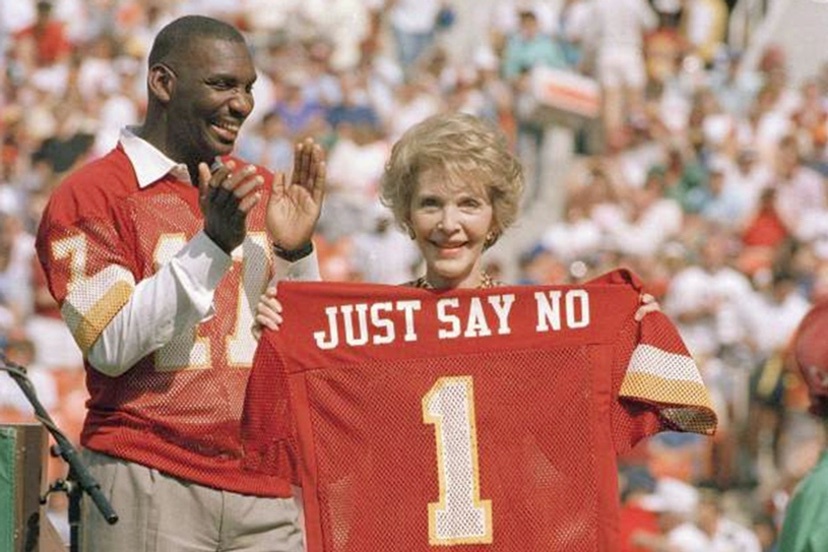
Where is Nancy Reagan when we really need her?
Underrated writer Louis Cannon grew up in the vast American West, although his ex-wife, given the slightest opportunity, will deny that he ever grew up at all. You can read more stories on his Substack account.