
When my daughter Ashley turned 9 years old, Darlene — my wife at the time — decided to buy her an American Girl Doll for her birthday.
As an introduction to American History.
Thus, Molly McIntire became a member of the family. She was assigned a seat at the dinner table. She participated in (or supervised) Ashley’s activities, indoors and out. Eventually — following numerous (necessary) accessory purchases from the American Girl mail-order store — Molly occupied approximately half of Ashley’s bedroom, decked out with an appropriately-sized closet, and bed, and desk, and even a dedicated recreation room.
The rec room included a Library, of course.
Molly hailed from a Scottish immigrant family, the McIntires, whom we never had a chance to meet, but she arrived with a library of a half dozen books detailing her personal experiences in America during and following World War II. Molly was 9 years old in 1944, as I recall from the books.
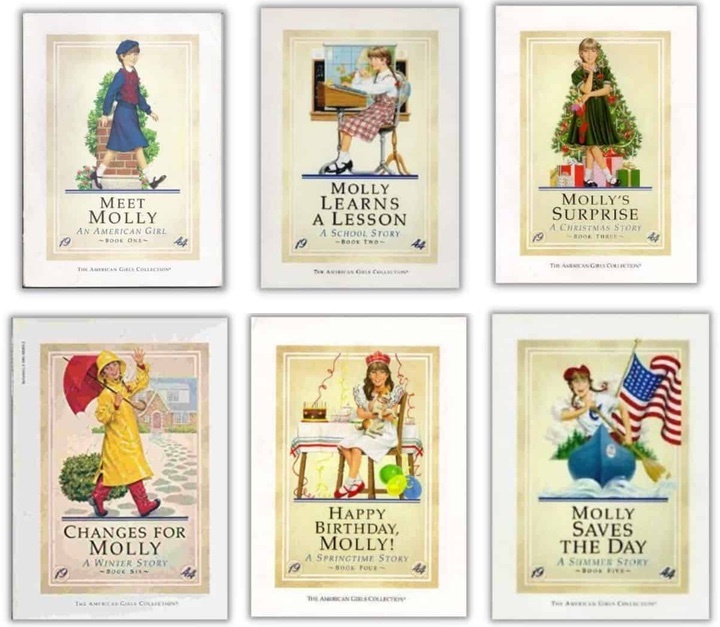
For Darlene, the books about Molly McIntire’s participation in American history were one of Molly’s prime attractions, and justified her rather extravagant purchase price.
As some will remember (or will have heard rumors about) the years immediately following World War II, which were probably the climax of American Greatness; a condition we’re now struggling to recreate.
As part of the process of reclaiming American greatness, we’re rethinking how many dolls we should buy for our daughters. Some of our nation’s leaders have expressed concerns about little girls owning too many dolls.
Last March, for example, President Trump told the media:
“All I’m saying is that a young lady, a 10-year-old girl, 9-year-old girl, 15-year-old girl, doesn’t need 37 dolls… I don’t think that a beautiful baby girl needs — that’s 11 years old — needs to have 30 dolls. I think they can have three dolls, or four dolls, because what we were doing with China was just unbelievable.”
This statement seemed to suggest that “what we were doing with China” is now in the past tense, and we’re no longer doing it. (Whatever it was we were doing.)
But I can certainly comment on the “number of dolls” question.
When Molly moved in with us, Ashley already owned several dolls, including Barbie, Ken, Skipper and Midge. Barbie and Ken were dating at the time; this was before Barbie was exposed to the Patriarchy, which ultimately resulted in Ken dating Midge.
Ashley also had two Cabbage Patch dolls named Brittany and Brianna. I vaguely remember a few other dolls in the collection, but can’t recall their names at the moment.
These other dolls were relegated to the attic soon after Molly arrived with all her bedroom furniture and impressive wardrobe.
The first Molly McIntire doll was manufactured and sold in 1986, along with the Kirsten Larson doll (whose family had immigrated from Sweden) and the Samantha Parkinson doll (an orphan who lived with her well-to-do grandmother in upstate New York; not sure if her family were also immigrants, but probably.) That means that Molly, Kirsten and Samantha will turn 40 this year. Technically speaking.
They don’t look a day older than 9.

Ashley, meanwhile, has grown up into a fine, well-educated adult, and Molly lives in the attic along with Barbie and Brittany and the rest, awaiting the possibility that my future granddaughters will someday want to learn about American history, and dating.
But I wonder whether dolls will be a “thing” in the future? Because our current government seems intent on discouraging the ownership of dolls. Especially, dolls that “immigrate” from Chinese factories.
“The reason they keep using dolls as their example is because they’re trying to frame ‘caring about material stuff’ as feminine and thus inherently shameful,” wrote Leah Greenberg, co-founder and co-executive director of the progressive organizing group Indivisible.
By focusing on dolls, and girls, the government’s message — an apparent attempt to encourage austerity? — seems to be defending the current trade war with a taunt.
“What are you afraid of? That your daughters won’t have dolls to play with?”
Speaking on Fox last spring, Treasury Secretary Scott Bessent suggested that our kids will have a better life than their parents because of the economic freedom now being created by administration policies and global strategies.
But maybe they won’t have better dolls.
Underrated writer Louis Cannon grew up in the vast American West, although his ex-wife, given the slightest opportunity, will deny that he ever grew up at all. You can read more stories on his Substack account.