
Final question: Is my robot vacuum a spy? Yes, but probably not any more than your cell phone, your credit card, your ISP, your Alexa, your gym membership, or your neighbors…
— from Reviewed.com, April 2023
When you’re an older confirmed bachelor like myself, you don’t truly need to be an excellent housekeeper, because the only people who will likely see the inside of your house are your own grown children, assuming they decide to visit occasionally.
This can happen around Christmas, and that was the plan for 2025. Two of my three kids decided to spend the holidays in town, which necessitated a couple of purchases. A cheap sleeper couch ($500) and a robot vacuum cleaner ($250) that does a good job picking up pet hair and crumbs from tortilla chips.
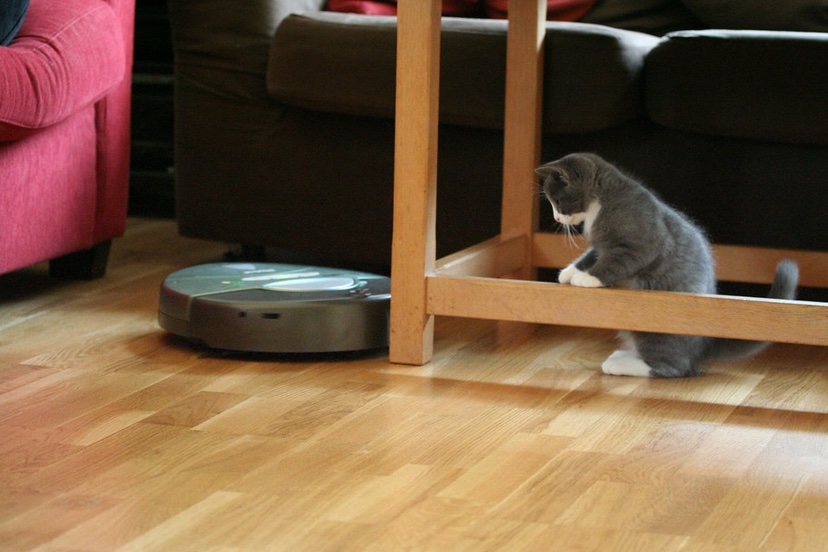
Shopping for a robot vacuum is not something I ever imagined doing. Nor is it something my cat, Roscoe, ever imagined me doing. But robot vacuums have become steadily more proficient, and nearly indispensable for older confirmed bachelors, if they care about tidiness.
The first commercially successful robot vacuum clear was the Roomba, designed by the Massachusetts-based company iRobot, appearing on the market in 2002. A boon to busy (or lazy) housekeepers, and a terror for small pets.
Right from the beginning, the Roomba was manufactured in China.
Which is the main subject of this column. Robot vacuum cleaners made in China, and sending data about your private home to China.
Most major robot vacuum cleaners are now made by Chinese companies, with the top five brands — Roborock, Ecovacs, Dreametech, Xiaomi, and Narwal Robotics — accounting for nearly 70% of the global market. The American brand iRobot, best known for the Roomba, is currently ranked sixth.
Massachusetts-based iRobot filed for Chapter 11 bankruptcy protection last week, after years of poor sales and after a proposed $1.4 billion sale of the company to Amazon fell through. If a judge approves the bankruptcy filing, iRobot will be taken over by a Chinese company.
I didn’t know this was happening when I bought my Roomba. Nor did I know that the Roomba was already being made in China. But the inconvenient truth always comes out, eventually.
The latest models use video and LiDAR to keep track of where the robot has and hasn’t cleaned. Apparently, my Roomba has made a digital map of my house, noting details like which rooms need cleaning most often and where my cat’s water bowl is located. Bowls of water being a hazard, of course, to electronic devices.
But another hazard is my privacy. Robot vacuums apparently store their video images and maps on a cloud server, sent out via the household WiFi.
Where, exactly, is this information about my personal living quarters being stored? Who has access to it? Do the videos include, for example, pictures of me sitting on my new sleeper couch eating tortilla chips?
And would I want a Chinese company to have said pictures, and maps? That concern has been much discussed recently in the Lamestream Media.
We have to wonder what our world is coming to, when we begin to fear our vacuum cleaners.
Final question: Is my robot vacuum a spy? Yes, but probably not any more than your cell phone, your credit card, your ISP, your Alexa, your gym membership, or your neighbors…
— from Reviewed.com, April 2023
Ah, yes. My neighbors.
And worse yet, my government.
When I really think about it, I would much rather have the map of my house accessed by a Chinese company, than by the U.S. government, or by U.S. tech companies, or by U.S. credit card companies.
The Chinese probably don’t give a damn about where my cat’s water bowl is located.
But at the rate things are going, I definitely don’t want the federal government to know anything about me. Or my cat.
Underrated writer Louis Cannon grew up in the vast American West, although his ex-wife, given the slightest opportunity, will deny that he ever grew up at all. You can read more stories on his Substack account.