
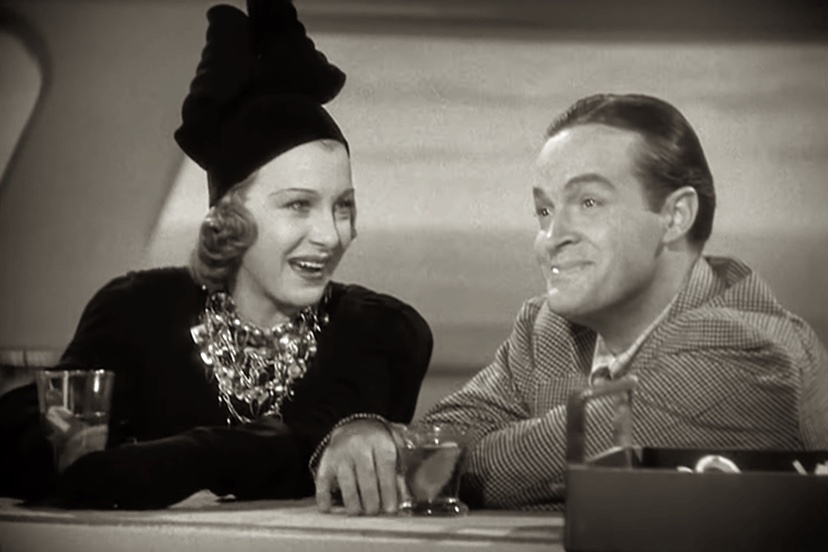
For many of us, Thanksgiving 2025 is now a memory. A memory that will be refreshed, over the next few weeks, every time we weigh ourselves.
It’s not, however, likely to be a romantic memory. That is to say, a memory of a romance, the details of which have become hazy.
Thankfully, romantic memories can linger, long after the divorce papers have become yellow and brittle. No need to step on the bathroom scales.
We might even be inclined sing about such memories.
SHIRLEY ROSS:
Thanks for the memory
Of China’s funny walls
Transatlantic calls
BOB HOPE:
That weekend at Niagara
When we hardly saw the Falls
ROSS: How lovely that was
HOPE: Thank you
It’s a proven scientific fact that no two people remember the same event the same way. We can view that as an annoying problem, or we can be thankful for it. Either way, it’s a funny thing.
Also, song lyrics can be funny. That’s another thing we can be thankful for, and remember. Song lyrics.
The lyrics for the song, “Thanks for the Memory”, were written by Leo Robin for the 1938 film The Big Broadcast of 1938, which featured Bob Hope and Shirley Ross as a divorced couple who encounter each other aboard a passenger ship, the S.S. Gigantic. Near the end of the film, the two sing this song as a duet, recalling their sometimes tumultuous relationship… and then decide to get back together.
Singing duets can do that for people. I’d personally like to see duet-singing make a comeback.
In the fifth verse, lyricist Leo Robin mentioned the couple’s romantic weekend in Niagara. His original lyrics were: “That weekend at Niagara when we never saw the Falls.”
However, the line was rejected by the film producers who feared it was too suggestive. This was 1938, when married couples still slept in separate beds, preferably in separate bedrooms. It’s somewhat remarkable that babies were conceived, back in those days.
Robin was furious with the film producers about the rejected lyrics, and a bitter fight ensued, with neither side giving way. Finally, a compromise was reached, with Bob Hope singing, “That weekend at Niagara when we hardly saw the falls.”
Robin never forgave this censorship; he considered it ridiculously prissy and thought it ruined the song. However, the way Shirley Ross responds with, “How lovely that was!” indicates that “never” was indeed the better choice.
The song won the Academy Award for Best Original Song. Probably thanks in part to the censors’ decision, considering this was 1938.
I was thinking a lot about about thankfulness yesterday, as so many of us were. We have so many things to be thankful for.
As was the case for Buzz Fielding (Bob Hope) and Cleo Fielding (Shirley Ross) aboard the S.S. Gigantic, most of what we can be thankful for is in the past.
It’s a rare billionaire who can feel thankful for the present.
In 1981, crooner Frank Sinatra recorded a version of “Thanks for the Memory” with completely new lyrics. The original 1938 version was duet — a couple remembering pleasant, or awkward, moments from their shared past — but Sinatra’s version evoked a lonely old guy feeling sorry for himself.
Thanks for the memory
Of letters I destroyed
Books that we enjoyed
Tonight the way things look
I need a book by Sigmund Freud…
I hardly think a book by Sigmund Freud would have helped. Listen, Frank, you already destroyed the letters. Psychoanalysis ain’t gonna help.
Still, Frank was thankful for the memory.
Here’s my confession. I would love to run across my ex-wife Darlene on a cruise ship, and sip cocktails while singing about Niagara Falls. Although I don’t exactly remember if we saw the Falls together. It might have been with an earlier girlfriend. I do recall that I actually did see the Falls with someone. Pretty spectacular.
I’m thankful for that memory.
No doubt Darlene remembers it differently, though. If she was even there.
Underrated writer Louis Cannon grew up in the vast American West, although his ex-wife, given the slightest opportunity, will deny that he ever grew up at all. You can read more stories on his Substack account.