
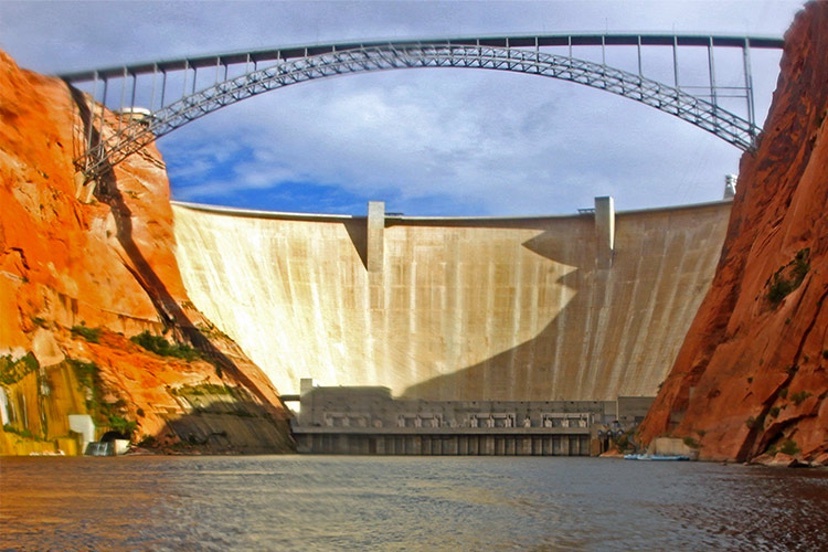
Photo: Glen Canyon Dam holds back the declining waters of Lake Powell near Page, Arizona on Sunday, February 2, 2025. (Photo by Spenser Heaps for Utah News Dispatch)
EDITOR’S NOTE: Today, November 11, is the federal government’s declared deadline for the seven Colorado River Basin states — Colorado, Utah, Wyoming, New Mexico, Arizona, California and Nevada — to agree on a ‘framework’ for a agreement to be signed by the end of 2026, to define the allocation of the water in the Colorado River, the hardest working river in the American West. A number of environmental organizations have issued recommendations discussed here.
The following story by Annie Knox appeared on Utah News Dispatch on November 8, 2025.
A fight over which states along the Colorado River have to cut their water use may still be damming up negotiations like the towering concrete of Lake Powell.
But time is running out. Utah and six other states are days away from their November 11 deadline to reach an agreement on how to manage the dwindling river and its reservoirs. If they don’t, the federal government has said it will decide for them. The existing agreement expires at the end of 2026.
Here are five things to know as the due date approaches:
Talks are tense
Arizona Governor Katie Hobbs gave a glimpse into negotiations when she called out the upstream states this week, saying they’re taking an “extreme negotiating position” and refusing to commit to water cuts.
The Upper Basin states of Utah, Colorado, New Mexico and Wyoming have resisted mandatory cuts in dry years, saying they generally use less than they’re allocated. The Lower Basin states of Arizona, California and Nevada have said all seven should share water cuts during dry years.
Hobbs said a plan “where we shoulder the entirety of the water reductions while not one single acre-foot is put on the table by the Upper Basin states is an unacceptable outcome for Arizona families, farmers and businesses,” the Arizona Daily Star reported.
“This is the extreme negotiating position we are confronted with as the Upper Basin states, led by Colorado, continue to run down the clock,” Hobbs said while speaking at a conference in Tucson Wednesday. A Democrat, she called on the Trump administration to step in and broker a deal.
Utah’s negotiator is still optimistic
Gene Shawcroft, Utah’s Colorado River commissioner, seemed more positive. He said Thursday the states are “making steady progress,” but didn’t go into specifics.
“These are incredibly complex negotiations, and we’re continuing to work through some challenging issues,” Shawcroft said in a statement. He went on to say the states are “making steady progress on key issues the federal government has identified, aiming to reach broad alignment by November 11 — even if the finer details come later.”
He said he’s hopeful the states can agree on a framework before their next deadline to submit a proposal to the federal government in February.
“Utah remains fully committed to defending every drop of Colorado River water to protect our communities and water users,” Shawcroft said.
The debate ultimately could land in court if the deal results in mandatory cuts that Utah wants to fight with a lawsuit, or if the Lower Basin states make a case the Upper Basin isn’t delivering the water it’s obligated to.
An already dwindling water supply could shrink
The Colorado River Basin has no more water today than in 2022, when reservoirs Lake Powell and Lake Mead made headlines for hitting historic lows, said Jack Schmidt, a professor emeritus in watershed sciences at Utah State University.
“We’re sort of like the frog in the pot of water whose temperature keeps getting a little bit hotter,” Schmidt told Utah News Dispatch Thursday. “We’ve now gotten kind of used to it, but we have a serious problem right now.”
Water managers are hoping for a bailout in the form of a big winter that will bring greater runoff and snowpack than normal.
“That’s not a situation you ever want to be in, and that’s the position we’re in,” Schmidt said.
Farms use most of the water
Agriculture uses roughly 80% of the river’s water, and a little more than half goes into growing livestock feed, including alfalfa and hay.
“From that perspective, we have a tremendous amount of flexibility in how we manage the system, and so from that perspective, we don’t have a crisis,” Schmidt said. “We simply have to change how we allocate water and use water.”
That’s already happening on some farms. Several Utah farmers are profiting from letting certain fields fallow, meaning they take a break from planting crops there. They lease the water they don’t use to the government.
Paying farmers for the conserved water has proved cost-effective, according to a comprehensive study focused on Colorado River conservation and supply projects.
There’s a gap in leadership at the federal level
There’s still no permanent boss at the federal agency working with states on the plan. President Donald Trump picked Arizona water expert Ted Cooke to head the U.S. Bureau of Reclamation in June, and Cooke was praised for his expertise at the time.
But the Trump administration withdrew Cooke’s nomination in September. Cooke told the Associated Press that he’d “been sacrificed on the altar of political expediency.” A deputy chief of the agency has been serving as acting commissioner since January.
EDITOR’S NOTE: The following comments by James Eklund, a Colorado water lawyer, rancher, and former director of the Colorado Water Conservation Board, are excerpted from a November 11 op-ed posted on BigPivots.com.
The River at a Crossroads
Today, November 11, the seven states that share the Colorado River face a deadline they’re unlikely to meet. The Department of the Interior has asked them to agree on the bones of a post-2026 management plan — the rules that will decide who gets cut, when, and by how much as the river keeps shrinking.
If they fail, Washington will write the rules for them. And if Washington falters, unelected judges will. Either way, the West loses control of its own destiny. That’s not leadership; that’s abdication.
The Lower Basin is braced for federal action. The Upper Basin is bracing for blame. Both are right to be worried — and both are missing the point. The river doesn’t care about politics or priority dates. It only responds to snow, sun, and science.
We built the Colorado River system for a climate that no longer exists. Reservoirs that once promised endless growth now sit half-empty — Lake Powell at roughly 29%, Lake Mead near 31%. The math is unforgiving: less water is coming in than going out.
Yet our governance still pretends otherwise. The Law of the River — that tangled mix of compacts, decrees, and deals — assumes a river of at least 16.5 million acre-feet. Nature is now giving us perhaps 12, maybe less. We’re overdrawn every year, and the overdraft is accelerating.
This isn’t a failure of hydrology; it’s a failure of adaptation. The West has always been proud of its self-reliance, but we’re behaving like a bureaucracy waiting for someone else to make the hard call. We need leaders, not hall monitors.
And if you want to know what failure of adaptation looks like, glance halfway around the world. Tehran, Iran, a city of more than eight million, is on the brink of evacuation. Its reservoirs are nearly dry, some below 10% capacity. Rainfall has fallen 40% below average. Iran’s president recently warned that if the skies don’t open, the capital may have to be moved. Moved. Imagine Washington, D.C. abandoned because the Potomac went dry. That’s not science fiction — that’s what happens when water governance waits too long to face reality. The Colorado River isn’t there yet, but the trajectory rhymes. Tehran is a mirror we should study before it shows our reflection.
The Pagosa Daily Post welcomes submissions, photos, letters and videos from people who love, and care about, Pagosa Springs, Colorado. More information available at 970-903-2673 or pagosadailypost@gmail.com