
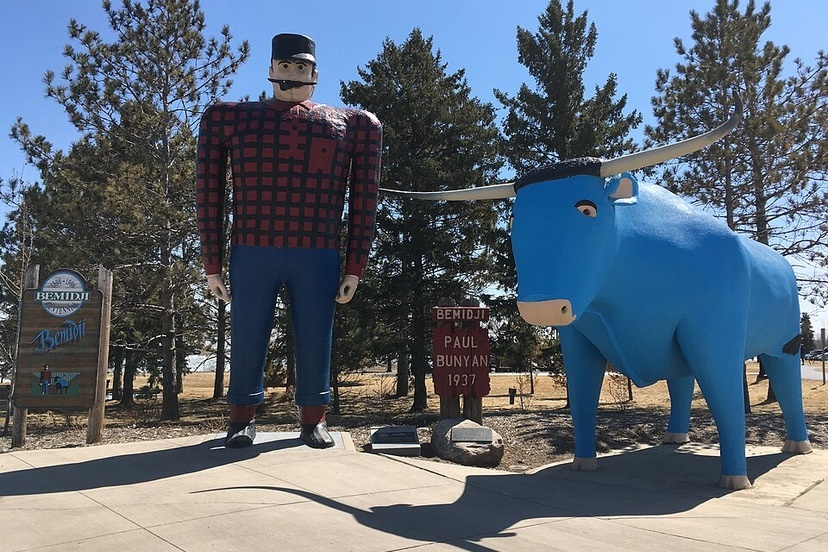
Photo: Near the shores of Lake Bemidji in Minnesota stands the historic statues of the legendary lumberjack Paul Bunyan and Babe the Blue Ox.
There’s a big problem with Paul Bunyan, that few people are willing to talk about.
But first, a quick refresher course in Bunyan history.
The statues shown above, of Paul Bunyan and Babe the Blue Ox, were installed in 1937 near Lake Bemidji, and are “the second most photographed statues in the United States”, behind Mount Rushmore in South Dakota. According to the Eastman Kodak company.
I found this information on Wikipedia. Some readers may remember the Eastman Kodak company, and some may have photographed the statues of Paul and Babe, considering their reported popularity. Perhaps using a film camera and Kodak film? The faded color print might even be sitting in a dusty photo album up in the attic.
I personally don’t believe the claim about “the second most photographed statues.” I’m pretty sure the Statue of Liberty has been photographed more often than Paul and Babe, and probably more than Mount Rushmore as well. Ditto, the statue of Abraham Lincoln in Washington DC.
But what do I know? Maybe Lake Bemidji, Minnesota, gets more tourist traffic than New York City or Washington DC.
Nevertheless, we have to admit that Paul Bunyan stands tall among America’s mythical folk heroes. About 18 feet tall, in the case of the Bemidji statue. And Babe the Blue Ox, standing 10 feet tall at the shoulders, is also an heroic symbol, but in a co-dependent manner.
In 1937, when these two statues were constructed, Paul and Babe were already famous for chopping down entire forests in Minnesota. I’m assuming the chopping was done mainly with an axe, since the chain saw was not widely available until the 1940s.
Apparently, the earliest recorded mention of Paul Bunyan is in a 1904 editorial in the Duluth News Tribune, describing the lumberjack culture:
In spite of a great deal of talk about the decline of the great American Lumberjack, he remains much the same jolly picturesque individual that he was in days gone by. His language, his jokes and his apparel are a never ending source of amusement to those who have not grown accustomed to his ways.
If the firm for which he works fails to suit his taste in the matter of food, blankets or length of the work day, the luckless capitalists are immediately classified as being “gunnysack,” “haywire” or “lard can.”
His pet joke and the one with which the green horn at the camp is sure to be tried, consists of a series of imaginative tales about the year Paul Bunyan lumbered in North Dakota. The great Paul is represented as getting out countless millions of timber in the year of the “blue snow”…
The editorial describes an enormous logging camp, and the massive cook stove necessary to feed the gluttonous lumberjacks.
The range on which an army of cookees prepared the beans and “red horse” was so long that when the cook wanted to grease it up for the purpose of baking the wheat cakes in the morning, they strapped two large hams to his feet and started him running up and down a half mile of black glistening stove top.
The job of decimating America’s great virgin forests required plenty of beans and “red horse” (which I take to mean, “corned beef” made from horse meat?) and a vast army of strong men and equally strong oxen. The men, to cut down the trees, and the oxen to pull the logs out of the forest. Sometimes, horses were used instead.
Oxen or horses; the animals had to be over-achievers.
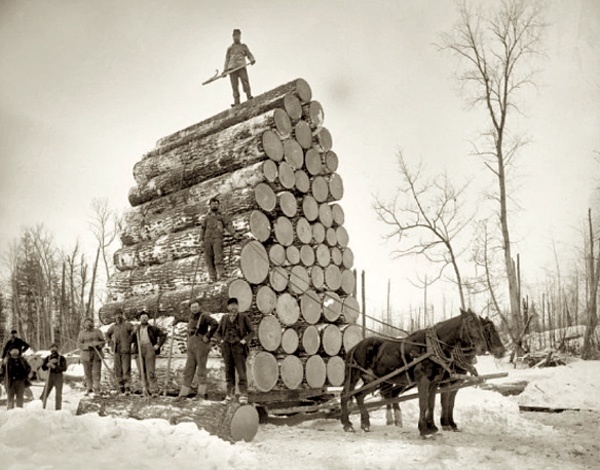
The loggers were also over-achievers.
According to one online source:
It’s hard to imagine what our continent was like before European whites came. Imagine, for example, that the land we know today had 90% more trees. Much of North America was blanketed in forest…
But it wasn’t just trees that were getting killed.
The History Collection posted an article: “15 Jobs So Dangerous They Were Basically a Death Sentence in the 1800s”. In their list, logging comes in at number 6.
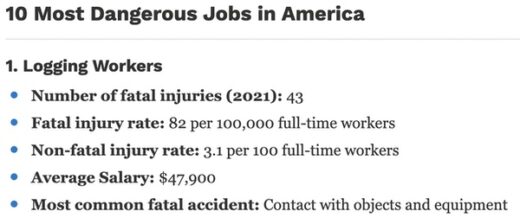
Things haven’t gotten much better.
From Forbes magazine:
I’m not sure if Paul Bunyan was actually 18 feet tall, like the Lake Bemidji statue, but he was definitely big. And strong. But he no longer with us. I found a eulogy on PaulBunyan.org that reads, in part:
All good things must come to an end, and, to his credit, Paul was one who knew how to live and live good. In his latter years, he retired to Dogtown near Princeton, Minnesota. There, he held celebrity status as the “local heavyweight” and his time there was contemporaneously referenced over a dozen times by a local paper (often misspelled as “Bunion”). He passed away suddenly while passing through Canada. In keeping with his wishes, he was laid to rest in Kelliher, Minnesota, three hours north of Princeton, to be closer to the forests he once destroyed. The erroneous dating on his tombstone (1794-1895) was due to it being purchased secondhand (the former owner turned up alive after having went missing in the woods).
The Paul Bunyan Problem is succinctly summarized in that phrase. “The forests he once destroyed.”
The Lake Bemidji statue portrays Paul standing tall — the way he stood when he was still alive — but absent his trademark beard.
The missing beard may be related to a battle he allegedly fought with the shape-shifting trickster spirit known as Nanabozho, who most often took the shape of a large rabbit named Gitchii-waabooz or sometimes as Michabo Ovisaketchak (“the Large Rabbit Who Created the World”).
Ojibwe legend describes Nanabozho’s encounter with Paul Bunyan.
Nanabozho confronted the fabled lumberjack along his path of deforestation, and implored him to leave Minnesota without chopping down any more trees. A fight ensued, lasting forty days and forty nights, and Nanabozho prevailed by slapping Paul across the face with a Red Lake walleye, causing the giant logger to tumble. Nanabozho then pulled on Paul’s whiskers, and made him promise to leave the area.
This story explains why Paul Bunyan is beardless in the Bemidji statue. He’s also facing west, presumably looking ahead to the future deforestation of the Pacific Northwest.
Underrated writer Louis Cannon grew up in the vast American West, although his ex-wife, given the slightest opportunity, will deny that he ever grew up at all. You can read more stories on his Substack account.