
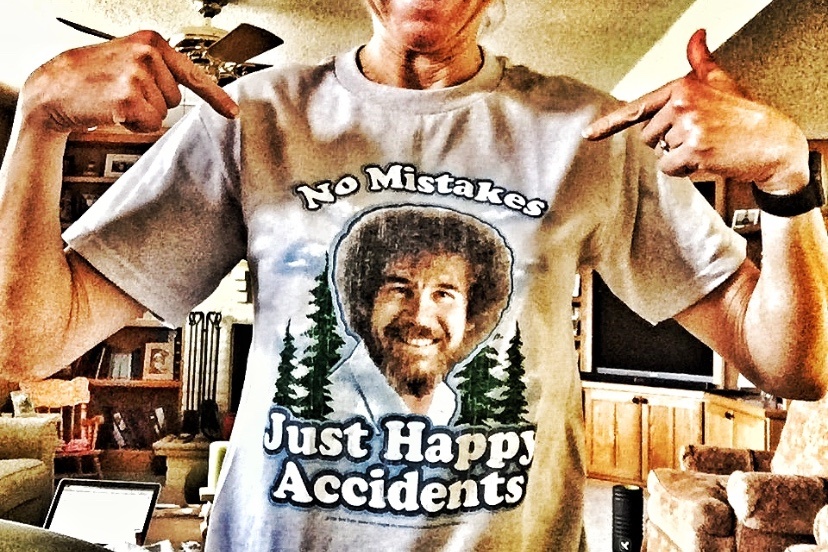
Most Americans who learned how to paint landscapes between January 11, 1983 and May 17, 1994, learned everything they knew about painting from Bob Ross, while watching his instructional television program, The Joy of Painting, on PBS.
Robert Norman Ross was born on October 29, 1942 and served in the Air Force at Eielson Air Force Base in Alaska, where he served as First Sergeant — responsible for the morale, welfare, and conduct of the enlisted members in his squadron. That is to say, he learned how to scream orders like a sergeant, and tell his men what they were doing wrong.
You would never know this from watching this shows. There’s a good reason for this. After leaving the military, he promised himself he would never again raise his voice.
For example, in this six-minute video:
It’s hard to imagine a painting teacher more relaxed and non-judgmental.
As mentioned, his show was called The Joy of Painting, and much of the joy derived from the fact that the paintings made no attempt whatsoever to represent any particular landscape that exists in the real world. The scene in a Bob Ross painting unfolded as a series of happy accidents based on techniques that almost any 10-year-old child could master.
We learned, from Bob Ross, that accidents could be happy, if your technique is correct. In fact, his whole world was happy. As he demonstrated his somewhat unusual — but simple — painting techniques, he told stories about the “happy little clouds” and “happy little trees” he was creating. After painting a tree trunk, Ross would usually add another nearby “because it needs a friend”.
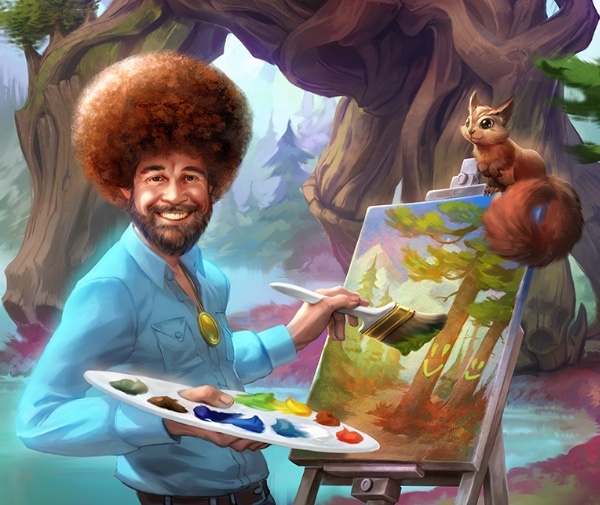
We learned that trees are happier, when they have a friend nearby. Even clouds and mountains need friends, to be fully happy.
He would occasionally present home video footage of himself with his pet squirrel, or with a baby deer or raccoon or other small animal. We naturally assumed these animals were also happy.
You can still buy Bob Ross painting kits, and you can watch a lot of his episodes on YouTube.

But Bob is no longer with us in the flesh. He departed for the big painting studio in the sky in 1995. No doubt, a happy place.
At the end of each episode, Ross was known for saying something akin to, “…so, from all of us here, I’d like to wish you happy painting, and God bless, my friend…”.
“Happy painting” meant “You can’t make a mistake. You can put the mountains and trees wherever you want, and make them as short or as tall as you want.” In fact, you don’t need to decide what you “want”. Wherever they end up, and however they look, will be just fine.
You are not painting the real world — you are painting a happy world. When happiness is the goal, all that mattered is your technique.
Bob Ross never included people in his paintings. Nor animals. No birds flew in his skies.
Basically, just trees and mountains and clouds and lakes.
No wonder the world was happy. No people! Just painting technique, and happy accidents.
We’ve forgotten the lesson that Bob Ross spent 10 years trying to teach us.
Now we find ourselves in the middle of an unhappy accident called “Project 2025”. But maybe it’s not an accident.
Underrated writer Louis Cannon grew up in the vast American West, although his ex-wife, given the slightest opportunity, will deny that he ever grew up at all. You can read more stories on his Substack account.