
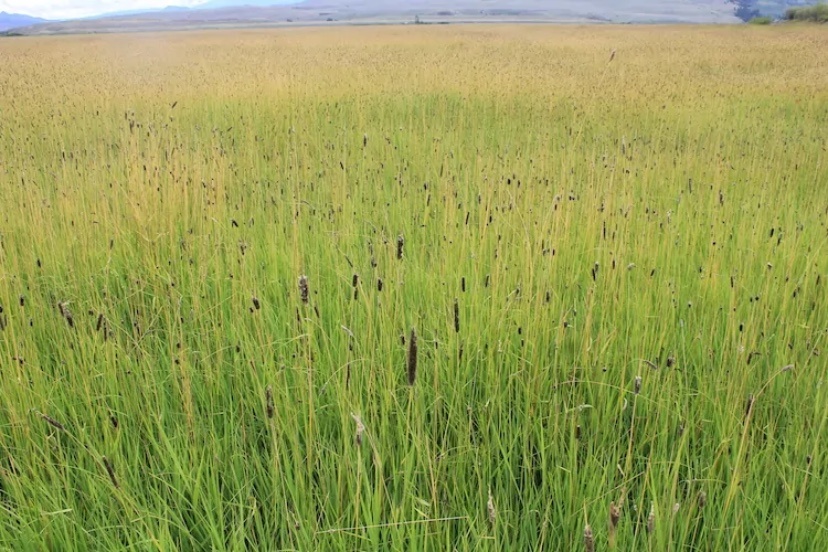
Photo: A hay meadow along the Colorado River in Middle Park, near Kremmling. Photo/Allen Best.
This interview by Allen Best with scientists Eric Kuhn, Anne Castle and John Fleck appeared on BigPivots.com on September 28, 2025. We are sharing it in three parts.
Your reports have been very action oriented, and that is particularly true of this last one, where you call for drastic and immediate action. Are you seeing evidence that your work is having impact?
Castle: It’s getting attention. I don’t know if it’s resulting in action.
Fleck: One of our goals is to move conversations into the public arena that should be held in the public arena rather than in the sort of cloistered spaces in which a lot of Colorado River decision making is conducted. Katherine Tara, the newest member or youngest member of our group, talks about the need for a Colorado River C-SPAN, the need for broader public forums. And I think our work has contributed to forcing some issues and discussions into public.
I want to go back to something that Eric said at the outset. You said that you are of like mind, because you’ve all studied the data, and the data take you to the same conclusions. If that is the case with you having studied the data, what does that say about the broader basin discussion? If everybody has studied the data, should that not take everybody to the same conclusion?
Kuhn: The problem is that all the principals work for a governor or a board or constituents. The six of us all have focused on the data, and I think many, many of the journalists and many of the experts in the basin acknowledge the data. There’s still a culture among the major agencies and the states that supports a system that is unsustainable. We must reduce our uses to match the supply. But they all have constituencies and probably lawyers that tell them this is why it’s everybody else’s responsibility, not mine or not ours. We have yet to crack that culture that the basin must reduce water use — but not me.
Fleck: One of the things important about the book Eric and I wrote is in the title, ignoring inconvenient science, because we have a history in this basin of doing things for political expediency. Looking away from the most unpleasant scientific conclusions about the available water supply makes it easier for political actors to deal with their local and state constituencies. Because it’s hard to go to a community and say, “I’m sorry, there really is less water.” So, the political incentives are not aligned with responding to the science the way we think they should be, which is why we have to say these things that are really hard for a governor or governor’s representative to say.
Castle: Because we’re independent and do not answer to political constituencies, we have the ability and, frankly, the luxury of pointing to wherever the data takes us. The political incentives are almost diametrically opposed to doing the hard things that need to be done to balance what nature is supplying with what we’re using. One of the goals we’re pursuing is to educate a broader community about what the data shows and what conclusions that leads us to. That enables people to advocate to their own representatives for sensible solutions.
Do you have a bigger game plan in mind? Are you being reactive to events or do you have a strategy that goes beyond into like what we do in 2026, for example.
Fleck: Speaking for myself, I believe it is possible for us to continue to have communities that not only survive but thrive with less water if we find reasonable and equitable ways of sharing the burden of the impact of climate change across the entire West. My personal concern is that sort of parochial advocacy creates a winner- loser situation. Some community might win and not have to cut at all; another community could have disastrous cuts. That violates my basic notions of the moral framework that I have for thinking about what I want the future to look like.
Kuhn: My goal in this goes back to what John said about our book, which is paying more attention to the data and the science. We no longer have the luxury of ignoring the data and the science. Doing so will lead to an outcome that our constituents won’t like. We have to get over that hurdle. That has been my goal all along. More reliance on good data-based decision making.
Are there lessons for the seven states in the Colorado River Basin from the recent Rio Grande settlement?
Kuhn: I think so. Going out on a limb, I think the lesson here is that even if there’s litigation in the Colorado River Basin, the negotiations are going to continue. The mediation is going to continue.
My view of this Rio Grande agreement from 30,000 feet and from a long way away was that the court-appointed special master pretty much forced them to reach an agreement. He kept pushing them to reach an agreement. They failed initially (and) at last succeeded.
So I think the lesson is, even if there’s litigation, there’s going to be continued discussions and negotiations. I question whether, without the litigation, New Mexico would have been willing to enter into the agreement that they have entered into. I think that the additional risk of the court case brought New Mexico to the table on several issues, but that’s just my view of it from a long way away.
Castle: A legal lesson learned from the Rio Grande experience is don’t ignore the objections of the feds.
Fleck: A related lesson I have taken is that we have a history of litigation in the Colorado River Basin that was very, very much conflict-based for more than a decade. But the Rio Grande experience shows that, while extremely unpleasant and extremely expensive, it was possible to manage this river. It’s my river, right? I’m in Albuquerque. On the Rio Grande, we’re able to manage this river during the time of litigation. It did force the parties into collaboration and compromise, however ugly and unpleasant the process may have been.
It makes me think litigation on the Colorado River would be a terrible idea. A collaborative solution is much preferred. But I also think that litigation might very well push us toward the collaborative solution anyway. My argument is let’s just do it now (without the expense and the heartache) because ultimately we will end up with the same thing. That is the lesson we might draw from the litigation on the Rio Grande.
What is the most hopeful thing that you’ve heard or seen in the last year or two in the Colorado River Basin?
Fleck: I have been really impressed with the continued push toward permanent, relatively deep reductions in the Lower Colorado River Basin. They’re consistently coming in well below their 7.5 million acre-feet. They’ve been learning important lessons about how to approach that since the early 2000s when California was using more than 5 (million acre-feet) and had to cut back to 4.4. There’s a lot of built-up experience about how to go about reducing your water use.
And the communities are still thriving. Las Vegas’s water use reductions are stunning. You’re seeing significant reductions in the water flowing down the Central Arizona Project canal and really successful adaptations in the Imperial Valley. Over and over again we are seeing that when people have less water, they use less water, and communities can still thrive.
One thing that bothers me — which I wrote about in my book (“Water is for Fighting Over: And Other Myths about Water in the West”) over a decade ago — is this sort of limbic fear that we get, that a reduction in our water supply means the death of our community. We can, in fact, get by with less water.
Allen Best publishes the e-journal Big Pivots, which chronicles the energy transition in Colorado and beyond.