

Photo: A dog — presumably, a French dog — with a bunch of French philosophers.
Reportedly, Jonny Thomson taught philosophy in Oxford for more than a decade before turning to writing full-time, and he’s now an award-winning, bestselling author of three books that have been translated into 22 languages.
Jonny is also the founder of ‘Mini Philosophy’, a social network of about two million curious, intelligent minds. He’s known all over the world for making philosophy accessible, relatable, and fun.
Even some people in America know about him.
Recently, he addressed a simple question, “Would you rather be an absurdist or an existentialist?”
That’s a darn good question. I’ve always thought they were the same thing, having sprung from the minds of a couple of French philosophers sitting around a table in Paris, drinking wine or maybe absinthe, and having nothing better to do than try their best to define a difference between two essentially identical philosophies.
Actually, there were three philosophers. Jean-Paul Sartre, Simone de Beauvoir, and Albert Camus. It’s not clear which of them was drinking absinthe. Maybe all three.
They agreed on one important point. That life is meaningless. By which we mean, there’s no omniscient being out there defining the meaning of life, so we each have to come up with our own reason for getting out of bed in the morning.
For Camus, the reason was to write absurdist novels. For Sartre and Beauvoir, the reason was to retain their teaching jobs at the university.
For me, the reason is to continue paying alimony. It’s the least I can do.
Author Jonny Thomson has his own ideas about existentialism and absurdism, and seems to think they’re different, which provides him a reason to post a short video and an essay about the differences. In other words, his reason to get out of bed in the morning is to identify differences between essentially identical philosophies, and then post the supposed reasons online.
Apparently, he’s been posting philosophical explanations online for many years, if he’s really managed to acquire two million followers.
Which is pretty much the same thing I’ve been doing — posting philosophical ideas online — but for different reasons, and for a different number of followers.
I visited Mr. Thomson’s ‘Mini Philosophy’ website and noted that he’s been spending his time summarizing philosophical ideas dreamed up by other people, without really telling you a whole lot about those ideas. Hence, the term ‘Mini’.
I guess you can get a job at Oxford, by doing this.
Oddly enough, these 1,200-word ‘Mini Philosophy’ summaries of perhaps very complex ideas are posted on a website called ‘BigThink.com’. If that seems to you an uncomfortable dichotomy — Mini Philosophy happening on a Big Think website — then you and I should have coffee sometime.
From what I can tell, Mr. Thomson began his online ‘Mini’ career posting little essays on Instagram, that were subsequently read by a few dozen people. I am certainly not suggesting that anyone visit Instagram, even for a tiny taste of philosophy. But I’ve grabbed a few samples of the early Instagram images that link to Mr. Thomson’s ‘Mini’ essays and ‘Mini’ videos on subjects like virginity and demons.
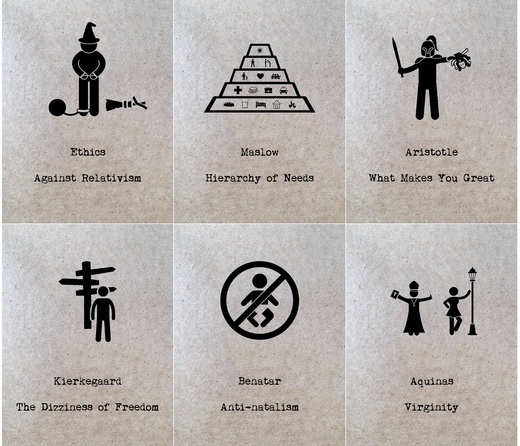
Later, he graduated to more complex topics that looked better on a stark black background.

The black background gradually felt boring (I’m assuming) and Mr. Thomson began adding some color to the topics. At this point he was getting thousands of people clicking on his brief summaries and short-form videos.
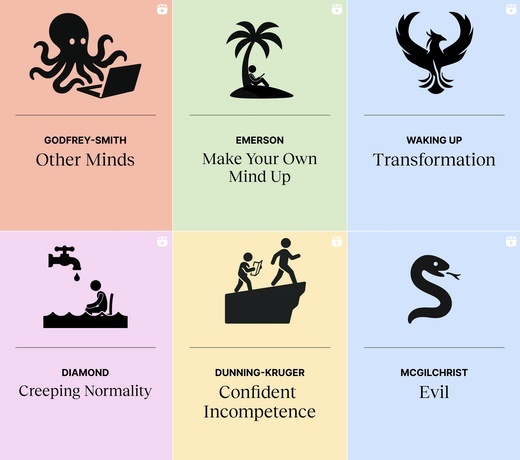
People these days aren’t as interested in existentialism and absurdism as they were in the 1950s when it was all the rage, among intellectuals, to argue about meaninglessness.
That’s something we don’t have to argue about anymore.
But there are plenty of other complex philosophical ideas to choose from, and Mr. Thomson is happy to summarize them for us, if all we’re looking for is a quick overview.
Evil, for example. None of us want to spend a lot of time thinking about Evil. It’s enough just to know it’s there when we need it.
Underrated writer Louis Cannon grew up in the vast American West, although his ex-wife, given the slightest opportunity, will deny that he ever grew up at all. You can read more stories on his Substack account.