

You may not have heard of Michael Shurtleff, the Broadway and Hollywood casting director who ‘discovered’ aspiring actors like Elliot Gould, Barbra Streisand, Dustin Hoffman and Gene Hackman, and handled casting duties for movies like The Graduate, The Sound of Music and Jesus Christ Superstar.
Presumably, he understood the art of acting better than most of us. And he understood the endless frustrations of being an actor. In his treasured 1978 book, Audition, he wrote:
“The truth is that for every actor who gets hired for a part, fifty or a hundred or two hundred do not. An actor is forever trying to get a part; an actor is forever getting rejected, never knowing why, simply not wanted. An actor’s life is not to be envied. It consists mostly of losing out, of being turned down. Unendurable, such a life, for most of us. I will never know how actors manage to persist.”
For many years, I have been envying actors, but now after learning the truth, the somewhat miserable life I lead as a journalist seems like Nirvana by comparison.
Not the rock band, Nirvana, but more like the Buddhist concept of blissful liberation from suffering. Sort of the opposite of the rock band Nirvana.
Apparently, however, Mr. Shurtleff was not a big fan of bliss. His recommendation to aspiring actors was to embrace conflict and competition.
Conflict is what creates drama. The more conflict actors find, the more interesting the performance.
I will readily admit that this quote accurately describes, not only the drama in movies and theater, but also my 25-year marriage to my ex-wife Darlene. We thought we were seeking bliss… but as it turned out, what we wanted even more, was an interesting performance.
America seems to have come to the same conclusion.

This wasn’t necessarily the case in the past. The U.S. Constitution specifically mentions domestic tranquility, although perhaps as a passing thought.
We the People of the United States, in Order to form a more perfect Union, establish Justice, insure domestic Tranquility… and blah blah blah.
This obviously doesn’t refer to “domestic tranquility” in the sense of “peace within the family home.” Because that has never been the case, as documented so well by cartoonist James Thurber in a thoughtful series of drawings in his graphic essay: “The War Between Men and Women”..
Here’s a selection of those illustrations, taken from the 1945 book, The Thurber Carnival:
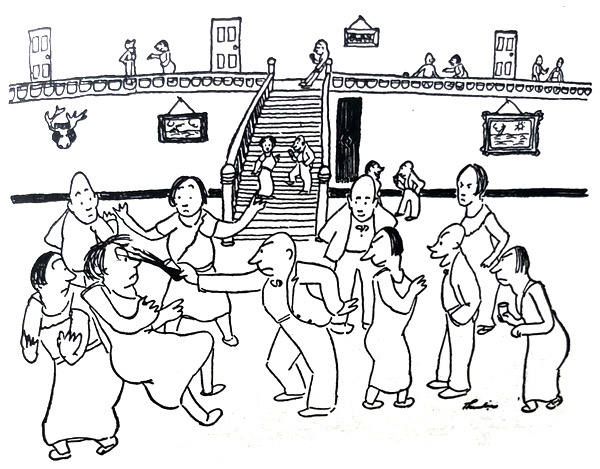
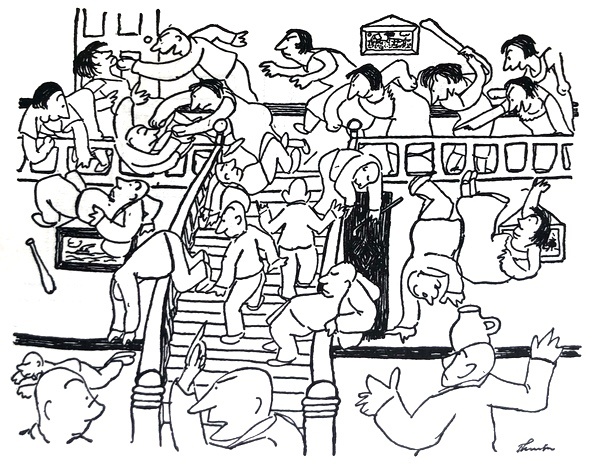
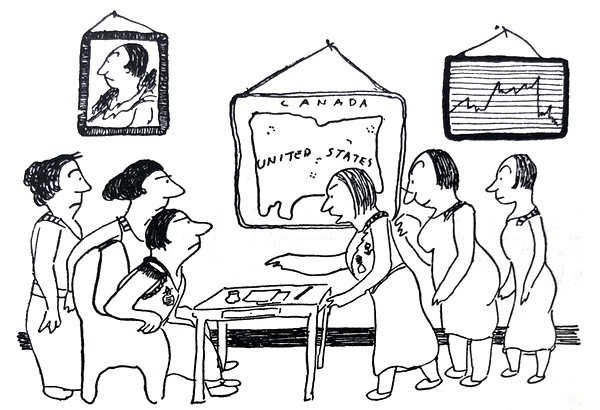
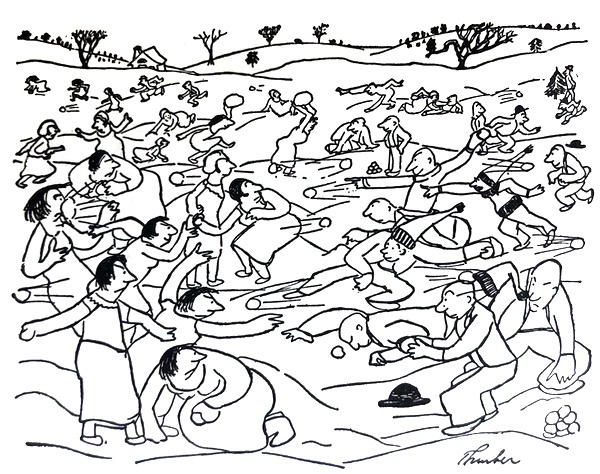
(I have purposely avoided displaying of the final illustration in Mr. Thurber’s series, titled “XVII. Surrender” because it shows the Women surrendering to the Men… which is not only sexist… and unrealistic… but also unfair, because a Man started the whole thing by tossing wine in a Woman’s face. Despite that obvious and grievous error, I highly recommend his book, as a whole.)
Further considering the term, “domestic tranquility” — the desired outcome of the Constitution was probably peaceful relationships between the various States. Good luck with that one, especially these days. Texas and California, for example. They’re acting lately like the Hatfields and McCoys.
We all actually love America. Right?
But we also love Drama. And the essence of Drama, as Michael Shurtleff so accurately points out, is Conflict.
While researching this topic, I came across a curious book on Amazon, titled Stay or Leave: How to remain in, or end, your relationship. Because those are obviously the only two choices. Stay, or Leave.
Speaking for myself, I’d like to remain in my relationship with America, being myself a citizen, and considering the money I spent obtaining a passport, etc.
But also, because — like any red-blooded American — I love Conflict.
The book Stay or Leave was curious, in part, because the Author was listed as “The School of Life”. That might be a person’s name, but it sounds more like an organization. I’m used to reading books written by a person. But times are changing, and we need to change with them.
I enjoyed these two paragraph in particular:
At points, in despair at yet more agonizing uncertainty about whether it would be best to stay in or to leave a relationship, we might find ourselves harboring a curious longing: that the relationship could be even worse than it is. If, for example, our partner had done something obviously and egregiously appalling, if they were cataclysmically unpleasant and we were unable to stand a single minute more in their presence — in short, if we despised them and they us — it would at least be clear what we should do next.
But our situation is typically complicated by a strange set of facts: that we continue to like our partner at times; that we laugh together, that we maintain respect… that they looked very charming the other night, that we think them impressive in company and that they’re superior to ninety-nine percent of the people who cross our path day to day.
As I said, the book is curious. This organization wrote their book from the perspective of human beings who have partners.
And the organization seems to think that people stay together because they laugh together, and find each other charming on occasion.
Wrong.
We stay together because we crave Drama and Conflict. And because our Partner — or our Organization, or our Country of Choice — provides it.

Underrated writer Louis Cannon grew up in the vast American West, although his ex-wife, given the slightest opportunity, will deny that he ever grew up at all. You can read more stories on his Substack account.