
In Part One, we briefly summarized the conversations talking place around a possible 2026 bond election for a new PK-8 school, proposed by the Archuleta School District Board of Education, the ASD Master Plan Advisory Committee (MPAC) and the District’s consultants, Colorado-Springs-based RTA Architects.
The current estimated cost of the bond issue is $218 million. The school is not needed due to increased enrollment, but the District claims its existing Middle School and Elementary School buildings can no longer be affordably maintained.
A different high-dollar tax increase has been proposed by the Pagosa Springs Town Council, through the approval of Ordinance 1014, which placed a new ‘Town-only’ 1% sales tax proposal on the November 4, 2025 ballot. The Town government does not currently collect its own sales tax.
This appears to be the only local tax measure headed for the November 2025 ballot.
The proposed sales tax will be voted on by the Town’s registered voters — a maximum of about 1,450 voters — but the sales tax would be paid by all 14,000 Archuleta County residents whenever they shop within the town limits. The tax would also be paid by 350,000 (?) annual tourists when they shop here or book rooms or vacation rentals within the town limits… and by part-time second-home owners when they visit.
The ordinance was approved by the Town Council on August 19.
The ballot language from Ordinance 1014:
SHALL TOWN OF PAGOSA SPRINGS TAXES BE INCREASED $3,675,692 IN THE FIRST FULL FISCAL YEAR AND BY SUCH ADDITIONAL AMOUNTS AS ARE GENERATED ANNUALLY THEREAFTER FROM THE IMPOSITION OF A SALES TAX OF 1.00% AS SET FORTH IN ORDINANCE NO. 1014, (SERIES 2025); SUCH TAX INCREASE TO BEGIN ON JANUARY 1, 2026, TO:
- CONSTRUCT, RECONSTRUCT, IMPROVE, REPAIR, BETTER, EXTEND, OPERATE AND MAINTAIN SEWERAGE AND WASTEWATER REUSE FACILITIES TO SERVE THE TOWN, INCLUDING FACILITIES OF THE PAGOSA SPRINGS SANITATION GENERAL IMPROVEMENT DISTRICT, AND
- FUND SUCH PURPOSES, SUBJECT TO ANNUAL APPROPRIATION BY THE TOWN, BY PLEDGING THE REVENUES FROM SUCH SALES TAX FOR PAYMENT OF CONTRACTS, LEASES, LEASE-PURCHASE AGREEMENTS, AND BONDS, WHETHER ISSUED BY THE TOWN OR THE DISTRICT
AND SHALL THE TOWN BE AUTHORIZED TO COLLECT, RETAIN AND SPEND THE PROCEEDS FROM SUCH TAX AND ANY INVESTMENT INCOME EARNED FROM SUCH PROCEEDS AS A VOTER-APPROVED REVENUE CHANGE UNDER SECTION 20 OF ARTICLE X OF THE COLORADO CONSTITUTION?
YES: _____
NO: ______
Disclosure: I’m one of the downtown residents who would greatly benefit from a ‘Town-only’ sales tax aimed at repairing and upgrading the Town’s downtown sewer system. I have also publicly offered to help with a future political campaign, to promote a ‘Yes’ vote on the measure.
The Town staff and Council conducted a series of informational presentations this past summer — in person and online — and conducted a ‘non-scientific’ survey prior to approving Ordinance 1014. Now that the measure has been officially scheduled for the November 4 election, designated as ballot measure “2A”, the Town government must refrain from spending any revenues promoting a ‘Yes’ vote.
An independent volunteer committee calling itself ‘Pagosa Sewer Solutions’ has been registered with the Colorado Secretary of State, and has been meeting for the past month to develop a “Vote YES on 2A” campaign.
Currently, our community’s local sales tax is a 4% County sales tax, which is shared 50/50 between the Town and County governments: 2% each. It currently generates about $9 million annually for each government, with each government required to earmark half their annual amount for capital projects.
A Town-only 1% sales tax — collected only within the town limits and not shared with the County — would generate perhaps $3.7 million per year… enough to address, eventually, what the Town has defined as a “$80 – 100 million” sanitation problem, including 5.8 miles of failing sewer lines and a long-range plan to replace the existing pumping system with a new downtown treatment plant. The pumping system, which went online in 2016, sends the Town sewage seven miles, uphill, to the Vista Treatment Plant operated by Pagosa Area Water and Sanitation District (PAWSD). The pumping system has already experienced numerous failures, some of which were potentially catastrophic in terms of polluting the San Juan River.
If the sales tax measure is defeated, the Town reports, an alternative revenue source will be needed. The Town has estimated that municipal sewer customer bills might need to be increased from $71 a month to $200 a month in order to meet Sanitation District needs.
As I wrote previously here in the Daily Post, the sales tax measure, as presented, is not entirely ‘fair’, because the Town Sanitation District — which would be the sole beneficiary of the increased taxes — serves less than 15% of the community’s resident population, plus the downtown businesses, but the entire Archuleta County population would be paying much of the tax.
One potential problem with such a tax is similar to the problem that brought about the famous ‘Boston Tea Party’ and played a role in the American Revolution:
Taxation without Representation

Only businesses located within the town limits would collect and submit that tax. But nearly all of the tax-collecting retail businesses that serve the Archuleta County community are located within the town limits.
The tax would be collected by the Town of Pagosa Springs — not by the Sanitation District — but would be transferred to the Sanitation District for repairs and upgrades…
…to include “wastewater reuse facilities”.
“…OPERATE AND MAINTAIN SEWERAGE AND WASTEWATER REUSE FACILITIES TO SERVE THE TOWN…”
This sentence indicates future plans by the Town to begin “recycling” wastewater effluent for local community uses, such as irrigation of municipal parks. Several communities in Colorado, such as Denver, Aurora, Longmont and Colorado Springs, currently recycle at least some wastewater into potable water.
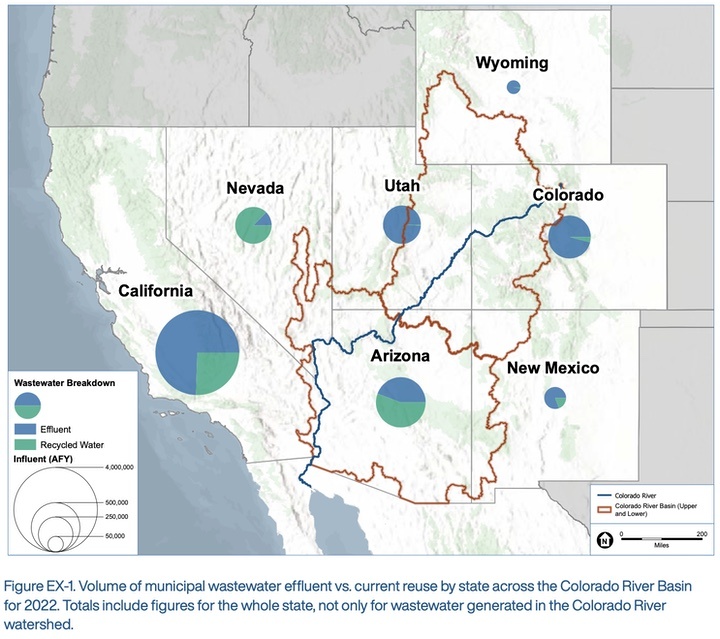
This map indicates that Arizona now recycles more than half its wastewater, and Nevada recycles nearly all its wastewater.
Then we have this language in the proposed ballot title:
“…AND SHALL THE TOWN BE AUTHORIZED TO COLLECT, RETAIN AND SPEND THE PROCEEDS FROM SUCH TAX AND ANY INVESTMENT INCOME EARNED FROM SUCH PROCEEDS AS A VOTER-APPROVED REVENUE CHANGE UNDER SECTION 20 OF ARTICLE X OF THE COLORADO CONSTITUTION?”
According to the Colorado Constitution — specifically, Section 20 of Article X, also known as the TABOR Amendment — governments in Colorado are (theoretically) limited in the amount they can grow their tax revenues, year over year. The stated purpose of the TABOR Amendment, approved by the voters in 1992, was to restrain government growth to keep it consistent with overall economic growth in the state. The above paragraph, if approved by the voters, would allow the Town government to retain all of the revenue it collects from the sales tax, with no TABOR-induced limitations.
As I write this editorial, the only local tax increase measures potentially headed for the November 2026 ballot seem to be the School District bond issue, and possibly an Archuleta County measure to increase the County Lodgers Tax and allow for additional uses of the tax.
More about the potential Lodgers Tax measure tomorrow.