
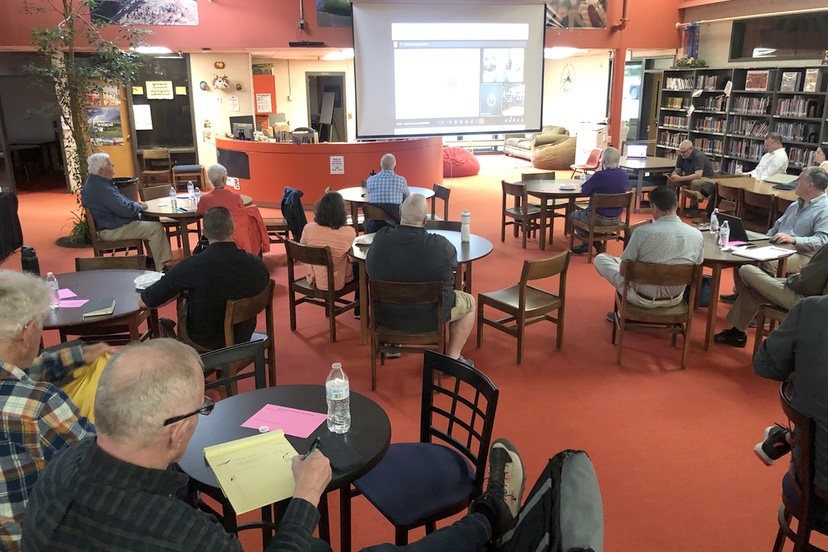
Photo: Archuleta School District MPAC (Master Plan Advisory Committee) hears a report on voter sentiments and potential locations for a potential new PK-8 school, on August 25, 2025.
Based on the discussion I’m hearing at various government meetings and from Colorado news sources, voters might have several options for increasing our tax burden in November 2026,
In Colorado, tax increases must be approved by the voters of the taxing jurisdiction. So governments looking to increase their revenues through higher taxes often start planning a year in advance. But not always. Sometime the campaign period is very short.
The Archuleta School District (ASD) Board of Education made it clear, at a recent gathering of their citizen work group — MPAC, the Master Plan Advisory Committee — that the District doesn’t plan to put a $218 million bond issue in front of the voters this coming November. But they seem intent on doing so at the November 2026 election instead.
So we have that to look forward to.
Disclosure: I currently serve as a volunteer on the Pagosa Peak Open School board of directors, and it’s possible that PPOS could benefit from a future ASD bond issue. I have also participated in the MPAC meetings. But this editorial reflects only my own opinions, and not necessarily the opinions of the PPOS board, staff, or community, nor of the MPAC committee.
That recent MPAC meeting also made it clear that the ASD Board of Education is not interested in upgrading and improving its existing buildings to make them last another 50 years, at which point they would be about the same age as my downtown house is today. (125 years old.)
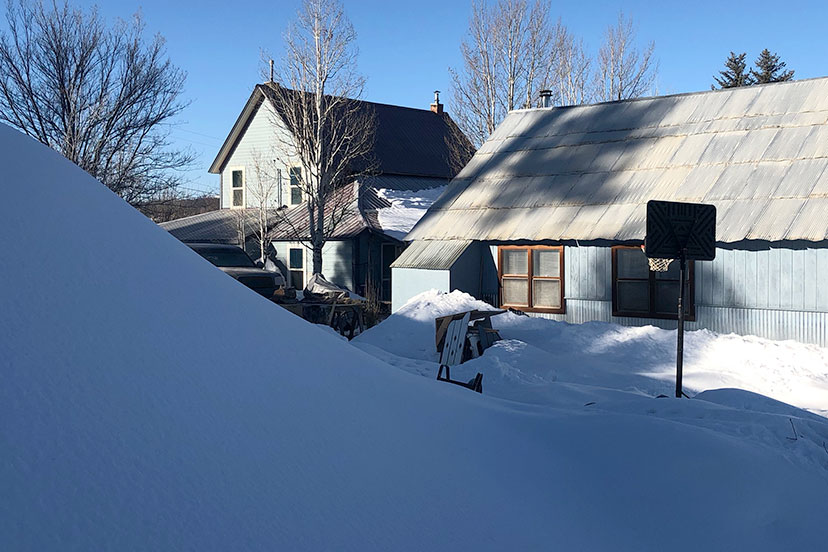
Such upgrades and improvements to our existing buildings would — by my calculations — cost $100 million less than constructing a brand new school building. So we don’t have that option to look forward to.
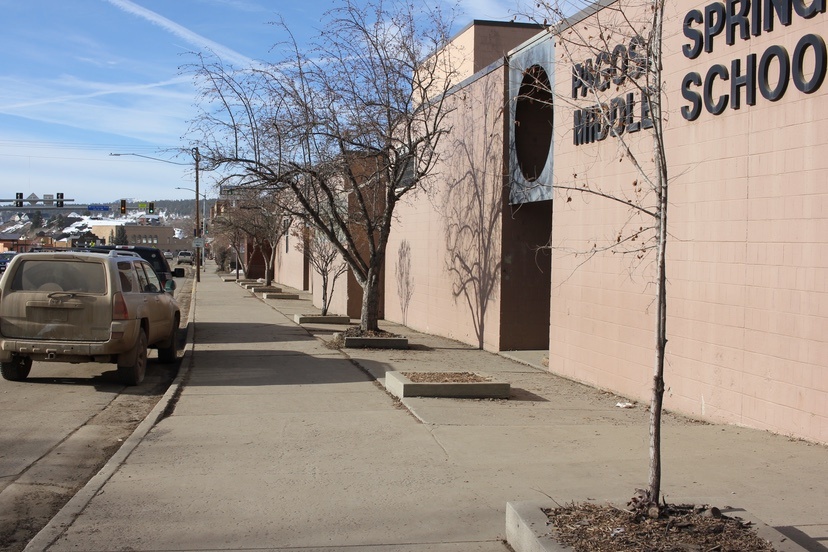
When I attended high school in Oakland, California, my high school building was about 70 years old — the approximate age of the Pagosa Springs Middle School — and was attractive and functional, but engineers determined that it might not withstand the next California earthquake. (A portion of a nearby double-decker freeway had collapsed during a previous earthquake.) The new high school was, in my humble opinion, modern and safe, but ugly.
We don’t have regular earthquakes in Southwest Colorado, and no one has claimed that the Pagosa Springs Middle School and the Pagosa Springs Elementary School are structurally deficient, except for what might be termed “deferred maintenance”. Both schools recently received new roofs, and ASD has spent considerable money improving safety and security at both schools. A lot more could be done for $20 million, if the voters were willing to approve a bond in that amount.
Instead, the School Board is considering a new PK-8 school, to replace both the Middle School and Elementary School, to include a new preschool, at a cost of perhaps $123 million. The location for the proposed school is still under discussion, as well as its design.
At the MPAC meeting on August 25, Superintendent Rick Holt noted that about 67 percent of the district’s students live uptown, west of Piedra Road, so the location ultimately proposed for a new school might play into how people vote on a bond issue. The two locations discussed were: on the same campus as the Pagosa Springs High School at the south end of downtown… and at the currently-vacant 37-acre ‘Vista property’ on Vista Boulevard, near the west end of the uptown area. ASD already owns both potential sites.
A $123 million bond would actually cost the taxpayers about $218 million, when we include the interest payments on the loan. The bond would be repaid through increased property taxes.
To get a sense of how construction costs have increased for government projects in the 21st century, the Pagosa Springs High School, including a new community auditorium, sports fields, and a massive parking lot, cost about $12 million in 1997, with a bond repayment cost of about $26 million.
The District is not experiencing enrollment growth, and demographic projections for Pagosa Springs are predicting enrollment declines in the future, as more families choose educational alternatives, and as the local housing crisis continues.
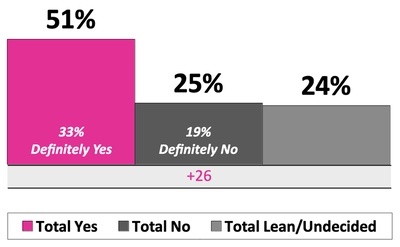
As noted, the School Board has decided not to put this project before the voters this coming November. Part of the reason for their reluctance came from a recent survey of 300 families this past summer, indicating limited support for such a bond issue. About 51 percent of surveyed voters, a “bare majority,” indicated that they might “vote yes” to support the potential project. About 25 percent of respondents indicated a “no” vote, and 24 percent were undecided.
Only 33% stated they would “definitely vote yes”.
Here’s the language presented to the survey respondents:
SHALL ARCHULETA COUNTY SCHOOL DISTRICT #50JT DEBT BE INCREASED $123 MILLION, WITH A TOTAL REPAYMENT COST OF NOT MORE THAN $218.2 MILLION (PRINCIPAL AND INTEREST), TO FINANCE CAPITAL ASSETS AND IMPROVEMENTS OF THE DISTRICT, INCLUDING BUT NOT LIMITED TO:
ADDRESSING STUDENT AND STAFF SAFETY IN THE ELEMENTARY AND MIDDLE SCHOOL BY BUILDING A NEW K-8 BUILDING;
AND SHALL THE SPENDING OF THE DEBT PROCEEDS BE MONITORED BY A CITIZEN’S BOND OVERSIGHT COMMITTEE;
AND SHALL DISTRICT TAXES BE INCREASED NOT MORE THAN $8.73 MILLION ANNUALLY TO PAY SUCH DEBT, AND MAY THE MILL LEVY BE IMPOSED IN ANY YEAR WITHOUT LIMITATION…
You can download the Powerpoint slide show summarizing the survey results, here.
According to my pocket calculator, this amount — $8.73 million — is roughly equal to $625 per Archuleta County resident, per year (about 14,000 residents). Or $1,250 per couple, per year. As noted, the bond would be repaid through a property tax increase.
Another possible reason for putting off the election until a later date? An uncertain outlook for the American economy.
The District will no doubt refine their designs and increase their community outreach over the coming school year, in hopes of generating more support in the community.
But don’t get too relaxed. This is not the only possible tax increase on the horizon.
On August 19, the Pagosa Springs Town Council approved Ordinance 1014, placing a new Town-only 1% sales tax on the November 2025 ballot, to be voted on by voters living within the town limits — about 1,340 active voters, about half of whom are registered as Unaffiliated. Town ballot measures and elections often attract fewer than 600 voters.
The sales tax would be in addition to the existing 6.9% sales tax, and would be paid by anyone shopping within the town limits, or staying in lodging within the town limits. All the community’s grocery stores, and nearly all the community’s retail businesses are located within the town limits, as are most of our motels and resorts. It would also be paid by town residents when they shop online.
Most vacation rentals are outside the town limits, and thus would not be subject to the additional sales tax.
More about this sales tax proposal in Part Two.
Bill Hudson began sharing his opinions in the Pagosa Daily Post in 2004 and can't seem to break the habit. He claims that, in Pagosa Springs, opinions are like pickup trucks: everybody has one.