
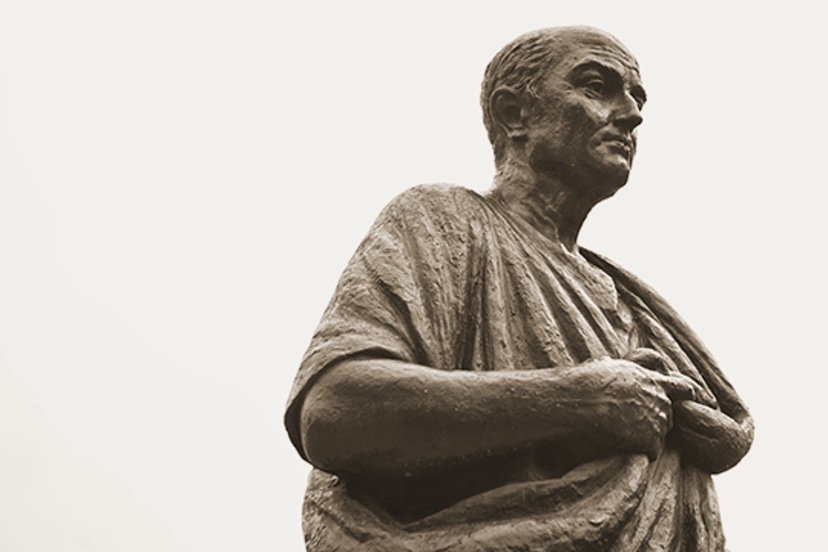
Photo: Roman philosopher and playwright Lucius Annaeus Seneca the Younger, when he was older.
The majority of mortals, Paulinus, complain bitterly of the spitefulness of Nature, because we are born for a brief span of life, because even this space that has been granted to us rushes by so speedily and so swiftly that all save a very few find life at an end just when they are getting ready to live…
— from ‘De Brevitate Vitae’ by Lucius Annaeus Seneca the Younger, 49 AD.
While I was reading excerpts from a letter written 2000 years ago, a tiny spider came dropping down from the ceiling, near my desk.
A momentary distraction from some important research.
I managed to redirect the spider — through clever use of a sheet of cardboard — into the garden outside, where the opportunities to live a long spider life were perhaps more numerous. But who can say, really, which life is more meaningful? Life indoors, hanging from the ceiling? Or life outdoors, hunting in the garden?
I’ve basically chosen life indoors — not hanging from the ceiling, but rather, sitting at a desk, hovering over my keyboard. Maybe a poor choice?
The excerpts under consideration on Saturday morning, prior to that momentary diversion, were from a translation of ‘On the Shortness of Life’ by Roman philosopher and playwright Lucius Annaeus Seneca the Younger, better known by the shorter version of his name, ‘Seneca’.
Life is short, so why waste time with a long name?
We must presume that Seneca did not know how short his life would be, when he wrote this letter to his friend Paulinus in 49 AD, when he was 53 years old. Apparently, he later got on the wrong side of Roman Emperor Nero Claudius Caesar Augustus Germanicus, better known simply as Nero.
Seneca had been hired as Nero’s tutor, and apparently taught Nero how to use the shorter version of his name. Later, when Nero became emperor, Seneca served as Nero’s trusted advisor, only to be accused of participating in a treasonous conspiracy and forced to commit suicide. Nero seemed to reap a certain pleasure from causing the deaths of the people closest to him.
For some reason, this story makes me think of Jeffrey Epstein. But that’s fodder for another day. If I live long enough.
Many years before committing suicide, Seneca had written long letters to his friends and political colleagues, including De Brevitate Vitae, translated as ‘On the Shortness of Life’. In the English translation, the letter is about 12 pages long. Apparently, people had time to read long letters, back then, regardless of the shortness of their lives.
From the letter:
It is not that we have a short space of time, but that we waste much of it.
That pretty much summarizes his 50-page letter. Along the way, Seneca notes the famous people (Romans, in his case) who complained about being too busy and wishing they could get off the treadmill and retire to the countryside.
You will see that the most powerful and highly placed men let drop remarks in which they long for leisure, acclaim it, and prefer it to all their blessings.
Roman Emperor Augustus, who apparently also kept his name short, held a god-like position in the minds of Roman citizens — Seneca used the word “deified”. This was back in the days when there were still a large number of gods, so being god-like was not such a big deal.
The deified Augustus, to whom the gods vouchsafed more than to any other man, did not cease to pray for rest and to seek release from public affairs; all his conversation ever reverted to this subject — his hope of leisure. This was the sweet, even if vain, consolation with which he would gladden his labors — that he would one day live for himself.
Seneca shared other stories of wealthy oligarchs and politicians who had nothing better to do than extract taxes from the Roman citizens to finance foreign wars. But all the while, these prominent men (and their equally conniving wives) were dreaming about abandoning the rat race and soaking up the sun on a Mediterranean beach.
But Seneca was equally critical of people who worked too hard at doing very little.
They are not unoccupied, whose pleasures are made a busy occupation. For instance, no one will have any doubt that those are laborious triflers who spend their time on useless literary problems, of whom even among the Romans there is now a great number.
This is where I started to take things personally. I work daily at solving literary problems, the main problem being, how to find a subject for my next humor column without resorting to fart jokes.
I don’t consider my work “useless” even if other people might. And for Seneca to describe me as a “laborious trifler” is downright insulting.
I certainly don’t want to compare myself to Seneca — despite of the obvious temptation — but I have never even thought about writing a 50-page letter on the subject of “The Shortness of Life”. I generally like to keep my columns to about 600 words.
If you can’t get a couple of chuckles out of 600 words, you’re not likely to get any out of a 12-page essay.
Like the man said, life is not necessary short, but humor columns ought to be.
But everything in perspective. That little spider I dropped into the grass outside will likely live, at most, two years. Seneca lived 35 times that long. Life only seems short, if you spend all your time complaining about how short life seems.
Underrated writer Louis Cannon grew up in the vast American West, although his ex-wife, given the slightest opportunity, will deny that he ever grew up at all. You can read more stories on his Substack account.