

As Americans become more polarized, even family dinners can feel fraught, surfacing differences that could spark out-and-out conflict. Tense conversations often end with a familiar refrain: “Let’s just drop it…”
— from “Agreeing to disagree is hurting your relationships” by Lisa Pavia-Higel on TheConversation.com, April 2025.
My family dinners rarely feel fraught, because it’s usually just me and my cat, Roscoe. And he eats on the floor.
When my kids visit during the holidays — assuming they visit at all — the conversation can get a little more dicey. But we’ve gradually become familiar with the topics that can, in words of Professor of Communications Lisa Pavia-Higel, “spark out-and-out conflict.” And all it takes is a spark.
A family or a couple usually knows where the particular spark plugs are located. In some cases, it’s politics, or religion, or body image, or public education.
Or, if you washed your hands after cutting the raw chicken.
In my own family’s case, we carefully avoid discussing the U.S. military invasion of Panama in 1989. We’ve agreed to disagree on that one. But pretty much everything else is fair game.
Vaccines, for example. We can argue about that one for hours on end. Also, handwashing.
Apparently, arguing for hours is good for relationships. It’s much worse when you “agree to disagree”, and stop talking. That’s the start of a downward spiral.
But there’s also an upward spiral in relationships, as I learned from Ms. Pavia-Higel’s article. She shared a model of relationship development developed by Mark L. Knapp — who happens to be a Distinguished Teaching Professor Emeritus at the University of Texas at Austin. But I don’t hold that against him.
Actually, the ‘upward spiral’ is more like climbing stairs, an exercise that I understand is actually good for your health. I came across this ‘stairway’ graph, below, in a different article about Knapp’s ‘Relational Development Model’.
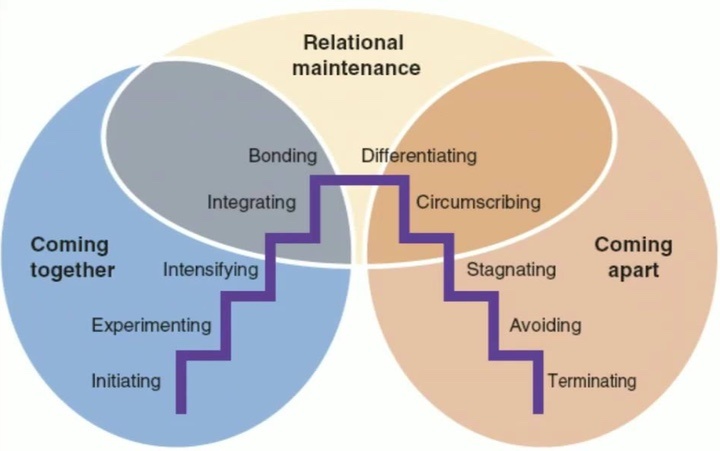
First you climb the stairs to reach the stage of “Relational maintenance” which is similar to “Car maintenance” but slightly different. The first step is called, innocently enough, “Initiating”.
Initiating
Your relationship — with a person who might, for example, someday end up as your ex-wife — starts at the bottom left. But you don’t yet know that a relationship has begun. In fact, you have just seen her for the very first time. She’s a server in the cafeteria at the college you are attending, and she asks if you’d like some macaroni and cheese. You don’t, in fact, want any macaroni and cheese, but the way she talks and the way she looks causes you, for some reason, to ask for a large helping.
During the Initiating phase, you form a ‘first impression’ of the person, which will ultimately prove to be wildly inaccurate.
For another example, I will mention my first meeting with my cat, Roscoe. He showed up at my back door on a rainy evening, dripping wet and looking like he hadn’t eaten in weeks. (This was actually an illusion. Cats look really skinny when they’re wet.) I had no idea that we would be entering into a long-term relationship when I offered him a bowl of leftover macaroni and cheese.
Just to clarify, I had slowly developed an appreciation for macaroni and cheese. Roscoe, meanwhile, had not.
Experimenting
This second step in Knapp relational staircase involves sharing information with your new acquaintance, like “How long have you been working in the cafeteria?” You know, small talk. You should not jump right in and ask what she thinks about the U.S. military invasion of Panama in 1989. That will come much later, or maybe not at all.
You can skip this step if your new friend is a cat.
Intensifying
If the two of you have been able to pull off the small talk successfully, you might then decide to intensify the relationship by sharing your phone numbers, for example, or maybe asking her out for coffee. You don’t want to get too serious yet. You’re still ‘testing the waters’, so to speak, but you’re beginning to suspect that the water is just fine. You will not hold hands until the next step.
If your friend is a cat, you might start offering IAMS Perfect Portions instead of Friskies. And he might start rubbing up against you leg.
The next two steps — Integration and Bonding — carry you up to the top of the staircase, where it becomes clear to everyone that you’re more than just ordinary friends, and they start predicting how long you can possibly stay together. Because they know what’s coming.
In the Knapp model, these top two steps require “Relational maintenance”. In other words, the real work has begun. No more goofing around.
But you’ve also reached the place where everything can start to go downhill. And believe me, they probably will.
In the Differentiation phase, you realize that she never really liked watching football with you, and you also discover that the two of you feel quite differently about how many pairs of shoes a person needs.
Then you begin to experience Circumscribing. You start to avoid talking about certain subjects (football, shoes, etc.) and the ‘maintenance’ feels more like a chore.
At the third downward step, Stagnation, what were once ‘patterns’ in the relationship have become ‘ruts’ and maintenance has fallen by the wayside. You basically stop talking because you already know what she’s going to say, and vice versa.
If your partner is a cat, you will probably go back to serving Friskies.
Next comes Avoidance, and we all know what that means. You have to work late at the office, even on weekends.
And then, the last step, Termination.
But you don’t have to take a painful tumble down the stairs like this, according to Ms. Pavia-Higel. When you find yourself entering the Circumscribing phase and it becomes challenging to talk about certain topics, you can probably save the relationship if you both learn a couple of useful communication techniques called “looping” and “reframing”.
Looping involves repeating back to your partner what you think she means, even if it really makes no sense. Deep down, what your partner wants most is to be ‘heard’, and looping helps you to convince her that you were actually listening.
Once you convince her that you understood what she was saying, you can then “reframe” the conversation by finding any areas of agreement hidden in the disagreements. This can sound something like this:
“We both agree that you should protect your feet, and shoes are useful for that purpose…”
Once you find the areas of agreement, good luck talking some sense into her.
Underrated writer Louis Cannon grew up in the vast American West, although his ex-wife, given the slightest opportunity, will deny that he ever grew up at all. You can read more stories on his Substack account.