
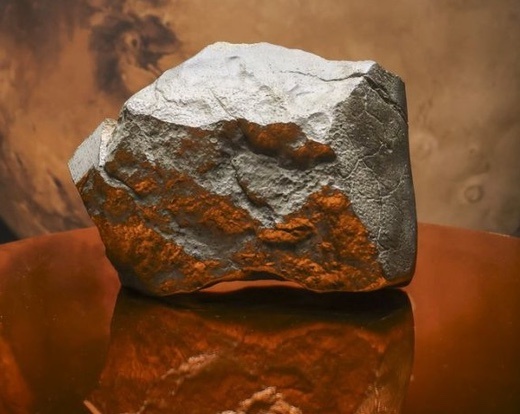
It looks an awful lot like an ordinary rock. And it’s not even an especially large rock. It weighs about 54 pounds, and measures 15 inches across.
I have some rocks in my back yard that look quite similar, but are twice as big.
But apparently, someone wanted this rock badly enough to pay $5.3 million for it. The original bid was $4.3 million, but with fees and additional costs, the total price of the rock increased to $5.3 million, according to the auction house known as Sotheby’s.
The Lamestream Media jumped all over the story, not because the rock was especially beautiful or anything, but because the rock came from Mars. Allegedly.
The rock was found in the Sahara Desert, in the Agadez region of Nigeria, by an unnamed “meteorite hunter,” in November 2023. Allegedly.
But it was postmarked “Mars”.
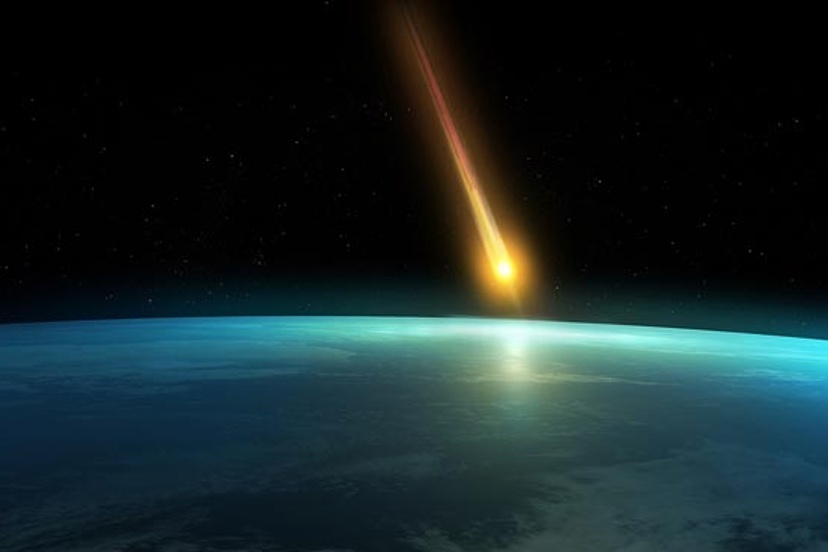
Based on my knowledge of the Solar System and astrophysics — which I studied pretty thoroughly in fifth grade — I have no doubt that the rock appeared to be out of place, sitting there in the middle of the desert. And quite probably, it fell out of the sky, because… well, why else would it be there?
Rocks do occasionally fall out of the sky. We can see them falling on a clear night. Meteors, streaking across the sky, sometimes more than a dozen per hour. Most meteors “burn up” before they reach the earth due to atmospheric friction, but very occasionally they reach the surface and become “meteorites”. For a “meteor” to become a “meteorite” is sort of rare. Like a fifth grader eventually getting his PhD in astrophysics.
About 95% of the meteorites that land on earth contain olivine and pyroxene, along with metallic iron and nickel, and maybe a smattering of iron sulfide. Or so the scientists tell us.
Where do all these meteorites come from? God only knows. We know that there’s a bunch of rocks of various sizes orbiting the Sun in what they call “the Asteroid Belt” — literally millions of rocks of various sizes. Maybe billions.
Trillions, if you counted the smallest grains of sand.
Anyway, someone decided that this particular $5.3 million rock came from “Mars”. A scientist, apparently. Maybe a well-paid scientist? If I was a scientist (which I’m not) and someone handed me a rock found in the Sahara Desert, and said, “Can you verify that this rock came from Mars? You will be well paid for your opinion…” I would probably do my best to accommodate them. But scientifically, of course.
Not that I’m a science whore or anything like that. I would accurately compare the composition of this particular meteorite with other meteorites that allegedly came from Mars. Because there are lots of meteorites that people have found lying around, that allegedly came from Mars. About 400 of them, in fact. Or so the scientists tell us.
A scientific analysis determined that the Mars rock contained olivine, just like 95% of the the 77,000 meteorites officially recognized by scientists. But it might have actually come from Mars. On the other hand, it’s a big universe out there, and rocks seem to be flying long distances. Who knows if it’s actually from the Andromeda Galaxy?
How much would that be worth?
When I went looking for ‘scientific proof’ that the $5.3 million rock came from Mars, I naturally did a Google search and was presented with 421 news reports that told basically the same story. Recently — the news stories say — an asteroid must have crashed into Mars and thrown up lots of rocks in the explosion, and a piece of that explosion traveled across space and time to land in Nigeria… got analyzed by scientists… was put on display in Italy… and then got sold for $5.3 million at a Sotheby’s auction. (Including the fees.)
Only one of those 421 stories bothered to ask the question, “Is this a $5.3 million scam?”
I find it curious that well-paid scientists can tell us that a 15-inch rock came from Mars, but they can’t tell us where the COVID virus came from.
Underrated writer Louis Cannon grew up in the vast American West, although his ex-wife, given the slightest opportunity, will deny that he ever grew up at all. You can read more stories on his Substack account.