

Photo: Jeremy Bentham’s ‘Auto-Icon’ at University College London. Courtesy Philip Stevens.
Students entering The Student Center at University College London have the opportunity to hang out and do homework under the watchful eye of the world’s one and only ‘Auto-Icon’ — an actual man’s skeleton augmented with appropriate padding and dressed in 19th century clothing… and topped with a realistic wax head. The skeleton once belonged to English philosopher Jeremy Bentham, as did the clothing, the cane he holds, and the chair on which he sits.
Perhaps, in a sense, the skeleton still belongs to Mr. Bentham? It’s all a question of ownership, I suppose.
Jeremy Bentham died in 1832, at the ripe old age of 84. During his lifetime, his activism and writings, as a respected philosopher and social reformer, had a limited but possibly measurable influence on English culture and politics. He advocated individual and economic freedoms… the separation of church and state… freedom of expression… equal rights for women… and the abolition of slavery, capital punishment, and physical punishment of children. He was an early advocate of animal rights.
You might say, he was 200 years ahead of his time.
The animals are still awaiting their rights, however.
Weeks before he died, he wrote a new will. He wanted to be dissected, and he left instructions that his good friend, Dr. Thomas Southwood Smith, should wield the scalpel.
Following the dissection, Dr. Southwood Smith was to initiate the conversion of the remaining skeleton into an “Auto-Icon”.
“The skeleton he will cause to be put together in such a manner as that the whole figure may be seated in a chair, usually occupied by me when living, in the attitude in which I am sitting, when engaged in thought in the course of time occupied in writing.”
Additionally, he wanted his head to be properly mummified and attached in the appropriate location. The mummification effort was, however, a failure, and the head was instead sculpted out of wax, with some of Mr. Bentham’s actual hair attached.
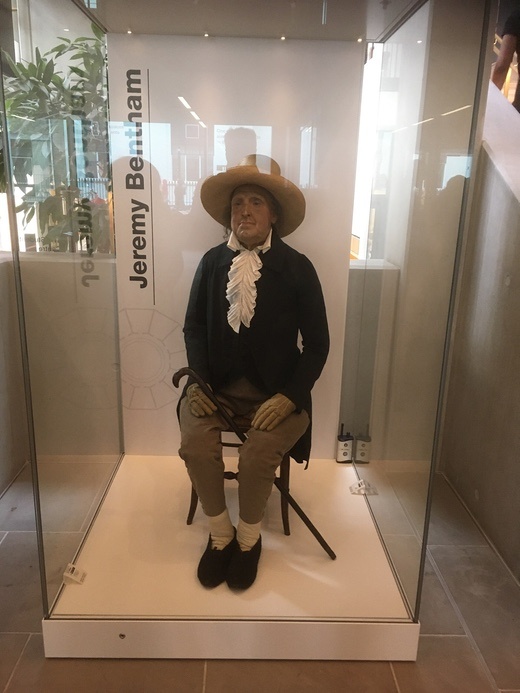
Speaking as a fellow writer, I fully understand why Mr. Bentham would want to be displayed “when engaged in thought in the course of time occupied in writing.” There are a number of more awkward positions a writer finds himself in, occasionally, that might not be suitable for display in a university setting. But I’m surprised to see that Mr. Bentham normally wore a broad-brim hat and a jacket with tails, while occupied in writing. I’m normally in my pajamas.
Mr. Bentham had also composed a lengthy essay, explaining why everyone should, in the future, be assembled into a similar “Auto-Icon” upon their death, rather than being buried in a grave somewhere. For one thing, this would provide the medical profession with an endless stream of corpses for dissection and training purposes — something in terribly short supply in Mr. Bentham’s day.
In his essay, Auto-Icon, or Farther Uses of the Dead to the Living, Bentham wrote, “If a country gentleman has rows of trees leading to his dwelling, the auto-icons of his family might alternate with the trees; copal varnish would protect the face from the effects of rain.”
Alas, the idea didn’t catch on, and to this day, Mr. Bentham is apparently the only “Auto-Icon” in existence. It’s somewhat painful to consider the number of English estates that could have been decorated with preserved skeletons lining the driveway.
At any rate, Mr. Bentham’s Auto-Icon continues to play a role in the lives of the University College London student body. Some users of the UCL Student Center pass the glass case without paying Mr. Bentham any mind, but others treat the Auto-Icon reverently, as a sort of educational altar.
According to Liz Blanks, the curator of UCL’s Science Collections:
“[Students] make a pilgrimage to the Auto-Icon in some cases, and actually ask for good luck on their exams. Sometimes we even find lipstick marks on the case as well, where people have kissed the case that he’s inside.”
We will note that Mr. Bentham never married, so who knows if he gets a little thrill out of the lipstick marks.
I’ve often thought about how I want my body handled, once I’ve shuffled off this mortal coil. Although dissection holds a certain attraction, I think I would prefer to be used as a crash-test dummy. Just seems more exciting.
Underrated writer Louis Cannon grew up in the vast American West, although his ex-wife, given the slightest opportunity, will deny that he ever grew up at all. You can read more stories on his Substack account.