
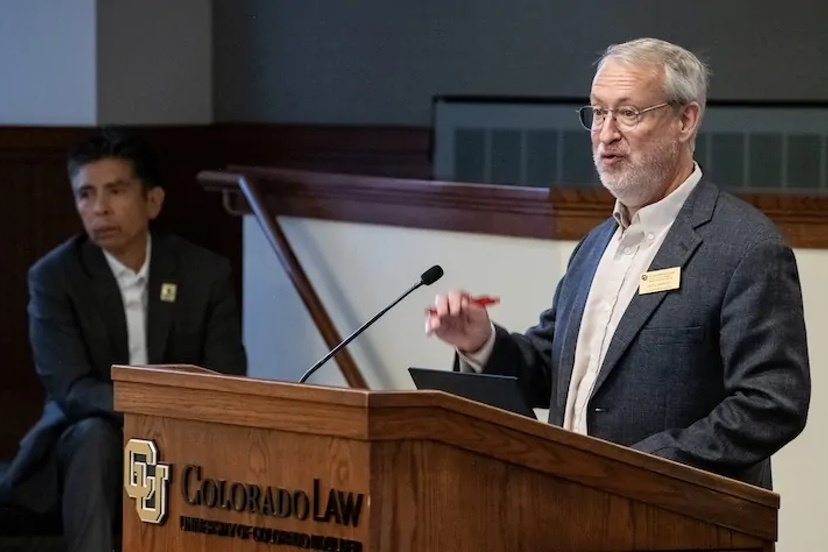
Photo: Doug Kenney speaks at the 2025 Getches-Wilkinson and Water & Tribes Initiative for the 2025 Conference on the Colorado River as Daryl Vigil, co-director of the Water & Tribes Initiative, awaits his turn at the lectern. Photo/Getches Wilkinson Center.
This story by Allen Best appeared on BigPivots.com on June 30, 2025. We are sharing it on two parts.
Some 92% of all the water in the Colorado River originates in the upper basin states.
When there’s insufficient water, the state engineer in Colorado and his district engineers cut off water users, mostly ranchers irrigating grasses.
The compact struck among the four-upper basin states in 1948 used a more common-sense approach for how to allocate the 7.5 million acre-feet allotted in the 1922 compact. It allocated the water among the four states based on proportions. Colorado gets a little more than half — and uses most of it. Wyoming has never come close to developing its share. Regardless, the rule of percentages makes sense for an uncertain hydrology.
“We realized real quickly that Mother Nature reigned supreme,” said Mitchell. “I would be in big trouble if I said the lower basin should do the same. I think they should, but they’re not there yet.”
Mitchell used an analogy to describe the difficult transition for the lower basin.
“It is much harder to take candy from a baby after they have it,” she said.
“It’s going to be hard for them, and my heart goes out to them. But we have an example up here of how it works. Seniors work with juniors,” she explained, using the shorthand for senior and junior water uses under the prior appropriation system governing water use in Colorado and most Western states. Ag works with environment interests, utilities with agriculture, and so on. They cut deals in advance of water-short years.
“We have examples of how to make it work. You have a budget. You have to work within it. That’s the deal. And sometimes that budget might fluctuate.
“We’ve not lost all of our junior water-right holders in Colorado because of one bad year or two bad years or three bad years, in a row, because we figure out how to make it work. And what we are saying to the lower basin is figure out where the deals are to be made.”
And she drew upon her childhood for another dynamic.
“What my mom always said is, you can have anything you want, but you can’t have everything you want.”
Translated to the lower basins, that means “you can’t have chip factories and the largest agriculture in the world and golf courses and pools and Scottsdale and whatever. You can have the capability to have a strong economy, a sustainable system. You just can’t have it all.”
The Federal Role
The federal government, through the Bureau of Reclamation, an agency housed within the Department of Interior, built the dams. Reclamation manages the dams. As Mitchell said, they turn the spigots. The onus is on the states to create a solution, an agreement of how to share the shrinking river, but the federal government could step in, if forced to.
Mitchell said the feds don’t want to.
“They really want a consensus deal with the seven states,” she said. That’s a hard thing, because there’s no way to do this without change. The math is the math. The facts are the facts. There’s not the 50 million acre-feet in these reservoirs that there were when these (2007) guidelines started. And so the consensus is harder.”
Mitchell said she wouldn’t disparage those who created the now obviously flawed 2007 guidelines. Climatologists had suggested only a 3% probability of the runoff that has happened since then would come to pass.
“What we’re trying to create through this federal process is something that can handle all the hydrologies. How do we all suffer when the river is suffering? How do we all benefit when the river is flush? And what does benefit look like? That’s different in the upper basin than in the lower basin.”
The federal government in this case has been nudging the states toward agreement.
“They’re trying to say, ‘You know, you might be able to open up different project funding if you guys can get to a deal.’ We know we need a deal. I’m not going to promise you that we’re going to get there, but it is a goal. And (the federal agencies) are part of that goal. They don’t want to make the hard decisions of cutting people off. They are the water masters in the lower basin. They can turn the valves, and that’s their role.”
Added Kenney: “Typically the states are happiest when the federal government is silent, (but) sometimes it’s helpful to have a federal government that is throwing out some ultimatums and some deadlines and some threats.”
In the last six months, the federal involvement in the negotiations has grown, and it might grow more yet. But a big part of the process — as Mitchell had said — is that the states need to be coming up with their wish list for Congress for consideration next spring.
“So there is a federal role,” Kenney summarized. “It evolves based on how the states are doing. But the tradition is, you want the feds to stay away until it’s time for someone to write the check.”
MItchell had the last word. She again pointed to the meager runoff from this year’s upper-basin rivers, source of 92% of the river’s water. Runoff is projected at a little more than 5 million acre-feet into Powell, which is to release 7.48 million acre-feet to the lower basin.
Again, it’s a match problem. And it could get worse.
“If next year looks anything like this year, or even as a 12 million acre-foot river, actions absolutely have to be taken, and those actions are going to be greater than anybody has put on the table voluntary.”
Tribal water rights
The Colorado River Basin has 30 federally recognized tribal nations, most in Arizona and California. Colorado has two, the Southern Utes and Ute Mountain Utes. The other upper-basin states have four others.
Under the Winters Doctrine of 1908, the Supreme Court ruled that when the federal government forced native Americans onto reservations, the guarantee of water rights was implicit. By that reckoning, about 25% of the total water in the Colorado River belongs to the 30 tribes. Only a few have made full use of that water.
“How will those water rights factor into the post-2026 negotiations?” Mitchell and Kenney were asked.
“I’m taking that one,” responded Mitchell. She pointed to work in the upper basin through a memorandum of understanding that allows them to develop the settled but undeveloped rights.
“We’re working with them to figure out how to have that water acknowledged in some way, and if they’re choosing not to develop it at this time, so that there’s some recognition of that.”
She added: “I’m not going to tell you that we have an answer yet, but I’m going to tell you it’s one of the highest priorities.”
Kenney offered a few nuances, pointing to the statement that Daryl Vigil, who is from the Apache tribe in northern New Mexico and represents a coalition of 10 tribes, always uses at the front end of his comments at conference: “If you know one tribe, you know one tribe.”
While the tribes will say that the negotiating table should have 37 seats, because they all represent sovereign governments, “in practice it’s completely unmanageable,” said Kenney. Add in Mexico and federal government, and there are 39 seats
“By and large, the tribes will tell you that they don’t think what’s happened to this point has been anywhere near adequate. I personally have to agree with that,” added Kenney, “But by the same token, it’s not at all obvious what the better approach is. So we muddle along, as we do in public policy processes.”
Kenney said Arizona’s negotiator, Tom Buschatzke, has the toughest job among the state negotiators.
“If there’s an agreement among the seven states, in Arizona you have to take that back to the legislature for approval, whereas the process in the other six states is simpler — not that it’s simple anywhere.”
Negotiators, he explained, have to balance all the different nuances in their states and then return to the negotiating table. “This is an incredibly difficult job.”
Kenney also drew attention to Nevada, which has the smallest apportionment of all seven states, just 300,000 acre-feet, a reflection that Las Vegas in 1922 was a very, very small town. Now, the population of metropolitan Las Vegas pushes 2.4 million.
Every other state has agriculture, and Las Vegas — the sole beneficiary of Colorado River water in the state — does not. That’s unlike Colorado or Arizona, which have both agriculture and urban populations, with some flexibility of supplies. On the other hand, Las Vegas gets 90% of its water from the Colorado River, with the remaining 10% from groundwater.
This was in Crested Butte, so of course there was the question about tension between the Front Range and the Western Slope, the headwaters of the Colorado River.
“I am here to protect all of Colorado, and we have to stand together as a state if we are to stand a chance,” responded Mitchell.
“There are going to be times for battle within our own states. There are going to be times for issues between the upper-basin states. Now is not that time, please.”
Allen Best publishes the e-journal Big Pivots, which chronicles the energy transition in Colorado and beyond.