
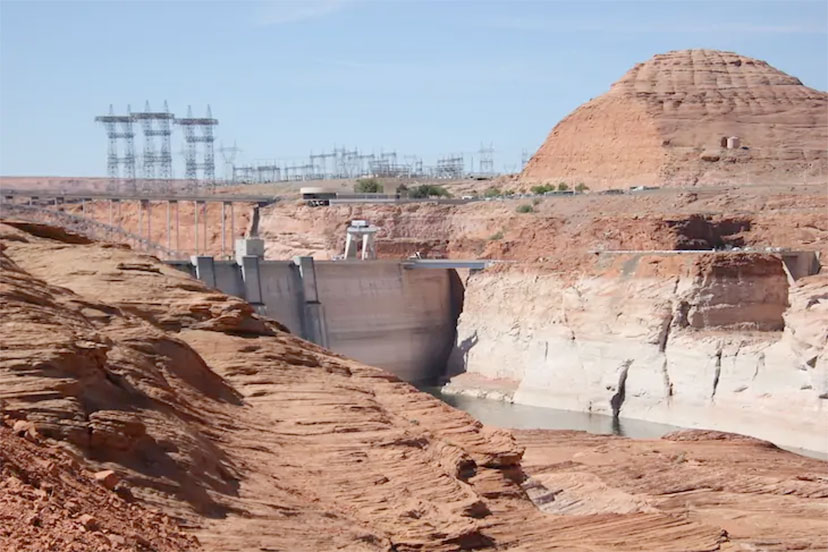
Photo: In May 2022, Lake Powell had dropped to the lowest levels since the 1960s, when it began filling after construction of Glen Canyon Dam. Photo/Allen Best.
This story by Allen Best appeared on BigPivots.com on June 30, 2025. We are sharing it on two parts.
The apple cart of the Colorado River has been upset for 25 years, and Doug Kenney and Becky Michell were on stage June 24 at the Crested Butte Public Policy Forum to talk about the bruised apples.
There’s broad understanding that what worked in the past won’t work in the future. As to what will work — ah, well, that has yet to be resolved.
“So far, we haven’t really been able to pull the demands down as quickly as supplies have been going down,” said Mitchell.
Adding tension to the conversation is another so-so or worse spring runoff in the river. Despite a decent snow year in northern Colorado, yet another early, warm and mostly drier-than-usual spring has produced an anemic projected runoff of a little over 9 million acre-feet. Average runoff into Lake Powell has been 12 million in recent years. The compact governing the river between the three lower-basin states and the four upper basin states assumed at least 20.
Kenney directs the Western Water Policy Program at the University of Colorado Boulder’s Getches-Wilkinson Center. The program puts on a conference each June that is considered one of several must-attend events for those drawn to the unceasing drama about Colorado’s namesake river.
The river and its tributaries provide water for farms almost to Kansas and Nebraska and, on the west side, to 23 million people crowded along the Pacific Ocean in southern California.
In Crested Butte, Kenney said that unlike other people in Colorado River discussions, whether they represent environmental or agriculture organizations, he enjoys a rare freedom. “I tell people sometimes, I don’t have a dog in the fight, and by that, I just mean I don’t have to represent an interest.”
Then he added: “That’s not entirely true.” He went on to confess that when he sees the Colorado River “sometimes it gives me goosebumps. And I’m not a goosebumps sort of guy.”
Mitchell shared that she was a “solid B student” who had grown up in Hawaii before arriving in Colorado to pick up two degrees at the Colorado School of Mines. She worked primarily as a consulting engineer before becoming the director of the Colorado Water Conservation Board. In 2024, Governor Jared Polis named her to a new position in Colorado government: the state’s negotiator on Colorado River issues. Unlike others in such roles, she’s not a lawyer.
“Often I think of everything as a math problem,” she said. “And a lot of what you see with the Colorado River is a math problem. It’s kind of simple math, almost like just addition and subtraction, not even algebra or multiplication.”
The two provided a high-level, yet sometimes detailed overview of the Colorado River during their hour on stage. However, students of the Colorado River, especially about the dramas, might have wanted another hour and the opportunity to ask additional questions.
For example, what do they make of the so-called “natural flow proposal” that was first formally discussed at a public meeting earlier that day in Arizona. As reported by the Las Vegas Review-Journal, this would base the release of water from Lake Powell on a three-year average of the “natural flows” of the river.
In their comments at Crested Butte, Mitchell and Kenney both broadly identified the need for the river to be shared in ways aligned with what Mother Nature is delivering, not a century-old compact.
Later, at a different meeting, Mitchell had this to say: “What we know today is that for any approach to work, it must be supply driven, perform well under both dry and varying hydrologies, and adapt to uncertain future conditions fundamental to this ‘divorce,’ or how we call it in Colorado, the conscious uncoupling.’”
Others might have asked Mitchell about the tensions behind the closed-door sessions — and the things that Kenney mentioned she could not really talk about in a public forum.
Or about the amount of water used to grow hay, including alfalfa, and other fodder crops for livestock. A 2020 study published in Nature Sustainability found that 55% of the water in the Colorado River Basin altogether goes to crops to feed primarily cattle. In the upper basin, it’s much higher.
Mitchell and Kenney did talk about Mead and Powell, the two big reservoirs in the basin, as all Colorado River conversations must.
“Those are the two biggest reservoirs in the United States, and they happen to fall on a river that’s not even one of the top 20 biggest rivers in the U.S. in terms of volume,” observed Kenney.
The reservoirs were close to full 25 years ago. Now, they’re two-thirds empty. “Optimists would say one-third full,” he said.
If you have more water going out than you have coming in, he explained, you have a mass balance problem. “That’s happening 8 out of 10 years. More water leaves than is coming into the reservoirs under guidelines adopted in 2007. Those interim guidelines govern operations, including how much water is released from the reservoirs and when.
“When we talk about Big River issues right now, the Big River issue is getting the system into balance and bringing back the sustainability of the system,” Kenney explained.
Management of the reservoirs was premised on meeting demand. To be more precise, demands of the lower-basin states. Until relatively recently, the lower-basin states were taking an average 10 million acre-feet even if the river delivered only 5 to 10 million acre-feet for the entire basin. Having two big reservoirs upstream allowed them to ignore the winters of scant snow in the headwaters and the rising spring temperatures that spiked evaporation and transpiration.
The First Big Shock
The first big shock was in 2002, when the river delivered only 3.8 million acre-feet. That was bad, very bad. But the reservoirs still had a lot of water. And there had been bad snow years before. In 1934, for example, the river delivered only 3.9 million acre-feet. And in 1977, a cold but uncommonly snowless winter, it had delivered 4.8 million acre-feet.
A big snow year did not soon follow 2002, so the states, guided by the Bureau of Reclamation, came up with a sort-of short-term set of solutions called the 2007 Interim Guidelines. Those guidelines remain in effect but are to be replaced with new guidelines. That’s a way of saying how the river is to be managed and, more precisely, who gets what and when. They’re called the post-2026 guidelines.
As were the 2007 guidelines, these will be interim, because the hydrology of the Colorado River Basin is not static. It is changing, with some concern that the river, already slimmed down from its 20th century average, will continue to shrink. The Colorado River Compact that was devised in 1922 to apportion the river’s waters assumed somewhere around 20 million acre-feet. This century the average has been 12.5 million acre-feet.
“The math problem is becoming worse,” said Kenney.
It will likely worsen. Some scientists have projected a further decline in decades ahead, conceivably to an average 10 million acre-feet or less.
How to shrink demands to correspond with the shrinking river?
Mitchell offered some thin optimism. Demands have ceased to rise. They have actually declined. The lower-basin states have reduced their take from the river to 7.5 million acre-feet.
That’s what the compact apportioned. But again, the compact from 1922 was flawed. It assumed more water than the river has delivered. Because of the two big reservoirs in the deserts of Utah and Arizona, the lower-basin states have been able to get their 7.5 million acre-feet (and more, until relatively recently). Arizona and California take way more than half of the river’s harvest. And because the upper-basin states were not taking their full allocation, they could get away with it without causing harm.
The 21st century combined with the aridification caused by rising temperatures have forced the issue. Even so, the reckoning has come slowly. The lower basin states did not reduce demand to stay within the compact until forced to by a declared shortage in August 2021.
While the decision was not a surprise to veteran Colorado River watchers, it vaulted the Colorado River troubles high into the national consciousness. The story ran on the front page of the New York Times: “In a First, U.S. Declares Shortage on the Colorado River, Forcing Water Cuts.” Arizona farms took the brunt of this declaration, but as the Times noted, wider reductions loomed as climate change continues to affect flows into the river.
The upper-basin states have been averaging 4.4 to 4.5 million acre-feet, far less than the 7.5 million acre-feet apportionment in the compact. How much they take depends upon how much it snows and rains.
“We have highs and lows because of hydrology. That can shift a lot. A really good example is from 2021 to 2022. Our use was 4.9 (million acre-feet), and then it went down to 3.9 the following year. That wasn’t because we’re amazing people.”
It was, Mitchell explained at Crested Butte, as she does in all of her talks, because the upper basin is limited by what Mother Nature actually delivers. The upper basin has no big dams upstream to serve as an aqua bank account. It has to moderate demand based on what kind of snow — and rain — year occurs.
Allen Best publishes the e-journal Big Pivots, which chronicles the energy transition in Colorado and beyond.