
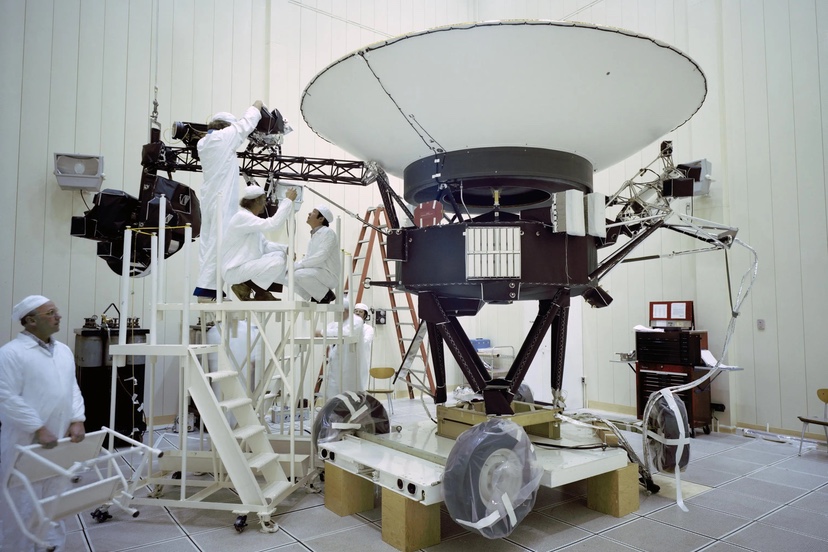
NASA’s Voyager I spacecraft under construction, 1977.
As we all know, light travels at the speed of light. That’s why we call it, “the speed of light”.
About 186,000 miles per second.
Traveling at that speed, the light from the Sun takes about 8 minutes to reach Earth. If the Sun suddenly stopped shining, we wouldn’t know about it until 8 minutes later. By then, it would be too late to do anything about it.
But luckily, the Sun cannot suddenly stop shining, according to what scientists tell us.
Some of these same scientists may have helped design NASA’s Voyager I spacecraft, which celebrated a kind of ‘milestone’ event yesterday by reaching a point in the galaxy “one light-day from Earth”. 16.094 billion miles away, according to NASA. The first human-made object to reach this distance from Earth.
Most of the known universe is much, much farther away than Voyager, but Voyager is special because humans made it and sent it there.
Voyager I was launched on September 5, 1977, visited Jupiter in 1979, visited Saturn in 1980, and kept on going, leaving the ‘heliosphere’ (the Sun’s magnetic field) in 2012 while traveling at a speed of about 38,000 mph.
It’s taken 49 years (17,995 days, to be more precise) for Voyager I to reach a distance that light can easily reach in one day. So NASA shouldn’t be bragging… but they can’t help it.
Voyager is still sending data back to NASA scientists, even though there’s not much going on in interstellar space. But Voyager has another task to fulfill. Scientists included a record album on the Voyager, so that a distant alien can listen to ‘The Sounds of Earth’.
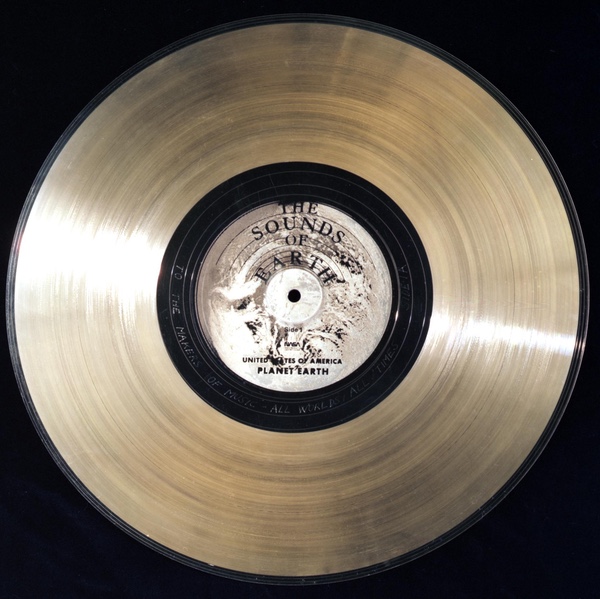
The contents of the record were selected by a committee chaired by prominent astronomer Carl Sagan, who enlisted the help of some of his academic buddies. They assembled a variety of natural sounds, such as those made by surf, wind and thunder, birds, whales, and other animals. To this they added musical selections from different cultures and eras, including compositions by Bach, Beethoven, Mozart, and Stravinsky, as well as Javanese Gamelan, Indian Raga, Japanese Skakuhachi, and Chinese Ch’in music.
The entire 16 2/3 rpm record runs nearly two hours, if you happen to have a record player that runs at that speed.
For whatever reason, the scientists neglected to include a record player.
Thankfully, one of the music selections was Chuck Berry’s ‘Johnny B. Goode’. But I have concerns. What if the aliens play the record too fast, or too slow? That would totally ruin the song.
The scientists also included a printed message from U.S. President Jimmy Carter.
This is a present from a small, distant world, a token of our sounds, our science, our images, our music, our thoughts and our feelings. We are attempting to survive our time so we may live into yours.
Other people may interpret that statement differently, but to me, the message sounds a bit pessimistic. Of course, by the time an alien race comes upon this spacecraft and figures out how to play the record, the human race may very well have failed in its attempt to survive its time.
An earlier NASA spacecraft — the Pioneer 10 — had made a more modest, but also more controversial, attempt to send a message to a lucky alien race, by including a plaque attached to the craft.
Pioneer 10 was launched in 1972.
The artwork was created by Linda Salzman Sagan, who was, at the time, married to Carl Sagan. She sketched a human male and female standing in front of a symbol of the Pioneer 10 spacecraft, to give the humans a sense of scale.
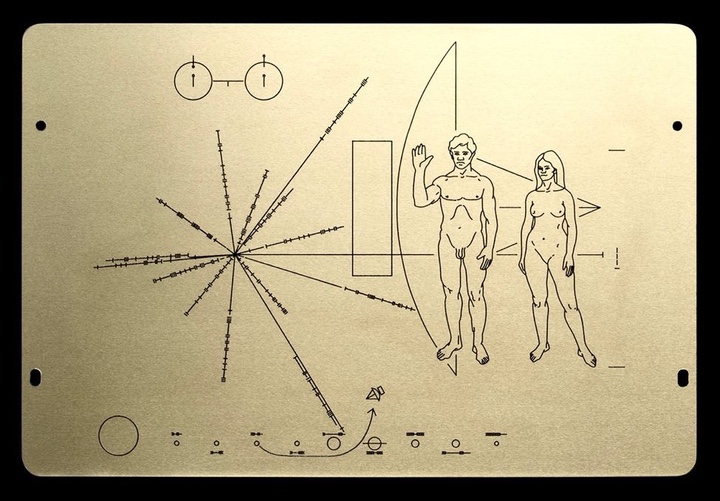
Knowing very well that clothing fashions come and go, Ms. Sagan portrayed the man and woman naked. This did not go over well with the Republicans in Congress.
At the same time, the women’s liberation army complained that the man was waving ‘hello’ and the woman was just standing there, naked, letting the man be the obvious leader.
The last signal from Pioneer 10 was received on January 23, 2003, after declining electrical power from its radioisotope thermoelectric generators left the spacecraft unable to operate its radio transmitter. At that time, it was about 7 billion miles from Earth. So we have no idea if an alien race is right now enjoying the pornographic images.
The pictures included with the Voyager mission feature a woman waving hello. But not naked. So that problem was fixed. Thank you, NASA.
Underrated writer Louis Cannon grew up in the vast American West, although his ex-wife, given the slightest opportunity, will deny that he ever grew up at all. You can read more of his nonsense here.