
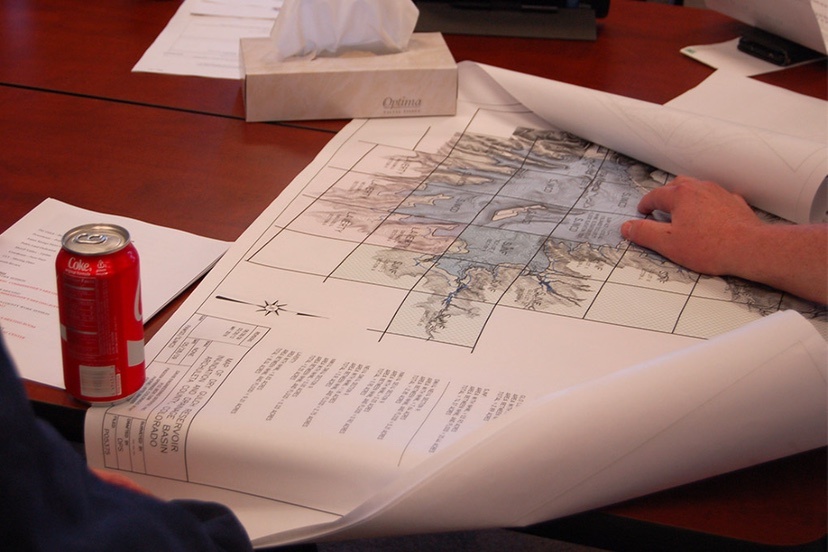
Photo: Rod Proffitt, then-President of the San Juan Water Conservancy District, shares a Dry Gulch Reservoir map at an Archuleta Board of County Commissioners’ work session, May 2016.
The Dry Gulch Reservoir Project has definitely had a troubled history, beginning in 2004, when the San Juan Water Conservancy District (SJWCD) asked Archuleta County voters for a tax increase to help fund the project — and voters said, “No thanks.”
By 2006, Pagosa Area Water and Sanitation District (PAWSD) had signed on as the financing partner, and had put in place a sizable new customer fee — the Water Resource Fee — to fund the proposed reservoir, and experienced a series of Board meeting full of angry citizens and community leaders.
In 2007, the Colorado Supreme Court ruled that the massive water rights PAWSD and SJWCD had acquired for the project constituted illegal “water speculation” and remanded the case back to the Durango court.
In 2008, PAWSD and SJWCD bought the reservoir site — the Running Iron Ranch — from the Weber family for $10.2 million — only to see it professionally appraised several years later as worth $4.6 million.
Then, in 2009, PAWSD and SJWCD got the unpleasant news that their reservoir project was going to cost $357 million. That same year, the Colorado Supreme Court ruled that a reduced water rights decree for the project still constituted illegal “water speculation” and once again remanded the case back to the Durango court.
In 2012, a newly elected PAWSD Board of Directors determined that the Dry Gulch Project was a terrible mistake and pulled the project from its long-range planning documents. PAWSD also withdrew its permission for SJWCD to continue making use of PAWSD office space and staff.
SJWCD realized that they would have to find a new partner with deep pockets if they wished to ever built the reservoir. 14 years later, SJWCD is still looking for that partner with deep pockets.
Meanwhile, PAWSD has continued to make payments of $255,000 annually on the $9.2 million loan from 2008, but due to accruing deferred interest, still owes an estimated $10.2 million.
Disclosure: I currently serve as a volunteer member of the PAWSD Board of Directors, but this editorial series reflects only my own opinions and not necessarily the opinions of the PAWSD Board and staff.
In 2024, a potential partner with deep pockets arrived — Zipper Valley Ranch LLC — offering to purchase the Ranch for the $10.2 million still owed by PAWSD customers, and also offering to work with SJWCD to build the reservoir.
SJWCD refused the offer without even talking to the prospective partner.
PAWSD then went to court to verify its right to sell the Ranch without SJWCD’s permission, and SJWCD counter-sued, accusing PAWSD of violating a 2016 contract agreement and asserting that PAWSD cannot sell the Ranch until 2035, the end of the “Planning Period”.
Last night, Monday, November 16, the PAWSD Board met in open session and discussed a potential agreement that would allow SJWCD to take over the remaining $10.2 million debt. SJWCD approved that agreement on November 6.
Essentially, the agreement gives SJWCD until December 31, 2027 to transfer the Ranch debt to themselves, and pay off a large chunk of the debt immediately by selling part of the Ranch. The agreement also puts the court case “on hold”.
If this process succeeds, SJWCD would own the Ranch, and PAWSD customers would be relieved of $10.2 million in future debt payments.
SJWCD, with its limited tax revenues, would then need to find a partner with deep pockets to pay for the reservoir construction and operations. Presumably, that partner would not be PAWSD.
The PAWSD Board, last night, was split on whether this agreement was the very best way to get PAWSD customers out from under a $10.2 million debt created without customer approval, for a project that the voters had rejected in 2004. (The voters rejected it again in 2017 when SJWCD asked for a small mill levy increase to continue work on the Project.)
One option on the PAWSD Board table: approve the new agreement and give SJWCD 13 months to make progress on assuming the debt.
Another option on the table: Confirm the offer from Zipper Valley Ranch to pay off the loan debt and create a perpetual reservoir easement in the middle of the Ranch, so that if and when Archuleta County needs another water reservoir, one could be built on the Ranch, for storage of drinking water.
Trey Fricke, representing Zipper Valley Ranch, attended last night’s meeting via Zoom, and confirmed that the purchase-and-easement offer still stands. For the time being.
But in order to sell the Ranch, PAWSD would still need to go back to court confirm its right to sell the Ranch “at its sole discretion” without SJWCD’s permission.
At last night’s meeting, two Board members — Glenn Walsh and myself — argued in favor of the Zipper Valley Ranch offer as the most likely to provide a community reservoir in the future. That argument was rejected by the other three Board members: Gene Tautges, Alex Boehmer and Bruce Jones.
Glenn then suggested two clarifying amendments to the SJWCD-PAWSD agreement, and those amendments were adopted in a 4-1 vote. (I voted ‘Nay’.)
The agreement, as amended, now goes back to SJWCD for their consideration.
Sadly, the purchase of the Running Iron Ranch by a former PAWSD Board was — in my humble opinion — a boondoggle from the git-go, plagued by corruption, back-room dealings, lack of transparency, and dismissal of public sentiment opposed to the project. I came to that conclusion in 2008, and nothing that has happened since has changed my opinion.
The odds that SJWCD will succeed in assuming ownership of the Running Iron Ranch? I give it a 50/50 chance.
The odds that SJWCD will ever build a reservoir in the Ranch’s Dry Gulch valley? One chance in a million.
The odds that SJWCD will spend the next couple of decades wasting taxpayer dollars? A sure bet.
Bill Hudson began sharing his opinions in the Pagosa Daily Post in 2004 and can't seem to break the habit. He claims that, in Pagosa Springs, opinions are like pickup trucks: everybody has one.