

You’ve shown so much love for Pagosa over the past few weeks. From thoughtful messages and check-ins to plans to come back and support local businesses, we’ve felt that care from near and far. We’re incredibly thankful for everyone who has reached out and reminded us how much this little mountain town means to so many people.
There’s still recovery work ahead after the recent floods, but Pagosa Springs is moving forward and welcoming visitors back. One of the best ways to support our community right now is simply to keep Pagosa in your plans. Eat local, shop local, stay a while, and enjoy the places and people that make this town what it is…
— from an email blast by VisitPagosa.com, November 8, 2026.
Every story has at least two sides, and one of the agreed-upon goals of the Pagosa Daily Post editorial team — back in 2004, when we actually had an editorial team — was to bravely publish the truth about our little mountain town. Warts and all. And the warts were many.
This did not make us popular with certain people in the community who had a vested interest in selling Pagosa as a mountain paradise.
And I do mean, “selling Pagosa”.
We have a sizable number of business and government leaders eager to sell Pagosa as a “recreational wonderland” and as a “tourist destination”. and much of that sales job has fallen to the Pagosa Springs Area Tourism Board and its website, VisitPagosaSprings.com
Here’s a top-of-page banner that appears on that website this morning:

We have not been relaxed in Pagosa Springs over the past two weeks, as back-to-back 100-year-flood events have hammered neighborhoods, roads, and infrastructure. It’s a real challenge to sell visitation to a town that many people now believe was washed away in a dramatic flood.
Albuquerque TV journalist Daniel Espinoza posted a news story on Friday about the clean-up effort at the Springs Resort and the effort by Riff Raff Brewing to keep serving customers in spite of infrastructure hurdles.
Jesse Hensle, vice president of marketing for The Springs Resort, said their biggest concern isn’t just the damage but also the perception created by online content.
“Last year’s flood, with all the viral videos that got sent around, it really gave a false impression about the resort being literally washed away,” Hensle said.
Hensle explained that the resort reopened within 24 hours after last year’s flooding, but months later, many people still believed it was closed. He said this misconception can harm a town that heavily relies on tourism. “We are open for business, and it’s more important than ever that people come and visit this community, because the lasting impact had a negative impact on a lot of local businesses,” Hensle said.
Down the street in the East End commercial district, loss of electricity and municipal water are still affecting businesses like Riff Raff Brewing, where owner Jason Cox has been using a generator, Starlink, and even his brewing equipment to keep the business running without normal utilities.
“Despite all of the logical things saying we should be closed, my staff needs to pay bills. We need a community gathering place, so we’re happy to be here,” Cox said.
Cox noted that the flooding has made it harder for some tourists to reach the area, which has impacted local businesses. Despite the challenges, he emphasized that his business and others in town are still welcoming guests. “We are open. We’re not going to go anywhere,” Cox said…
Tourism officials in Pagosa Springs said the upcoming holiday season is a critical time for local businesses. They encourage visitors to check road conditions before traveling and to contact the town’s Visitor Center with any questions.
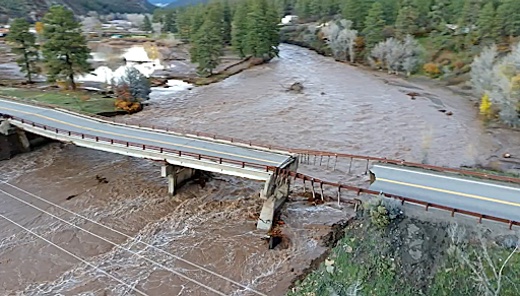
One of the “road conditions” that people will hear about, if they contact the Visitor Center (now temporarily located at the Ross Aragon Community Center) will be a washed-out bridge across the Piedra River, which precludes direct access to Pagosa Springs from Bayfield and Durango to the west. The repairs to that bridge may take up to four weeks, according to a recent Colorado Department of Transportation (CDOT) estimate.
Pagosa Springs has seen hard times before. The closing of the San Juan Lumber Company sawmill at the east end of downtown, for example. The sawmill had employed an estimated 25% of the town’s working population.
That closing was followed a few years later by the Texas oil bust during the 1980s, when the price of oil slid from $31 a barrel in 1981 to $13 in 1986. Oil industry bankruptcies in Houston and Dallas had a significant negative effect on Pagosa Springs real estate sales, and the local economy in general.
More recently, the popping of the housing bubble during the Great Recession caused a record number of foreclosures in Archuleta County between 2008 and 2011.
Eventually, though, the hard times mellow out and the community once again becomes attractive to investors, and borderline unaffordable for working families.
It’s tempting to believe that Pagosa Springs can pull itself up by its own bootstraps. I admit to having that belief, myself, and one of my goals with the Daily Post has been to promote government policies and business decisions that will allow a diverse population to thrive — young people, retirees, working families with a variety of cultural backgrounds.
Some of our community leaders believe that a diverse population will thrive, ultimately, if our policies focus on attracting “high-end” visitors and second-home buyers, based on the well-loved “Trickle Down Theory” of economics. One of the businesses that has been at the forefront of promoting that theory is the Springs Resort. Here’s a quote from 2024, from vice president of marketing Jesse Hensle, speaking to the Pagosa Springs Area Tourism Board.
How should the Tourism Board deal with the part of the community that opposes tourism growth? Well, basically, we need to bring in a more affluent class of tourists. We’ll have less trash around the community.
Mr. Hensle:
“You’re always going to have your nay-sayers. And I think part of it too, is finding the right people to bring here.
“If we look at the conversions, and we look at bring in the right type of affluent markets, bringing in people, bring in visitors who have a higher threshold for the average daily rate at our hotels, and spending more money in the restaurants, they will probably behave more normally within the town. Throwing less parties. Less trash around the community.
“So if we start to look at those segments, and start to maximize those types of visitors that we want in town, we can quiet that noise with all the visitors creating all the negative impact.
“If people come here, and draw more dollars in, at less volume, we’re still going to be ahead of the game. Because the Tourism Board — we’re supposed to be bringing in tax-generated revenue, into the community. So bringing in the more affluent people will help with that…”
The better-behaved, wealthier tourists. We saw how that worked out for Aspen, Vail, and Telluride. Everything becomes unaffordable.

And the Lord God commanded the man, saying, “Of every tree of the garden you may freely eat; but of the tree of the knowledge of good and evil you shall not eat…
The story of Adam and Eve suggests that, if you’re tempted to seek the knowledge of good and evil, things will turn out badly for you.
Better, perhaps, to simply look at the sunny side?
Pretend it’s “Paradise”?
If you’ve been wondering about visiting Pagosa Springs after the floods, we understand! Road repairs and recovery efforts are still underway, and some routes into the area remain affected. Before heading our way, be sure to check COtrip.org for the latest highway closures, detours, and travel conditions…
Bill Hudson began sharing his opinions in the Pagosa Daily Post in 2004 and can't seem to break the habit. He claims that, in Pagosa Springs, opinions are like pickup trucks: everybody has one.