

We had hot water for a shower when I awoke on Sunday morning, November 1, which meant that Black Hills natural gas was still arriving at my house.
The electric tea kettle still had power from LPEA.
I had learned from the devastating October 23 flood here in Pagosa Springs that either, or both, of those forms of energy could possibly disappear early Monday morning, at least temporarily, when the next flood arrived, around midnight.
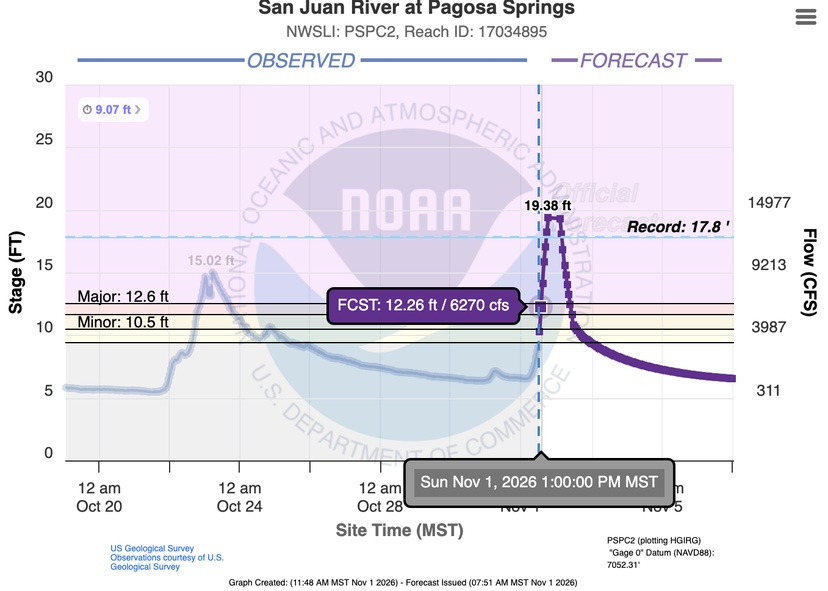
A steady misty rain was falling in downtown, obscuring the San Juan Mountains normally visible from the kitchen window, and according to the National Oceanic and Atmospheric Administration (NOAA) river prediction website, the San Juan River in downtown has already begun to rise slightly, with a predicted peak around midnight tonight.
Peaking at 19.38 feet. The previous record flood in Pagosa Springs, back in 1911, was estimated at 17.9 feet.
Back in 1911, it was sufficient to measure a flood to the nearest 1/10th of an inch, but the science of measurement has made great strides since then, and NOAA can now predict a flood to the nearest 1/100th of an inch. Or at least, they can pretend to predict a flood that accurately.
The alerts that are coming from Archuleta County this morning are predicting 16.9 feet. So more of a “rough estimate”.
No way to know if either of those estimates will hold water, so to speak.
(NOTE: As of 1:30pm Sunday, NOAA was predicting a flood peak of 21.87 inches.)
I’m writing this editorial on Sunday morning sitting at a table at Pagosa Baking Company, which faces Highway 160 — about 400 feet north and slightly uphill from Hermosa Street, one of the neighborhood streets likely to be seriously impacted tonight by a seriously overflowing San Juan River.
Pagosa Baking is one of my favorite coffee shops, and this morning I can hear the sound of traffic splashing down the highway, like waves crashing on a beach.
A moment ago, the power went out for a minute or two, and when the lights blinked back on, the customers gave a cry of delight. We are psychologically preparing ourselves for an extended loss of power tomorrow.
Follwing the momentary loss of power, one of our Pagosa Springs Town Council members, Gary Williams, came through the coffee shop, handing out “Emergency Public Safety Notices”. He announced to the gathered customers, with a voice of authority, that we will can expect power and natural gas outages… that the river is rising faster than expected… that all roads going in to and out of downtown Pagosa would be closed as of 4pm… and that the river is expected to crest at 19.7 feet at around 11pm tonight.
Another rough estimate.
Other information on distributed “Notice”:
“Please stay out of the river.”
“Electricity / Water / Sewer / Internet / Cellphone Services all may be impacted.”
No mention of natural gas service?
The flyer that Council member Williams was handing out indicated that the entire downtown was now under a “Mandatory Evacuation Order.”
I can’t really imagine the entire downtown — about 1,900 people — taking such an order seriously, when most of the homes and businesses are located well above the maximum height of the flood.
But I understand that governments have the power to issue mandatory evacuation orders and want the very best for all of us, especially if they are planning to close the roads in to and out of downtown.
The bakery staff just announced that they would be closing early, at 11am — that’s in half an hour — and that croissants are now priced half off, and the self-serve coffee is free.
Time for one more cup of coffee, and then head home. I live about five blocks away.
Some Daily Post readers may enjoy the publicly-available stories we post Monday through Friday (and during times of emergency, even on Saturday and Sunday) but without knowing how this whole operation works.
I am, in fact, writing this on Sunday morning, but it will not appear for our readers until Monday morning. The stories normally get assembled on a desktop computer in my office (which also serves as my bedroom) on a 126-year-old house at the end of a short dead-end street. (Five blocks from the Bakery, as noted.) The stories are then uploaded, via the internet, to a “server” that I believe is located in Dallas… or maybe somewhere in Louisiana. In other words, to a data center.
Although I hate data centers as much as the next guy, the Daily Post’s operations, as currently formulated, would not be possible without one.
I normally “post” the day’s stories to that distant data center at around 7am Central Time, and they then become available to Daily Post readers. But things are looking a bit different this morning, as the flood waters are rising. It seems quite likely that my house will be without electricity tomorrow morning at 7am — so I am going to upload this editorial to the server now, on Sunday morning, and schedule it to appear automatically for readers at 5am on Monday.
It won’t be “fresh news”, per se. It will be about 18 hours old.
But better “an old editorial” than “no editorial at all”.
Driving around downtown yesterday evening, the sidewalks were full of children and parents dressed in Halloween costumes. The weather was pleasant, and people seemed in good spirits.
You wouldn’t have suspected that a Mandatory Evacuation Order was just hours away.
Bill Hudson began sharing his opinions in the Pagosa Daily Post in 2004 and can't seem to break the habit. He claims that, in Pagosa Springs, opinions are like pickup trucks: everybody has one.