
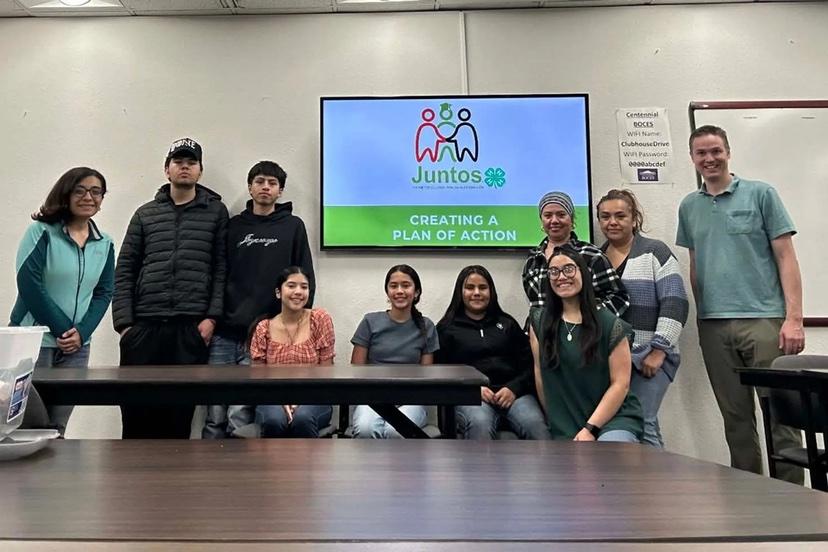
Weld County’s Juntos 4-H held its first workshops for high school students in January and will launch middle school workshops this fall. (Photo courtesy of Weld County CSU Extension)
This story by Emily Lytle, Open Campus, appeared on The Daily Yonder on October 15, 2026.
Editor’s Note: A version of this story first appeared in Mile Markers, a twice-monthly newsletter from Open Campus about the role of colleges in rural America.
For me, growing up as a 4-H kid meant summers walking sheep around a makeshift ring in the barn, spending evenings in a brightly-lit meeting room learning about everything from animal nutrition to how to deliver a lamb from inside a cardboard box meant to resemble the backside of a ewe, and then of course that day of the county fair when sawdust lingered in the air, and we awaited the hour we finished showing sheep and could run to order a black raspberry ice cream cone.
But I knew 4-H clubs across the country went far beyond the livestock clubs that I was familiar with – and in many ways, they have played a significant role in leadership and career development for young people, especially in rural areas. So, I started to ask some questions about what that looks like.
That’s how I learned about one unique version of a 4-H club that recently launched in Weld County, Colorado, and aims to prepare youth and their families for life after high school.
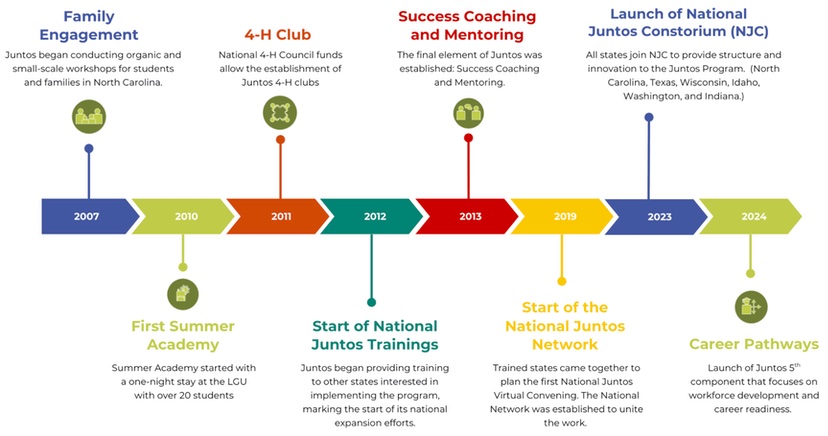
Juntos 4-H is now a national 4-H program that began at North Carolina State University almost 20 years ago. Translating to “together” in Spanish, Juntos started as a response to high dropout rates among Latino and Hispanic youth in North Carolina. After surveys and focus groups involving hundreds of Latino youth and their families, leaders at NC State Extension launched small-scale workshops that brought parents and youth together to learn more about navigating the educational system from middle school to high school and beyond. These workshops started in high schools with an early focus on three rural counties in the state.
As it grew in North Carolina, Juntos added other elements like a “summer academy” where students would visit a land grant university like NC State. Then, after the National 4-H Council came on board and funding arrived from the New York Life Foundation, dedicated Juntos 4-H clubs spread across the country. Other land grant universities and extensions began replicating the Juntos model, starting with Oregon State University in 2012.
Juntos 4-H also incorporated other elements like one-on-one coaching and mentoring and more recent programming focused on career readiness and workforce development.
As it has evolved, the driving force of Juntos 4-H seems to still be family involvement. In Colorado, it’s common for parents, younger siblings and other family members to show up to the sessions for high school and middle school students. (One former Juntos trainer, Lisa Auer in Larimer County, Colorado, said she has even provided childcare in the past to help ensure access for families).
This isn’t a program that reaches students and families by email, either. Juntos coordinators post flyers and present at back-to-school nights. Sometimes they hold meetings at soccer fields or churches. They use WhatsApp groups to communicate between workshops. Depending on what the families prefer, the sessions can be in Spanish, English or both.
Meals and music are also common. Patrick Pulis, the 4-H outreach instructor who leads Juntos 4-H in Weld County, described a recent scene where a student and his father volunteered to play guitar, amp and all, at the beginning of a session. Ruben Flores, who now works in a different role at Colorado State University Extension but helped research and launch Juntos 4-H across Colorado, echoed how this story exemplified the overall environment at Juntos 4-H clubs.
“The typical recruiting that you would use for 4-H: you put your single out, so to speak, and wait for people to come to you. That’s not what Juntos 4-H does,” Flores said. “We go into the communities.”
For example, Jafet Sanchez is a 10th grader who went through Weld County’s inaugural workshop for high school students in January. He said he learned about the program through an English Language Learner lab at his school.
Sanchez said he attended the Juntos workshops with both his parents, and while he learned more about different careers he hadn’t considered before – like engineering jobs – the biggest learning curve was likely for his parents who he said were completely new to the educational system in the United States.
“It was difficult to understand at first but when they got into the [Juntos] program, it was easier,” he said.
In that first iteration of the workshops, Pulis said he was impressed by the shift he saw between parents and their children, how their conversations became more lively as the sessions went on.
“Families may not talk to their youth very much about their education or their future, and something like Juntos gets them starting to think about how can the parent be involved with the youth education, how can they support them, how can they talk to them on a daily basis about their schoolwork, about being successful,” he said.
While Juntos got its start from serving Latino and Hispanic communities, and it continues to thrive in areas of high Spanish-speaking populations (like Weld County, one of the fastest growing areas in the state with just over 9% of the population born outside of the U.S.), multiple people involved with the program emphasized that Juntos is not exclusive.
“Even though the word Juntos is in Spanish, we’re not going to turn any family away if they want to help their son or daughter look at educational options,” said Flores.
One County Left
When Colorado adopted Juntos in 2021, it took off in multiple counties over the next couple of years, often finding strong partnerships with local high schools and the family liaisons that supported students and their families there. Now, though, Weld County is the only active Juntos 4-H program in Colorado.
In 2023, seeking longer-term sustainability, Juntos 4-H shifted to a national consortium model, meaning states and counties needed to pay to access the programming and evaluation support from the national level, administered at NC State. With that model change, six states (plus Weld County) joined the consortium. Some remained independent and still others halted their Juntos programs, pointing to a lack of funding.
Larimer County was one of the places where Juntos 4-H initially thrived but could not continue to financially support a full-time coordinator, according to Auer, community development specialist at CSU Extension’s Larimer County Office.
“The program was great,” Auer said. “It didn’t stop for lack of need but capacity and funding.”
Weld County was different because they received a large anonymous donation from an energy company based in the area. The company specifically earmarked those funds to run a Juntos 4-H program in the county where that company employed many families who would benefit from a program like this, according to Flores.
At the national level, Juntos 4-H is following other extension programs in looking to move away from a reliance on federal grants and instead focus more on philanthropy from corporations and foundations.
Some like Flores, who now travels the state to connect with rural students about college opportunities (even beyond CSU) as part of the Access to Education program, are hopeful that the recent launch of Juntos 4-H in Weld County is the sign of more efforts like it.
“I’m looking forward to the day when Patrick says, ‘Hey, we have somebody that went through Juntos 4-H, and they want to know more about those educational options.’ Because it would almost be like being part of that relay where we’re passing the baton, if you will,” Flores said. “In the meantime, I’m going to continue to go into schools in Weld County and tell them about Juntos 4-H or the work that we do, and you never know, the program in Weld County may grow.”
This article first appeared on The Daily Yonder and is republished here under a Creative Commons Attribution-NoDerivatives 4.0 International License.
The Daily Yonder provides news, commentary, and analysis about and for rural America. They welcome photos, tips, observations, and links to stories about rural America. Reach them at news@dailyyonder.com