

The Pagosa Area Water and Sanitation District (PAWSD) board of directors are scheduled to meet tomorrow, Thursday October 15 at 5pm at the district office, 100 Lyn Avenue, at the west end of town. The discussions will likely focus on possible increases to customer fees in 2027.
Perhaps substantial fee increases.
Alternatives to fee increases? Putting off system maintenance and upgrades. Delaying salary increases. Reducing customer service. Etc.
Disclosure: I currently serve as a volunteer director on the PAWSD board, but this editorial series reflects only my own opinions and not necessarily the opinions of the PAWSD board or staff.
Last week, at the other end of town, the Pagosa Springs Town Council delayed a final decision on a ‘Planned Development Agreement’ proposed by the Town Planning Department and potential developer Modern Community Builders LLC. This agreement would authorize the “Ponderosa Mountain” subdivision. If approved, the Agreement would facilitate Ponderosa Mountain’s next stage of planning processes.
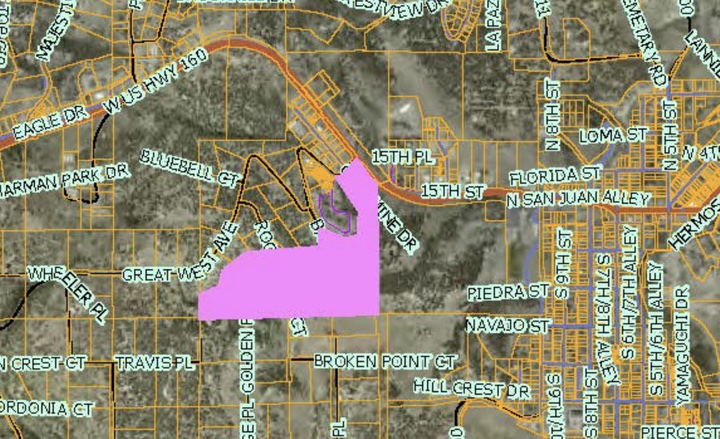
Ponderosa Mountain would be a mixed commercial and residential development on 70 acres adjacent to Great West Avenue — at a much higher density than the ‘Rural Transition’ zoning currently assigned to the parcels in question.
The Town Council delayed consideration to allow for additional information to be presented. Another Council hearing on the Planned Development Agreement might take place on Tuesday, October 20.
I mention these two issues — (likely?) fee increases at PAWSD, and an (unlikely?) mixed use development near downtown — in the same editorial, because they’re intimately linked.
When governments want more money in their budgets — and what government doesn’t want more money in their budget, year after year? — they have only a few options.
1. Increase fees and/or taxes.
2. Encourage growth.
3. Write more grants.
In Colorado, governments cannot increase tax rates without voter approval. But they can increase “fees” with a simple majority vote of the governing board.
Growth means more people and businesses paying fees and taxes to government. But it also means more people needing services and more stress on infrastructure.
Increased fees and taxes, meanwhile, can have a negative effect on growth. But many other policies and practices also affect growth and development.
Take PAWSD, for example.
Three years ago, the PAWSD board received a “rate study update” from a consulting firm called Stantec. Stantec offers a wide range of consulting serves connected with engineering and planning, and the firm has developed clever computer software that can estimate how much a water and sewer district (for example) needs to collect from customers and taxpayers over, say, the next 10 or 15 years, in order to avoid bankruptcy.
And also, in order to make all the system improvements the board and staff want or need to make.

For a government entity delivering drinking water, and treating wastewater, state and federal laws define water quality requirements, and those requirements become only more strict with each passing year. Thus, clean water gradually becomes more expensive.
Following the Stantec study, the PAWSD board greatly increased its Capital Investment Fees on new residential and commercial development, to allow for continued maintenance and upgrades to its water and wastewater systems, and also to its administrative systems.
Two of the notable system improvements recently made by PAWSD: a $44 million replacement water treatment plant on Snowball Road, and a $10 million upgrade to the sewer treatment plant at Lyn Avenue. The Snowball Plant has been in the planning stages for 20 years. The sewer treatment plant upgrade was demanded by the Colorado Department of Public Health and Environment. Both projects were funded mainly with borrowed money, that customers will be repaying over the next couple of decades, with higher fees.
(PAWSD has invited the community to attend the ‘ribbon-cutting’ at the Snowball Plant this coming Saturday, October 17 at 11:00am. The plant is located at 3100 County Rd 200.)
The Snowball Plant is larger than the old plant, and is capable of producing nearly three times as much drinking water per day — thus allowing for increased development on the eastern end of the community, someday.
Not much development is happening at the moment. But a couple of large subdivisions have been proposed, just west of the Pagosa Springs Elementary School. The 80-acre ‘Pagosa Views’ subdivision plan was approved a couple of years ago, but no work has yet started. And with interest rates increasing recently, we might assume this is a poor time to borrow the millions of dollars needed to install the roads and utilities necessary before parcels can be properly marketed. (Although I guess a developer can sell parcels with a ‘promise’ that they will be served by roads and utilities ‘someday’. And the Town government does require a bond to ensure that roads and utilities will, in fact, be installed.)
‘Ponderosa Mountain’ is adjacent to and immediately west of the proposed ‘Pagosa Views’ subdivision, and the two subdivisions — if built — would share an access road.
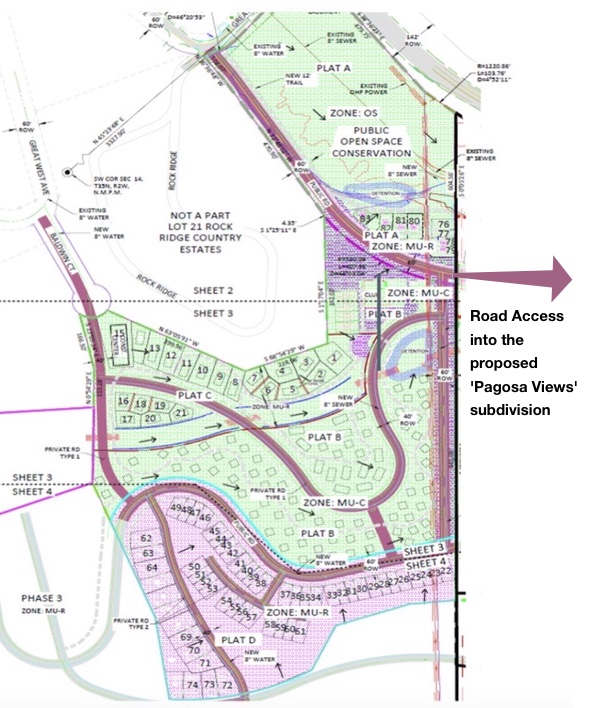
Together, these two developments would more than double the number of homes in downtown Pagosa Springs — and thus, would double the amount of sewage flowing into the Town’s troubled sewer system. About 20 years ago, the Pagosa Springs Sanitation General Improvement District (PSSGID) was planning to build a ‘state-of-the-art’ treatment plant near the High School to replace its failing lagoon system… but eventually opted for a joint project with PAWSD to pump the PSSGID sewage 7 miles uphill to the PAWSD Vista Treatment Plant. That pumping system has been nothing but (very expensive) trouble since it began service in 2016, and PSSGID is now planning to finally build the downtown treatment plant they were discussing 20 years ago.
So some questions central to the possible Planned Development Agreement under consideration by the Town Council:
Can the Town’s 7-mile pumping system handle two new subdivisions? Or will these projects need to wait until the Town builds a new treatment plant?
Will the Town’s new treatment plant need to be twice as big as originally planned?
How many more new subdivisions does the Town expect to approve in the future? That is, given infrastructure limitations?
It was quite obvious during the Ponderosa Mountain discussions — at the Town Planning Commission meeting last month, and at the Town Council meeting this month — that the Town Planning Department is eager to see the Ponderosa Mountain subdivision get approval.
As far as I can tell, this eagerness derives partly from a belief, among the Town Planning staff, that (inevitable?) population growth in Archuleta County should occur in proximity to the existing downtown, rather than spread all across the landscape in the community’s historical pattern of ‘suburban sprawl’. It’s well recognized, by planners these days, that sprawl development is ultimately financially unsustainable without a very high local tax burden.
The Town planners are also promoting ‘Ponderosa Mountain’ because the developer promises to include some ‘attainable housing’. (Which is different from ‘affordable housing’…)
Read Part Two… tomorrow…
The Pagosa Daily Post welcomes submissions, photos, letters and videos from people who love, and care about, Pagosa Springs, Colorado. More information available at 970-903-2673 or pagosadailypost@gmail.com