
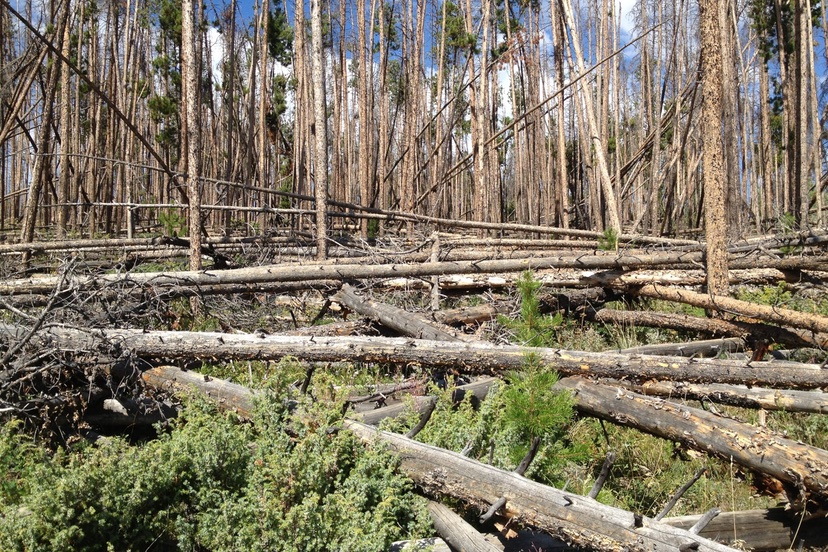
Trees killed by mountain pine beetles crisscross the forest floor in Grand County. Photo: CSFS.
This story by Jennifer Oldham appeared on Capital & Main on September 30, 2026. Used with permission. Copyright Capital & Main.
The white Cessna banked right to reveal dense forests of Douglas fir, pines and quaking aspen in varying shades of green bathed in the early morning light. Yet secreted under the layered bark of some pines is a pest whose upcoming flight places Colorado’s highest concentration of real estate and infrastructure values at risk.
Damage wrought by the mountain pine beetle is already evident in thousands of dead and dying red-needled ponderosa pine knitted throughout these stands. Their gray skeletons line highways, heighten already elevated wildfire risk and threaten watersheds that millions of residents rely on for clean drinking water.
On some mountain properties about 40 miles west of Denver most every pine is dead. Many residents cannot afford to remove the infested century-old ponderosas. One quote ran $15,000 an acre. The growing price tag to mitigate the damage and protect high-value trees from the next onslaught presents a quandary for local, state and federal agencies.
An historic drought weakened ponderosa pines, allowing the beetles to chew their way through hillsides of trees bordering mountain towns at the gateway to popular ski areas and hiking trails. Impacted acreage increased 148% to 5,544 acres in 2025, when compared with 2024, alarming foresters, communities and lawmakers.
This year, the breadth of the insect’s footprint and the intensity of its attack is expected to expand exponentially. At stake: More than 600,000 acres of ponderosa pine forest woven throughout areas where about 4 million people live in nine counties on both sides of the Rocky Mountains.
“We anticipate there to be anywhere from twice as much, to three times as much, activity as we saw last year,” Dan West, an entomologist with the Colorado State Forest Service, told Capital & Main in June.
“That is startling.”
A U.S. Forest Service map of the endemic pest’s potential to spread through 2030 is equally startling: Dark red blotches indicating infestation intensity cover forests at every latitude from Boulder, north of Denver, to the Black Forest, where high-end suburbs hug Colorado Springs, to areas behind Pikes Peak to the south. The counties most at risk contain thousands of acres of ponderosas. Some of the pines sit just outside the state’s Capitol.
To minimize the spread, foresters are prioritizing early detection and response. It’s no easy task. Forests harbor twice as many trees as those better able to resist a beetle outbreak. A century of fire suppression and more intense and extreme weather caused by heat-trapping emissions from expanding oil and gas extraction in Colorado and elsewhere contributed to the dire outlook.
Across the country, climate change is ravaging ecosystems, bringing more robust storms, rising sea levels, record-setting conflagrations and fatal heat waves. In Colorado, the staggering die-off of the majestic pines is difficult to stomach.
To track the outbreak, West regularly hikes to infected stands to inspect last year’s broods. What he found this spring surprised him: Females who burrowed into large green trees in 2025 laid double the number of larvae the scientist observed in previous infestations. The lack of sub-zero temperatures this winter — which marked the state’s lowest snowpack on record — ensured their survival.
Peeling the bark off ponderosa pines with his hatchet, West counted between 60 and 120 larvae coming off each female pine beetle. The insects tunnel their way into the trunk, impeding the tree’s water and nutrient supply and killing it within a year. During wetter years, trees are healthier and can more easily repel the beetle with sap. This year, many are defenseless against the rice-sized insect’s relentless assault.
Its small stature belies its ability to wreak havoc. The last major outbreak, which spanned 1996 to 2013 and decimated about 82%, or about 3.4 million acres, of the state’s pine forests, is fresh in Coloradans’ minds. In some ski communities, such as Winter Park, entire mountainsides of trees perished, dramatically altering the landscape.
Dead lodgepole pines intensified the two largest wildfires in state history in 2020. The Cameron Peak Fire swept through 326 square miles of forest in Larimer and Jackson counties and Rocky Mountain National Park, along with 492 structures, while the East Troublesome Fire burned through Grand County and Rocky Mountain National Park, reducing to ash over 300 square miles and 500 structures and killing two.
The insects started to migrate from higher elevations to coniferous forests, but a historic 2013 rainstorm stopped their advance. Now, following the state’s warmest climatological spring on record, the beetles are poised again to expand their territory.
Their advance threatens Denver Water’s 2.5 million acre watershed — at least a quarter of which is covered with ponderosa pine. The utility has spent $96 million since 2010 to restore forests in this region, including spraying some pines in hopes of protecting them from infestation, said Madelene McDonald, watershed planning manager.
“The threat of high intensity wildfire is not theoretical — it’s one we’ve experienced,” she added. “High intensity fires lead to brown, sediment-laden water flowing into treatment plants, which is really expensive to treat.”
McDonald is among 39 people who sit on a Ponderosa Mountain Pine Beetle Task Force created by an executive order Democratic Gov. Jared Polis issued in December after West, the entomologist, and the state forester warned him to get ahead of the outbreak.
The governor stressed an urgent need to educate residents, protect high value pines and prioritize the removal of diseased trees that harbor broods. This work must be planned around the insect’s annual flight to find new trees between June and September. The task force is charged with quickly mobilizing resources to mitigate the infestation, which has overwhelmed residents and muncipalities alike.
“It’s hard emotionally as somebody who cares deeply about our forests — in areas of our district there’s not a tree left,” said Jess Moore, wildland project coordinator for Evergreen Fire & Rescue. “We encourage homeowners to reach out to contractors, arborists and foresters so they can get the best support they can to protect their current trees.” The “sheer volume of impact” has prompted some residents to take such steps, and to thin their trees, she said.
It’s expensive and time consuming. Just ask retired environmental science professor Harv Teitelbaum, who lives in Evergreen on a wooded property that’s long, narrow and hilly. He teaches people how to climb trees, including pines. Yet the infestation required him, with the help of volunteers and a tree care service, to remove 45 ponderosas from his land. The bill: $10,000. Another 40 or so are dead or dying.
“This has been a lot more devastating — in the past, you would have isolated trees here or there that were killed,” he said. “This is more widespread.”
A few years ago, Teitelbaum lost his favorite training tree, a ponderosa nicknamed “Gramps,” to the beetle. This year, to protect his remaining pines he stapled pheromone packets to their trunks and injected some with a chemical treatment. He hopes it works so he can continue to train new generations to climb on his property.
“Up there, you see a country you haven’t seen,” he said. “The tree is a living, breathing thing. You feel it swaying, and you’re breathing oxygen it’s giving off from its crown.”
About a dozen miles south near Conifer, Brad Huddleston used similar methods to protect pines on his property. The arborist founded Splintered Forest, a fire mitigation company, 22 years ago after losing his family home in a wildfire. He advises clients to inject large pines with insecticide before the tree’s green needles start to change color. The every-other-year treatment runs up to $300 per tree. Pheromone packets and spraying, which cost up to $25 a tree, are other alternatives. The pheromone treatments release a scent that tricks beetles into thinking a tree is full, causing them to go elsewhere.
“A lot of homeowners take solace when I tell them that despite them seeing major beetle destruction along our two main corridors, their properties are not destined for the same thing,” he said. “We can turn the tide on individual trees.”
Fallen trees lay crisscrossing each other on the ground in a dense forest of mostly standing dead trees
Huddleston’s company has been busy removing hazardous diseased trees near homes and access roads and thinning overgrown stands. The downed wood must be covered to smother the beetle, or hauled away to sites designed to handle infested timber, known as “hot logs.”
Such work increased this year. Jefferson County, home to both Evergreen and Conifer, collected 10.3 million pounds of slash, or woody debris, in 2025, up from 9.5 million in 2024. The response underscored the stakes — the region’s wildfire risk is 98% higher than that of counties nationwide, said Jefferson County Commissioner Lesley Dahlkemper, who is the Democratic nominee for lieutenant governor.
“I went to a recent breakfast at the Conifer Chamber of Commerce, and the scale of the crisis and how its impacting constituents became crystal clear,” she recounted. “I asked who was dealing with mountain pine beetles on their land and every hand went up.”
Little infrastructure exists statewide to accommodate the amount of wood now coming off properties. The dry winter prompted counties statewide to ban slash burning, which some rural landowners rely on in part to dispose of beetle-kill. This practice allows property owners to burn small piles of wood on their property, in some cases with a permit and during certain weather conditions.
In smaller counties, a reduced tax base provides officials no wiggle room for mitigation funding. About 24 miles northwest of Conifer in Idaho Springs, lawmakers are seeking funds to mitigate the damage and to take protective measures. Of major concern is the stability of the Clear Creek Watershed, which 450,000 people rely on for drinking water.
“We are kind of raising the flag — we just need more work, faster,” said George Marlin, a Clear Creek County commissioner. “It’s complicated to accomplish mitigation on interlocking federal, state and private land — we need all of these entities to have adequate funding to get it done.”
The challenge Marlin and his colleagues face is evident from the white Cessna’s window. Red and brown ponderosas crown hillsides ringing the former mining town. The mosaic prompted pilot Evan Anderman, a volunteer with LightHawk, a nonprofit that works with pilots who donate their time and aircraft for conservation causes, to bank his craft yet again.
What’s most worrisome is not yet visible from his aircraft. For every red tree, there are between 2½ and 10 green infested trees. In the early stages of infestation, these trees are only identifiable by sawdust at their base, sap on the trunk, or tunnels under the bark. West urges homeowners to prioritize these trees for removal.
Residents in Jefferson and Clear Creek counties are getting the message. People in both areas approved tax increases in 2025 for fire protection services. Identifying additional funding for wildfire mitigation is among action items Polis’ task force included in a June 30 work plan. The document identified numerous gaps in the current outbreak response.
These included “fragmented public communication,” inconsistent coordination across governmental boundaries, a constrained workforce and “uneven community and landowner engagement.” It also contained a stark warning: “The outbreak will persist for a decade or more, trees will die at a visible scale, and fire risk will remain elevated.”
Keith McMillan knows how beetle-kill influences fire risk. The former fire captain worked 21 years with Breckenridge’s Red, White & Blue Fire Protection District. The ski town lost 90% of its lodgepole pines between 1999 and 2013. Fire risk is highest when red and brown needles remain on the pines — they can help speed a blaze through the canopy, he said.
McMillan, who today is the only fire mitigation specialist for a homeowner’s association in the West, is using his experience to encourage residents in Ken-Caryl Ranch, a 4,400-home Denver subdivision, to protect their ponderosa pines.
The retired firefighter advises homeowners in what he calls an “urban forest” to spray or use pheromone packets on trees, or to remove them if they are too close to homes. It’s emotional work. People are attached to trees they planted when they moved in, or to celebrate a child’s birthday. And he doesn’t have enforcement power.
“We are trying to stay ahead of it — my No. 1 challenge is public perception” of public safety risks that accompany large tree die-offs, McMillan said. “We are just on the edge of the mountain pine beetle epidemic making it to our land.”
Copyright 2026 Capital & Main. Capital & Main is an independent, nonprofit investigative news publication that reports on inequality, climate change and other issues.