
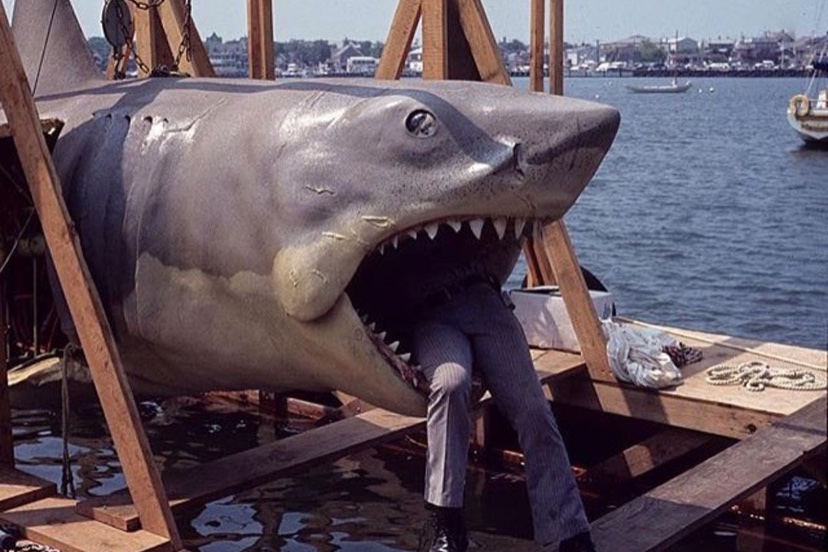
In the classic 1975 movie, Jaws the shark is terrifying because audiences do not see it very often.
In The Shark Is Broken, the shark creates trouble for a completely different reason: it will not work.
That malfunction provides the setting for Thingamajig Theatre Company’s first production of the 2026-2027 fall and winter season, opening October 9 at the Pagosa Springs Center for the Arts and running through November 15.
Tickets are available at pagosacenter.org or by calling 970.731.SHOW (7469).
Directed by Laura Moore, the production features Tim Moore as Robert Shaw, better known to movie audiences as ‘Quint’, along with Scott Moorehead as Roy Scheider, who played ‘Chief Brody’, and Cameron Vargas as Richard Dreyfuss, who portrayed ‘Matt Hooper’. The play is not a stage version of Jaws, and it does not attempt to recreate the film’s famous shark attacks or retell its familiar plot. Instead, it takes audiences behind the scenes and imagines what might have happened during the long stretches when the cameras stopped rolling.
The year is 1974, and the location is the Orca, the fishing boat from Jaws. Production has stalled because the mechanical sharks, collectively nicknamed Bruce, are malfunctioning in the salt water. The three actors are stranded together between takes, and boredom quickly becomes its own kind of pressure as the men look for ways to pass the time and maintain their control over an increasingly chaotic production.
Robert Shaw is proud, volatile and struggling with alcohol. Roy Scheider tries to keep the peace, while Richard Dreyfuss is younger, ambitious and determined to prove himself. They are playing three men who must work together to kill a shark, but the actors portraying them are not always sure they can make it through lunch together.
That tension gives The Shark Is Broken its comic engine. The men argue over acting styles, fame, money, age and the question of who is really carrying the movie. Their conversations move from the ridiculous to the unexpectedly intimate, with jokes becoming insults and insults becoming confessions. As the waiting continues, the actors begin to reveal the fears and ambitions beneath their public personas.
The play’s personal connection to Jaws is unusually strong. It was written by Ian Shaw, son of Robert Shaw, in collaboration with Joseph Nixon. Ian Shaw was brought to the Jaws set as a child and remembered encountering the mechanical shark, an experience that left a lasting impression on him.
The idea for the play began years later, when Shaw was wearing a mustache for another acting job. He looked into the mirror and saw something familiar: his father as Quint. That moment led him to revisit the production of Jaws, studying interviews, documentaries, family stories and accounts of the film’s famously chaotic shoot.
Shaw also consulted his father’s personal journals, including a drinking diary that offered a more intimate picture of Robert Shaw’s struggles during the making of the film. Robert Shaw died when Ian was still young, and Ian’s decision to portray him means stepping into the shadow of both a famous actor and a beloved parent. The play is not simply an impersonation of Quint; it is an attempt to understand a complicated man through the role that made him immortal.
That complexity is built into the character. Robert Shaw’s Quint is a towering screen presence, a hard, dangerous and deeply wounded man. In The Shark Is Broken, he is also an actor trying to find the right words, a father remembered by his son and a person fighting private battles while the cameras wait.
The production eventually moves toward Quint’s famous USS Indianapolis speech, the monologue that gives Jaws much of its haunted power. Robert Shaw helped rewrite the speech himself, and the play considers the complicated process by which a famous piece of dialogue comes into being. The scene is not only a highlight from the movie; it is also a glimpse into the collaboration, pressure and personal history behind the performance.
The play began at the Edinburgh Fringe in 2019 before moving to London’s West End and later Broadway. Its appeal is easy to understand because everyone knows the finished movie, but The Shark Is Broken asks audiences to imagine the unfinished version: the days when the boat sank, the shark failed, the schedule collapsed and nobody yet knew whether the film would become a classic or a catastrophe.
At the Pagosa Springs Center for the Arts, Laura Moore’s production brings that story into the intimate setting of the Thingamajig stage, where three actors will spend an evening trapped together on a boat, waiting for an impossible machine to come back to life. The play offers movie fans a new perspective on a familiar story, while also standing on its own as a comedy about artistic ambition, professional rivalry and the uneasy relationships that can develop when people are forced to wait together.
The Shark Is Broken opens October 9 and runs through November 15. Tickets are available at pagosacenter.org or by calling 970.731.SHOW (7469).