
This story by Chase Woodruff appeared on Colorado Newsline on September 17, 2026.
As the clock winds down on a historically dry year in the Colorado River Basin, Colorado water officials Wednesday said they’re willing to launch a new state-run conservation program that would chip in to address system-wide shortages — but not without more certainty from the federal government, and possibly the state Legislature, about how the program would work.
Members of the Colorado Water Conservation Board, the state’s lead water agency, voted 9-0 to conditionally approve a “near-term contribution program” to fulfill the voluntary conservation efforts requested by federal officials this year, as the seven states that rely on the Colorado River continued to fall short of a long-term agreement on how to share its shrinking water supplies.
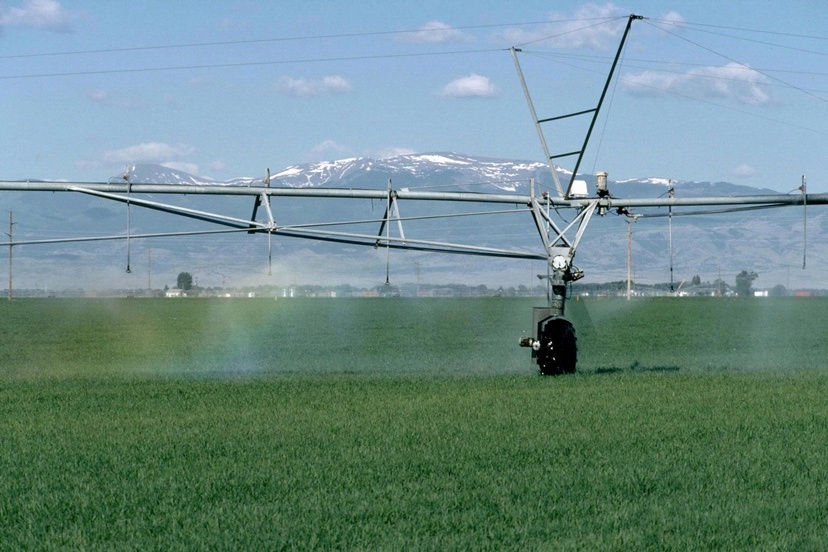
The program aims to reduce water use during the 2027 “water year,” which will officially begin October 1. Funding provided by the U.S. Bureau of Reclamation would pay for fallowing, deficit irrigation, crop-switching and other conservation projects that would be approved by the CWCB and the federal government before the spring runoff begins next year.
“None of us want to be in this situation, where we are dealing with these kinds of impacts from climate-change-driven drought,” CWCB member Taylor Hawes said during the board’s monthly meeting, held at the Copper Mountain ski resort. “We’re not doing this for fun. We’re doing this because our situation requires it.”
In nearly a century of record-keeping, the Colorado River’s cumulative streamflow at Cameo, just upstream of Palisade and Grand Junction, has never been lower than it has been in water year 2026. Downstream, Lakes Powell and Mead fell to record lows, forcing the Bureau of Reclamation to make deep cuts to water allotments for the Lower Basin states of California, Nevada and Arizona. The unprecedented drought conditions are part of a long-term warming and drying trend fueled by human-caused climate change.
Colorado officials have faced mounting criticism and threats of litigation over the state’s refusal to agree to mandatory cuts like the ones the Lower Basin states are facing. But the CWCB’s rollout of the near-term contribution plan put a spotlight on the internal political pressures and legal obstacles that stand in the way of more substantial conservation commitments in the Colorado River’s headwaters state.
“There’s better ways that we can put this money to use than to put farmers on welfare,” Troy Waters, a fifth-generation farmer in Fruita, told the board during public comment.
“There needs to be statewide participation, not just West Slope ag,” said Wendell Koontz, a Delta County commissioner and chair of the CWCB’s Gunnison Basin Roundtable. “West Slope ag always feels like it’s got a bullseye, and often a knife, in the middle of our back.”
The scale of the reductions targeted by CWCB officials in the near-term contributions program is relatively modest — 50,000 acre-feet in water year 2027, only a fraction of the 1.25 million acre-feet of cuts that will be forced on water users across the three Lower Basin states next year. But even that has been a tough pill for Colorado water users to swallow in the wake of the program’s announcement in July.
“This program is only going to be run on a voluntary basis. We’re not going to force anyone to participate. It’s going to be compensated by federal funds, as we’ve discussed, and temporary, which is especially important for agricultural projects,” said Amy Ostdiek, chief of the CWCB’s Interstate, Federal, and Water Information Section. “We’re not contemplating permanent reductions in our state’s water use.”
Legal framework
In an 18-page letter sent to the CWCB on Aug. 26, the Colorado River District, a water manager serving 15 Western Slope counties, outlined a long list of concerns with the proposed program, including its potential to “inadvertently create regional sacrifice zones on Colorado’s West Slope.” The district requested changes to the criteria the agency will use to select conservation projects and more guardrails to ensure impacts to agriculture are temporary.
Agriculture accounts for about 90% of all Colorado water use. Under the project criteria adopted by the board Wednesday, the CWCB will prioritize “participation statewide and across water sectors” — meaning municipal users, not just farmers and ranchers.
“We’re very much in agreement that this program, unfortunately, is — we look at it as kind of a necessary evil,” Andy Mueller, the Colorado River District’s general manager, told CWCB members. “We understand that climate change is wreaking havoc on the system, and all of us need to figure out ways to contribute.”
Mueller thanked agency staff for the outreach work they’d conducted since July, but said the proposed project criteria were still too vague. He and other Western Slope water managers are especially concerned that the state lacks clear legal authority to “shepherd” conserved water downstream — that is, to track and verify the amount of conserved water flowing to Lake Powell, and ensure Colorado is properly credited for it.
The CWCB outlined the existing legal authorities it says it will use for the conservation plan, including its instream flow program, a legal mechanism the agency uses to preserve natural streamflows for environmental purposes. But the Colorado River District, in its letter, urged the board to let the state Legislature to establish a clearer legal framework when it reconvenes next year, ensuring “adequate legal protections and intentional criteria” are “clearly articulated in statute.”
“Frankly, it could result — if not done correctly — in huge disruptions to our agricultural industry, to the communities that rely on it,” Mueller said of the CWCB’s administration of the program. “Just thinking about all the thriving communities within my district that may suffer losses of main street businesses, and other consequences — school districts without funding, you can go down the list.”
Mike Camblin, the CWCB’s vice chair, agreed that the state’s shepherding authority was “fuzzy.” After extensive discussion, the board adopted the program criteria “subject to and conditioned on agreement or assurance” from the Bureau of Reclamation that the Upper Basin states will be credited for the conserved water.
Ostdiek also said the state “still need(s) additional clarity on what projects” the feds will allow the available funding to be spent on. Many agricultural users urge the state to prioritize long-term infrastructure upgrades over temporary fallowing, or “buy and dry” schemes.
Becky Mitchell, who leads the state’s Colorado River negotiations as its commissioner to the Upper Colorado River Commission, said she “heard loud and clear” that water users on the Western Slope want to avoid large-scale fallowing.
“I heard a lot of comments from the public today, a lot of comments from the board today,” Mitchell said. “It is my responsibility to take that back to the Bureau of Reclamation and the Department of Interior and say, these are the kinds of things that we can do in Colorado — and fallowing is not the only answer, and the impacts of that may be too great.”
Colorado Newsline is part of States Newsroom, a nonprofit news network supported by grants and a coalition of donors as a 501c(3) public charity. Colorado Newsline maintains editorial independence. Contact Editor Quentin Young for questions: info@coloradonewsline.com.