
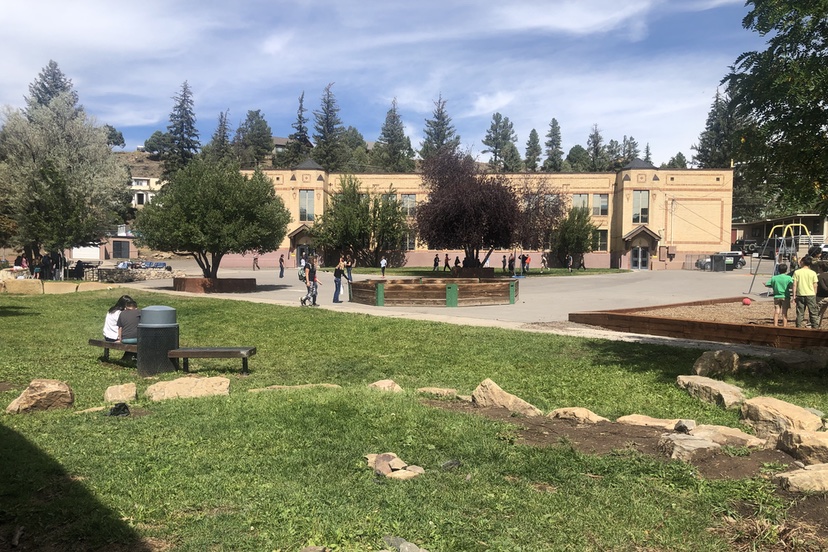
Photo: The Pagosa Springs Middle School campus, fall 2026.
I concluded Part One by mentioning that our government leaders may, or may not, get accurate information from the expert consultants they hire.
This editorial series is titled “Misinformation vs. Disinformation in Pagosa Springs.”
By my definition, “disinformation” means the intentional sharing of false information; a person or organization intentionally trying to trick us with propaganda, by presenting “facts” that they know to be false or intentionally exaggerated.
“Misinformation” on the other hand — as I am defining it — means that someone got their facts wrong, and then shared those wrong facts. They were careless, or were getting their info from an unreliable source, or they misinterpreted “opinions” as “facts”. Such person may or may not have an agenda, but they are not intentionally misleading anyone. It’s just an unfortunate mistake. Happens all the time.
Then we have “opinions”… personal ideas and beliefs, which might be based on accurate information, or on misinformation, or on disinformation. Or on a ‘gut feeling’.
I wrote last week about financial challenges at Pagosa Area Water and Sanitation District (PAWSD) where I currently serve as a volunteer board member. (My editorials do not necessarily reflect the opinions of the PAWSD Board or staff… just my own opinions.). It appears very likely that the PAWSD Board will increase customer fees in the near future to help cover a projected 2027 budget shortfall of around $1.6 million — with a similar shortfall in 2028 as well.
As I mentioned in that editorial series, there’s more than one way to skin a cat, or to balance a budget. As my friend Steve Smith used to say, “There’s no best way to skin a cat. Only better ways.” Raising fees and increasing taxes are two ways to address the increasing cost of government, but there are other ways. Better ways, perhaps?
We’re now heading into another election season, when the local economy is feeling somewhat challenging for many people. The housing crisis remains serious. Inflation is worrisome, with the cost of government as one of the inflationary factors.
According to the U.S. Bureau of Labor Statistics, wages nationally grew by about 3% last month, year over year. Inflation was 3.4% over the same period.
Is this a good year to put a substantial property tax increase measure on the ballot?
Maybe not — judging by the advice given to the Archuleta School District (ASD) Board of Education, last July, by their expert consultant Kathryn Hahne.
Ms. Hahne told the School Board that voters are not likely to approve a $156.5 million property tax increase for a new school on Vista Boulevard. Not right now. Not in November 2026.
Here’s Ms. Hahne, speaking to the School Board last July:
“I will say that, right now is a very difficult political environment. Not just in your district, but in fire districts and counties and municipalities and a whole lot of other districts that I do research for.
“When we attempt to pass tax measures for things that are ‘new’ — versus tax measures that would take care of existing buildings or existing infrastructure — we’re not seeing a lot of success across the state, with any type of measure that talks about ‘new construction’ or ‘new roads’ or anything that’s ‘new’.
“If you think about the economic environment right now, you might feel that your wallet is being… pinched? Especially with how gas prices have been. We all know how high gas prices have been this year. And that’s certainly different than what we saw last year…”
This is not “misinformation” or “disinformation”. This was merely expert advice; an “opinion” based on Ms. Hahne’s years of experience working on ballot measures and her sense of the political environment in 2026.
Nevertheless, the School Board went ahead with their plan to put a big property-tax-funded bond measure — the biggest bond measure, by far, in Archuleta County history — in front of the voters. They’ve been pursuing this specific plan for at least two years now. But the dream dates back to 2011, when the voters overwhelmingly rejected a previous K-8 ‘mega-campus’ south of downtown.
So how do you get Archuleta County voters to approve a $156.5 million property tax increase for a new school, when your community is struggling with what feels like a stagnant economy, ongoing inflation, unaffordable housing, poorly maintained roads, rising utility rates, high gas prices, and various other challenges?
That’s the daunting task that the campaign committee ‘Citizens for ASD’ has taken on.
The tax increase process began in earnest in 2024, with some community meetings led by Archuleta School District (ASD) Superintendent Rick Holt.
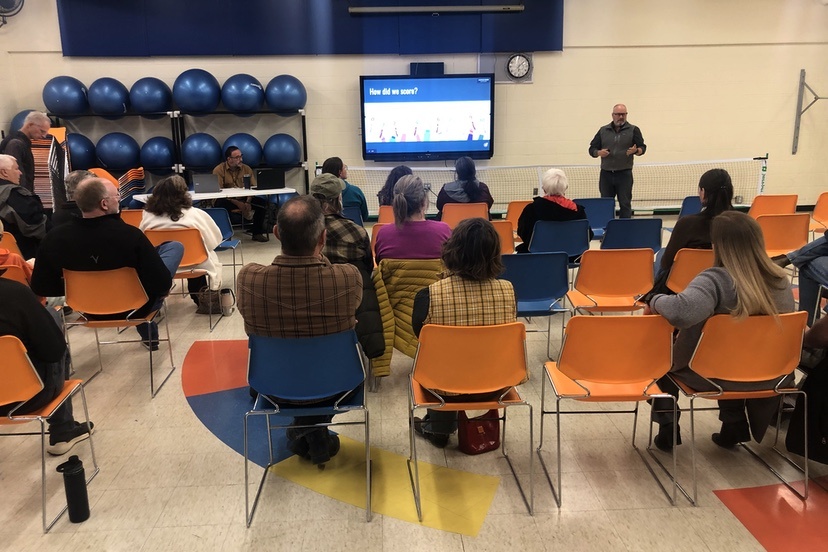
Purportedly, Mr. Holt wanted to hear from the community. The District was struggling to keep up with maintenance on its facilities — as are many school districts elsewhere. Even though the community’s voters had approved a $1.7 million per year Mill Levy Override in 2018, and even though schools had benefited from federal and state COVID funds, Mr. Holt told us that ASD might want to abandon its existing Middle School and/or Elementary School facilities and build new, modern school buildings.
If that’s what the community wants?
Or would the community prefer to keep maintaining and using our older, existing buildings — for at least the time being?
Some of the folks who showed up for Mr. Holt’s presentations wanted the community to pay higher property taxes for a very expensive new facility, and some have recently advertised that desire by posting “Vote YES on 5A” signs in their front yards.
I don’t expect to see “Vote NO on 5A” signs in people’s yards. I suspect a lot of people don’t feel comfortable announcing, publicly, that they’re opposed to “the very best for our kids.”
But… can a typical family in Pagosa Springs really afford “the very best” In 2026?
Read Part Three… tomorrow…