

Photo: The cloud from the first successful hydrogen bomb test in 1952.
I’ve been having a lot of cool dreams lately. I wake up every morning and say to myself, “Wow, that was a cool dream.” Then I sit up and stretch my arms… and the dream instantly fades from my memory.
All I can remember, at that point, is waking up and saying to myself, “Wow, that was a cool dream.”
I sometimes have a vague sense that my ex-wife Darlene was in my dream, and we were still in love. Or that I was rolling dice at a big beautiful casino in Las Vegas and winning thousands of dollars effortlessly. Or that I was heading up a team of scientists who are solving the problem of controlled nuclear fusion.
Like I said, cool dreams.
But totally unrealistic.
I don’t mean to imply that nuclear fusion — the fusion of hydrogen nuclei accompanied by an incredible release of heat and light — is nothing but a dream. The process takes place constantly inside the sun, and creates enough warmth and light to make life on earth possible.
Without nuclear fusion happening inside the sun, I wouldn’t be writing these columns for the Daily Post. Nor would I be waking up and totally forgetting my dreams.
Back in the 1950s, scientists and engineers found a way to make nuclear fusion happen here on earth. They call it, a “thermonuclear bomb.” Also known as a “hydrogen bomb.”
The first successful test of a thermonuclear bomb was conducted by the United States on November 1, 1952. There may have been ‘unsuccessful tests’ prior to 1952, but government people only talk about the ‘successful tests’.
The main fuel in these bombs might be lithium deuteride, a compound of lithium and ‘heavy hydrogen’. But we don’t know for sure, because it’s a military secret. Even though everyone seems to know how build these bombs.
In fact, here’s a drawing of the general design for an H-bomb that I easily found on the internet, just in case you’re thinking of fooling around with the idea.
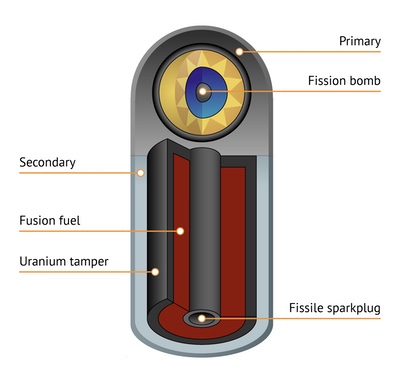
Looks a lot less complicated than the engine of my Subaru. About on the same level as my combination convection oven/air fryer.
The problem with this kind of “uncontrolled” fusion is… yes, it creates a lot of energy at an incredibly cheap price, but it kind of destroys everything in the neighborhood.
So the ‘problem’ I occasionally solve in my dreams isn’t ‘making fusion happen’. We know how to do that. The problem is making it happen in a highly-controlled fashion, similar to the way my air fryer works.
If we could figure out the problem of controlled fusion, humanity could generate all the energy we could ever need, practically for free. A few pounds of lithium deuteride would go a long, long way, if we can figure this thing out.
But most of the scientists and engineers who were working on the problem have walked away from fusion research and are now working on ‘AI’. AI already works and might even make a profit someday, while controlled fusion is definitely not working, even though scientists have been trying to make it work since the 1960s.
One little problem is, to make fusion happen, the lithium deuteride fuel must be heated to temperatures above 100 million degrees Celsius, creating a state of matter known as ‘plasma’. At these temperatures, no solid material can touch the fuel, so scientists have to use fancy methods to keep the plasma from spilling all over the place and burning holes in the floor.
This isn’t a problem when plasma is created inside the sun, because the sun’s incredibly strong gravitational field keeps everything safely contained. But scientists don’t know how to generate incredibly strong gravitational fields. In fact, we don’t even know what ‘gravity’ is. We just know it when we see it.
So the few scientists still working on this project typically use magnetic fields — which we do know how to generate — to confine the plasma. They call the confinement device a ‘tokamak’…
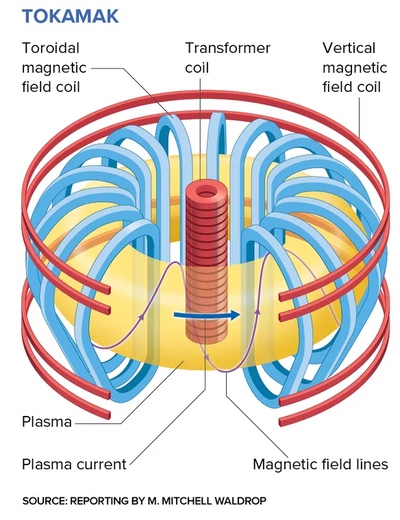
…not to be confused with a ‘tomahawk’, which has a completely different use.
Scientists have had some success causing momentary bursts of fusion energy, but unless AI can figure out the solution, we probably won’t see a useful fusion device in our lifetime. There’s a lot of stuff scientists are still clueless about, according to GitHub.
No fusion device has produced net electricity.
Materials have never been tested under real fusion neutron conditions.
Cost of fusion-generated electricity is genuinely unknown.
Component lifetimes under reactor conditions are uncertain.
The gap between “scientific demo” and “power plant” is enormous.
The U.S. government budgeted about $790 million for fusion research in 2026. That might seem like a lot of money. But for comparison purposes, the municipal government in Durango, Colorado, will spend $135 million in 2026.
If you find this subject fascinating — which I confess I do not, after researching and writing this column — you might enjoy the 122-page ‘2026 Fusion Science
and Technology Roadmap’ from the U.S. Department of Energy, which begins:
This Roadmap does not commit the Department of Energy to specific funding levels. Future funding is subject to Congressional appropriations.
Good luck, guys.
Underrated writer Louis Cannon grew up in the vast American West, although his ex-wife, given the slightest opportunity, will deny that he ever grew up at all. You can read more stories on his Substack account.