
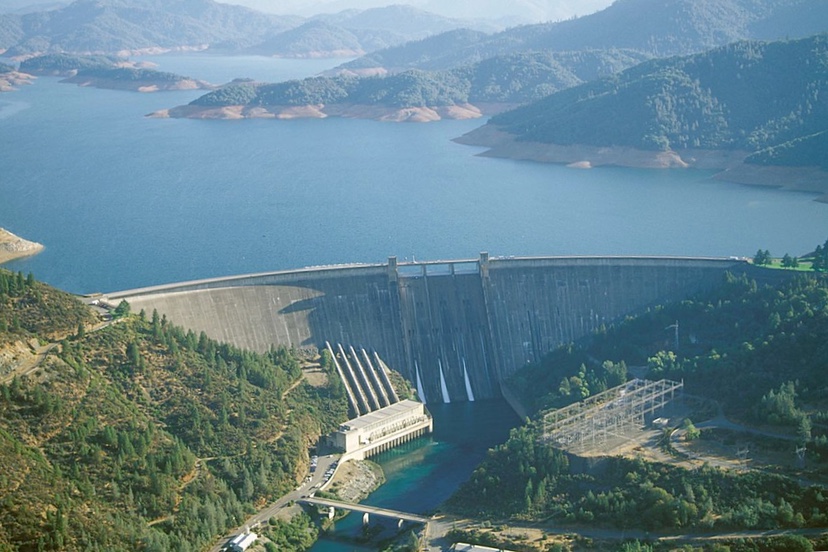
Photo: Shasta Dam in Northern California.
On Friday, August 21, the California Air Resources Board (CARB) issued a “determination” that the Newsom-appointed agency would begin estimating and publicly reporting the yearly greenhouse gases (GHGs) caused by dams and reservoirs across the state.
Importantly, CARB now fills the gap for the same emissions, using the same methodology, that President Trump’s EPA stopped reporting to the U.N. in April of 2025.
The determination comes in response to a petition filed in March, 2026, by conservation and business groups, asking CARB to require dam and reservoir operators to count and report their emissions to CARB — a petition that generated a prominent, front-page, April 15 story in the Los Angeles Times. Although CARB formally denied requiring dam and reservoir operators to count and report their emissions, CARB granted the petitioners “relief” that included the agency itself estimating and publicly reporting the significant amount of dam and reservoir GHG emissions across the state using the same EPA-approved methods recommended by the Intergovernmental Panel on Climate Change (IPCC).
“We are pleased that California is taking up the slack in climate reporting that the Trump Administration has so mistakenly dropped,” said Keiko Mertz, Policy Director for Friends of the River, one of the conservation group petitioners. “Hot, polluting reservoirs devastate rivers and worsen the climate crisis. By measuring reservoir emissions, California is being a climate leader across the U.S. and the planet.”
On page 2 of the determination, CARB describes the actions it will take in response to the petition:
“As an alternative solution to the action requested by the petitioners, CARB intends to work to resolve the petitioners’ concerns over accounting for GHG emissions from dams and reservoirs in California’s inventories, starting by:
- taking appropriate actions to incorporate greenhouse gas (GHG) accounting for dams and reservoir systems within CARB’s Natural and Working Lands
(NWL) Carbon Inventory; - taking initial steps to report dams and reservoir system emissions as Flooded Lands within the wetlands category (3B4) of the Intergovernmental Panel on Climate Change (IPCC) standardized GHG accounting framework;
- reviewing existing research and identifying need for future research to support direct measurement of emissions from dams; and
- convening a meeting to discuss hydropower-related GHG accounting andinviting other state partner agencies to participate in that meeting.”
The thoroughly researched 29-page determination also includes a lengthy scientific review of how and why dams and reservoirs cause the emissions of GHGs — which is the first time a California state agency has officially acknowledged that these emissions exist — as well as describing the biological and chemical pathways that cause dam and reservoir GHG emissions.
“We’ve long known dams and reservoirs contribute to the climate and nature crisis,” said co-petitioner Patagonia CEO Ryan Gellert. “We applaud CARB’s recognition of that fact and its commitment to assessing the greenhouse gas emissions caused by dams and reservoirs across the state. This is a critical step forward in California’s transition to cleaner energy and water infrastructure.”
California is now the first state in the U.S. to take action using the best-available climate science for how dams and reservoirs cause GHGs. Our coalition of petitioners looks forward to continuing to engage with CARB to implement this determination.
The co-petitioners are Tell the Dam Truth, Patagonia, California Trout, Friends of the River, Ridges to Riffles Indigenous Conservation Group, Ríos to Rivers, Center for Biological Diversity, and Save the World’s Rivers.
Gary Wockner, PhD, is a scientist and conservationist based in Colorado. Follow him on Twitter, @GaryWockner. Learn more at savethecolorado.org