
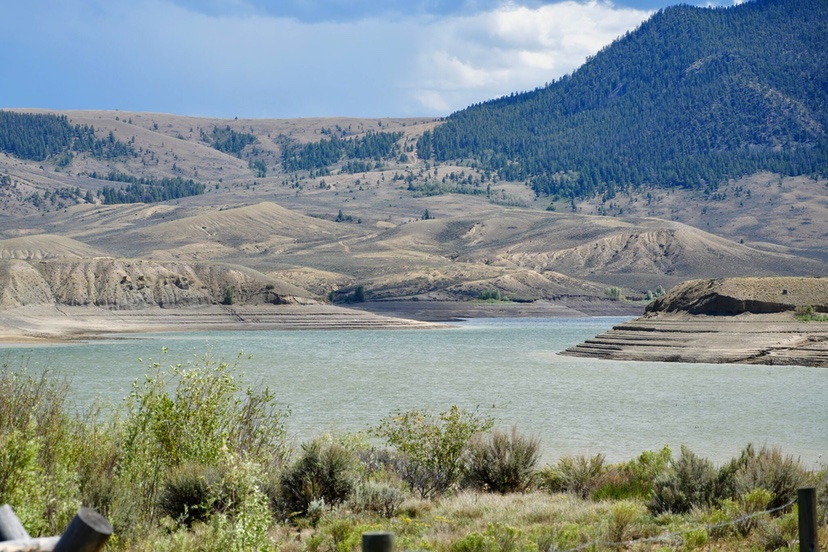
Photo: Water levels in the Wolford Mountain Reservoir in Grand County, which dams a tributary of the Colorado River, have dropped by more than 30 feet during extreme drought conditions in 2026. (Photo by Chase Woodruff/Colorado Newsline)
This story by Chase Woodruff appeared on Colorado Newsline on August 21, 2026.
Routt County rancher Philip Rossi knew as early as January of this year — as the Flat Tops range above the Yampa River basin sat largely bare of snow — that 2026 would be a difficult water year.
“You can just feel it,” said Rossi, whose family has run cattle in the upper Yampa River valley for more than a century. “This is no good. We’re just not getting any moisture.”
Water managers at the Upper Yampa Water Conservancy District say that agricultural irrigators across the district received only about half of their normal water allocation from storage infrastructure like the Yamcolo and Stillwater reservoirs this year. For Rossi, it was even less, forcing him to pick the best quarter of his cropland to irrigate and let the rest go dry.
“Being in this area all my life, this has been the worst that I’ve seen,” Rossi said. “We’ve had our (bad) years — 2012, 2002, 1977. This is the worst that it’s been for me.”
Some ranchers in the Yampa basin had to cull a third of their herds before the spring calving season, said Todd Hagenbuch, Colorado State University’s extension agent for Routt County. This summer, many are trucking water to overstressed pastures to keep their cattle alive.
Agricultural producers are coping with similar challenges in river valleys all across Colorado’s Western Slope, where cumulative streamflows — a measure of the total amount of water that has flowed past a given point on a river since the previous October — range from near-record to record lows. In nearly a century of record-keeping, total water volumes have never been lower on the Colorado River at Cameo, just upstream of Palisade and Grand Junction, than they have been this year.
The effects of this extreme drought, part of a long-term warming and drying trend fueled by human-caused climate change, will be felt long after the dismal 2026 water year ends, even if hoped-for projections of a wetter-than-average winter come true. Hard choices will need to be made as feed remains scarce, and fuel, fertilizer and other input costs for farmers and ranchers continue to soar.
“Decisions being made with cattle herds in Grand County will be similar to the ones being made in Routt County, in Gunnison County, in Saguache County,” Mike Ritschard, a Middle Park rancher and Colorado River District board member, told a state water conference Thursday. “How do we hold it together for the next year and the year after? Do we cut cattle numbers to the feed we have? Do we buy feed and haul it to the cows so they can stay on the ranch? How much is the cost of hay or alfalfa, the cost of trucking?”
Other drought impacts can be felt across Colorado’s economy, especially in mountain resort towns where dry streams and rivers limit fishing and rafting and many reservoirs are closed to boating. But it’s the agricultural sector where chronic drought conditions pose the most immediate and existential threats.
Roughly 90% of the water used in Colorado goes towards irrigating farms and ranches, the overwhelming majority of it to grow alfalfa, grass pasture and other crops used to feed livestock. And as long-running discussions about the future of water in the West enter a tense, high-stakes new phase, Colorado agriculture hangs in the balance.
Just as experts and decision-makers from across the water policy landscape gathered in Steamboat Springs this week for the annual summer conference of the Colorado Water Congress, grim news arrived from about 600 river miles downstream: Water levels in Lake Powell, on the Colorado River along the Arizona-Utah border, had officially fallen to a record low, the Bureau of Reclamation announced. Further downstream, Lake Mead, which together with Lake Powell forms the backbone of a Colorado River Basin system that serves an area home to 40 million people, hit its own record low a week earlier.
Years of negotiations between Colorado and six other Colorado River Basin states have failed to produce a new long-term agreement on water allocations, and a set of federal operating guidelines for Lakes Powell and Mead that had been in place since 2007 will expire at the end of this year.
Under a new plan announced by the Bureau of Reclamation last month, Colorado would continue to be spared from federally-mandated cuts to water use, while the Lower Basin states of Arizona, Nevada and California could face sharp curtailments. The new guidelines, which must be finalized by October, appear increasingly likely to prompt a historic lawsuit by Arizona over allegations that Colorado and other Upper Basin states aren’t sending enough water downstream.
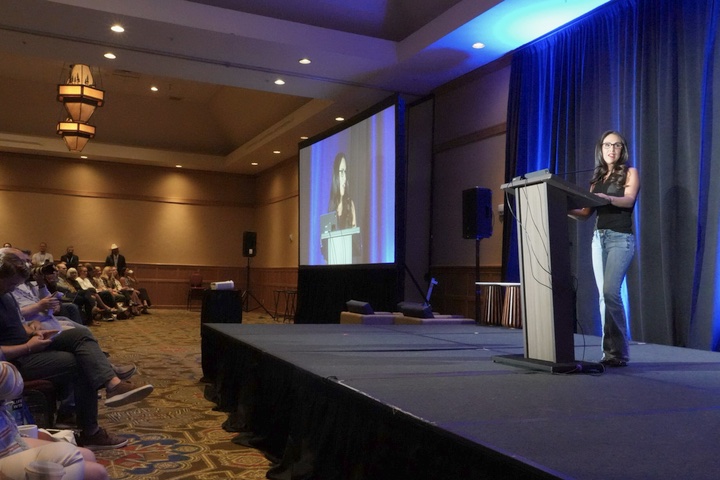
Addressing the Water Congress, Colorado Attorney General Phil Weiser, the Democratic nominee for governor and the heavy favorite in November’s general election, sounded some of his campaign’s most well-worn themes as he emphasized the role of “collaboration and innovation” in meeting drought challenges, and promised “a system of water management that involves real listening and grassroots governance.” But he and other elected officials from both sides of the aisle also drew a sharp line against efforts by other states that could harm Colorado water users.
“My job as attorney general — and I will take this responsibility as governor as well — is to defend our rights and interests,” Weiser said. “We’re not going to walk away from our hard-earned rights.”
U.S. Rep. Lauren Boebert, a Windsor Republican, put things even more bluntly.
“I have a lot of dear friends in Congress. One of them, hopefully, will be the next governor of Arizona, Andy Biggs — and I tell him all the time, ‘We’re getting our water back,’” Boebert said. “Y’all better get real good at that xeriscaping for your lawns and everything you’re building out there. Your cacti might do just fine. But we’re taking it back.”
Threats of litigation
The seeds of the West’s current water-management crisis were planted in the 1920s, when the seven states making up the Colorado River Compact agreed to divide the basin’s water based on a faulty estimate of typical annual flows. The agreement allocates a total of 16.5 million acre-feet of water each year to its member states and Mexico, but 20th-century flows in fact averaged closer to 14 million acre-feet, and the onset of the region’s climate-fueled megadrought has depressed them even further, to an average of less than 10 million acre-feet.
After years of stalled negotiations between the states, the urgency of looming federal intervention and this summer’s extreme drought conditions doesn’t appear to have brought them any closer to a deal. On the contrary, it’s led to an increasingly bitter and public war of words between the Upper and Lower basins, with Colorado at the head of the former and Arizona leading the latter.
As Colorado officials tell it, the Lower Basin states failed to recognize the threat posed by the post-2000 megadrought until it was too late, and spent years recklessly depleting Lakes Powell and Mead after it was clear conservation was necessary. The Upper Basin states have long used less than their full combined allocation of 7.5 million acre-feet. As the Colorado River’s headwaters state, Colorado has never been able to rely on upstream storage to meet its water needs; it’s the first to feel the impacts of dry years, its defenders say, and has modeled conservation efforts that the Lower Basin has been slow to adopt.
“The fact of the matter is that the Lower Basin didn’t take cuts until 2022,” Becky Mitchell, who leads the state’s Colorado River negotiations as its commissioner to the Upper Colorado River Commission, said during a Water Congress panel Thursday. “We’ve been in a record drought for nearly 20 years, and cuts were not taken from the releases from those reservoirs until 2022.”
“If we don’t make fundamental changes before we continue to look upstream for more, there’s not going to be an ATM to pull from, and that’s what I’m looking for in the next agreement,” she added.
“We cannot provide certainty to our Lower Basin neighbors that we, as Upper Basin water users, have never had ourselves,” said Amy Moyer, chief of strategy for the Colorado River District. “And this year demonstrates better than any other the lack of certainty for water users in Colorado.”
Some water experts, however — including former Colorado River District general manager Eric Kuhn — have disputed the Upper Basin states’ claim that they already routinely use less water in dry years. And some conservation advocates are beginning to see cuts to water use in Colorado as an expedient way to keep a threatened river system alive: “Every drop of Rocky Mountain water that California is legally entitled to, supports thousands of miles of riparian habitat as it flows downhill to its destination,” wrote author Zak Podmore earlier this year.
The Lower Basin states, meanwhile, consider Colorado’s refusal to accept any mandatory cuts — a position reiterated by Mitchell and Moyer on Thursday — to be a dealbreaker. The Arizona Department of Water Resources has retained a top law firm as it prepares for a possible legal challenge against the Bureau of Reclamation’s post-2026 operating guidelines, and last week, reiterated its legal threats in a letter to the Interior Department, which oversees the agency.
“By refusing even to articulate its understanding of (Colorado River Compact) requirements, the Department gives Arizona neither transparency about how the River will be managed nor any basis on which to plan for its water future,” wrote ADWR director Thomas Buschatzke. “As a result, Arizona reserves the right to seek the resolution of its Compact rights in an appropriate judicial forum.”
Weiser, at the Water Congress, called federal intervention a “suboptimal situation.”
“We’re going to work to make sure we’re protecting all of our communities, and make sure that all basins can make reasoned and sustainable decisions,” he said. “I’m not going to be afraid to make the right deal. I’m also not going to be afraid to challenge the wrong deal.”
Later, Mitchell’s voice wavered with emotion as she responded to critics who say that what Colorado has offered at the negotiating table is “not enough.”
“I ask you to think about your children’s futures, and what you’re willing to give on their behalf,” Mitchell said. “When you say more, I want you to pick out who you want that to come from — and if it’s not yourself, then that’s not where the solution lies.”
Colorado Newsline is part of States Newsroom, a nonprofit news network supported by grants and a coalition of donors as a 501c(3) public charity. Colorado Newsline maintains editorial independence. Contact Editor Quentin Young for questions: info@coloradonewsline.com.