
We’re sitting in Commissioners’ meeting room at the Archuleta County administrative offices on Lewis Street, looking at some numbers — millions of dollars of future debt — projected on the room’s video screens.
A block away, the Colorado Department of Transportation (CDOT) and its contractor WW Clyde continue to tear up Highway 160, with a promise that we’ll have a safer, more durable roadway when they are finished — maybe this year?
Reported cost of the project: $24.5 million.
The highway project is being funded mainly by taxpayers across the state of Colorado, and also by U.S. taxpayers through federal grants. But many millions of dollars have been contributed to the project by local Pagosa Springs governments — particularly, by the Town of Pagosa Springs, and by Pagosa Area Water and Sanitation District (PAWSD).
CDOT knew the approximate cost of the project before they started last year, because WW Clyde had submitted a bid and won the contract. But before that winning bid came in, CDOT had estimated the cost at around $19 million. At that point, they were sort of shooting in the dark. Their estimate was only about 75% of the actual bid.
Back in 2022, three Archuleta County commissioners sold the historical County Courthouse, overlooking Highway 160 in the center of downtown, for about $550,000. The building measured 25,000 square feet, but most of that space — 19,000 square feet — was County jail and Sheriff offices. The rest of the County officials and the District Court were operating in 6,000 square feet.
A study by a local architect suggested that the County officials and employees would be more comfortable if they had 22,000 square feet of space… in addition to a new jail ($20 million) and a new Courthouse ($6 million) and a new Sheriff’s office/Dispatch Center (not sure of the cost.)
We now have the new jail and a new Courthouse and new Sheriff offices. And new long-term debt.
But let’s get back to the Commission meeting on August 11. Almost everyone who had packed the meeting room at the start of the meeting…
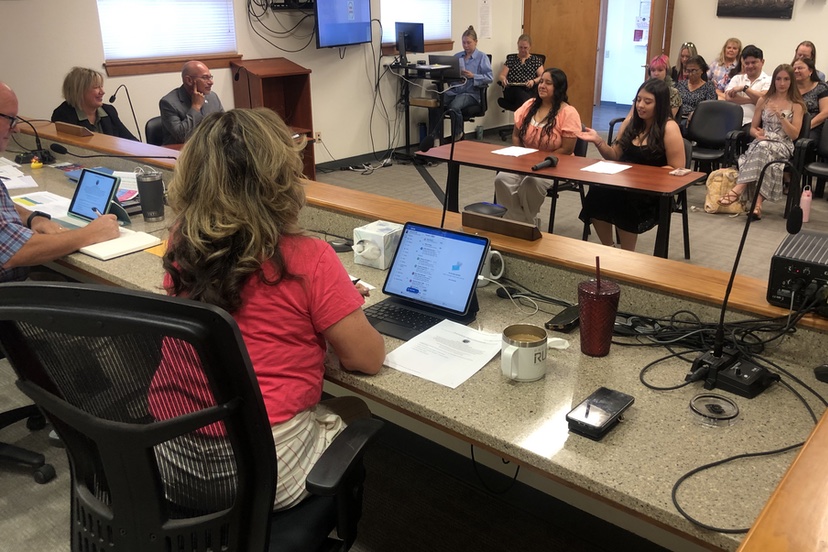
…has now departed, so only a few of us are hearing Commissioner John Ranson discuss the numbers he’s projecting on the video screens.
“We’ve had discussions over the past several months about different possibilities for the Admin building. We had an executive session when we were in Arboles in June. Had another one last week. And so far we haven’t reached a point where we are moving ahead.
“And part of the problem, in my mind, is that one of the locations we’re looking at, is a ‘remodel’… and they did not really want their name out there [in the public] because they have a current tenant. But they have, since our meeting last week, said… if it helps to name the location…
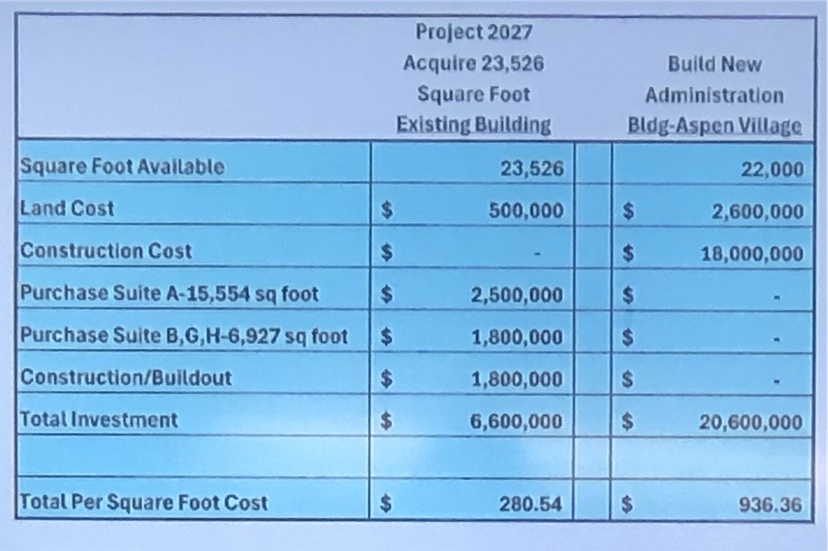
“So I presented a couple of different options, comparing the spaces — and I have handouts [for the media] — and putting them side by side… the Project 2027… it’s basically the [Camino Real location] and two adjacent suites… enough space for current needs, and the additional spaces in the future…
“And you see the land costs would be for the vacant parcel next door… for parking…”
The chart compared the cost for a remodeled ‘Camino Real’ facility and the cost for a brand new building constructed in Aspen Village.
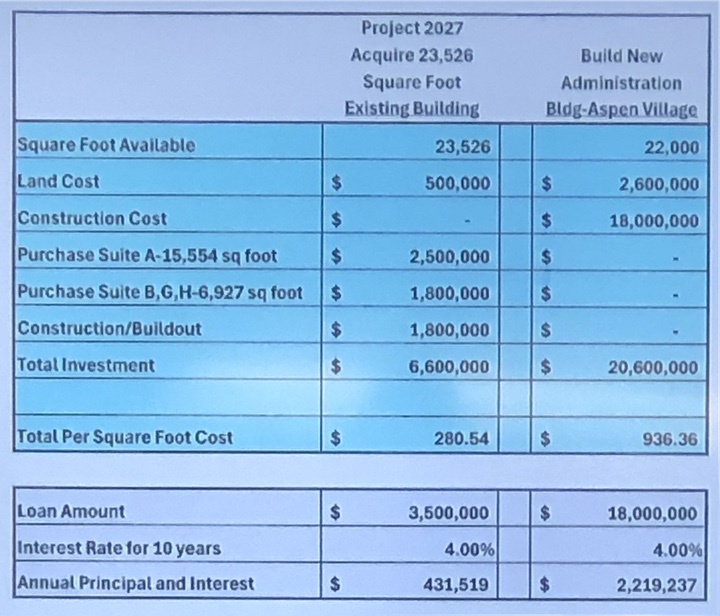
Commissioner Ranson is partly shooting in the dark, here, because the BOCC has never gotten a firm price for a proposed 22,000 square foot facility on their $2.5 million parcel in Aspen Village. We also don’t know how accurate Commissioner Ranson’s numbers are, for remodeling the ‘Camino Real’ building.
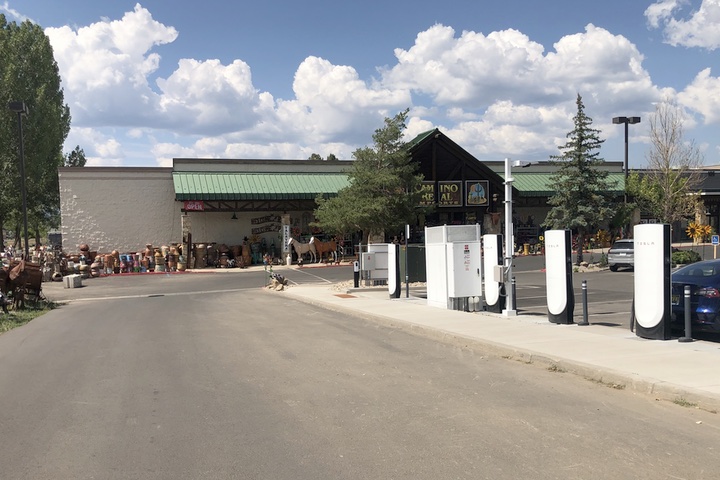
But we might find it interesting that the potential Camino Real facility would be served by new Tesla EV charging stations.
Looking into the future, I mean. When everyone is driving EVs?
I find it interesting that Commissioner Ranson is referring to this Camino Real option as ‘Project 2027’. The obvious indication here being, that the County could feasibly be moving into this space next year.
Finished construction in Aspen Village, by comparison, is at least three years in the future, even if enough money could be found. And at three times the cost to the taxpayers?
Commissioner Ranson mentioned two other options: an expansion of the Wyndham building on Village Drive, and “do nothing”. (Doing nothing is always an option. The County government is functioning reasonably well, at the moment, in its existing facilities.)
“I’m not pushing for this [Camino Real option] but I am asking that we have a conversation, and let these [owners] know if we’re not interested… and then move ahead with the new building. But I’m not going to vote for a $20 million COP. I just can’t do it.”
When a government leader is faced with an option that appears likely to save the taxpayers tens of millions of dollars, it’s always possible to bring up reasons for spending more money on a more expensive option.
Here’s Commissioner Veronica Medina, reacting to Commissioner Ranson’s presentation.
“Thank you, Commissioner Ranson, for your due diligence and working on this. I know it takes a lot of work and dedication to get the numbers…
“Looking at that property, a couple of concerns for me is the wetlands that are there, and then… that area there is already so congested, with traffic, which is the businesses that are there… City Market… I just worry, because if you look at the parking lot [where County offices are currently operating in the Wyndham building] they are just jam packed, and I know we’re causing hardship on the businesses there…”
Parking is certainly a concern when choosing the location for a public facility — but I wonder if Commissioner Medina didn’t hear Commissioner Ranson’s suggestion that the County could expand the shopping center’s parking lot onto a vacant parcel next door?
Nevertheless, Commissioner Medina had additional reasons why saving the taxpayers millions of dollars might be the wrong idea.
Bill Hudson began sharing his opinions in the Pagosa Daily Post in 2004 and can't seem to break the habit. He claims that, in Pagosa Springs, opinions are like pickup trucks: everybody has one.