
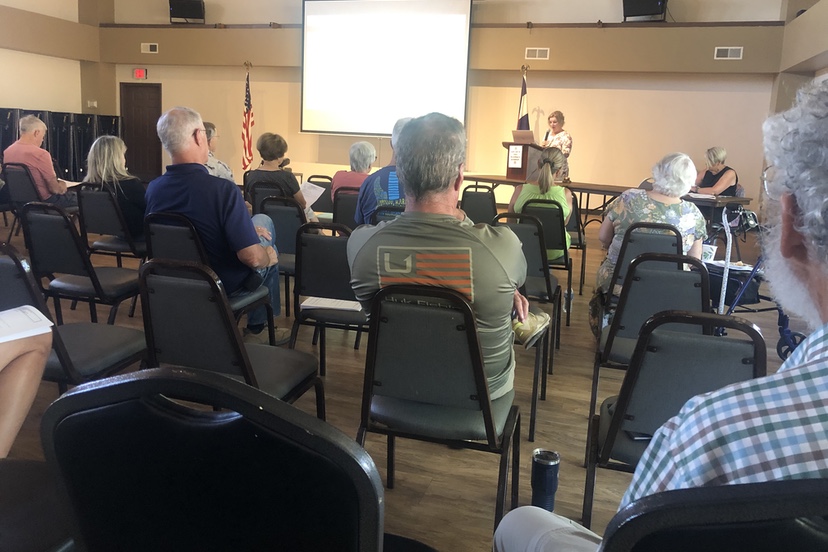
Photo: Lauren Holms, long-time attorney for the Pagosa Lakes Property Owners Association (PLPOA), presenting at the July 25 annual meeting.
I attended the annual meeting of the PLPOA on Saturday and heard about budgets, the recreation center, trails, fishing, youth activities, pine needles, wildfire mitigation, and a variety of other association-related topics. The presenters included staff, committee members, Board members… and we were treated to a fairly lengthy ‘member education’ segment by Association attorney Lauren Holms.
But no one mentioned data centers.
I’ve lived in Pagosa Springs for over 30 years and had never before attended a PLPOA annual meeting, due mainly to the fact that my property is not within the Association boundaries. Nevertheless, I found the 2 1/2 hour meeting to be educational and occasionally entertaining.
About 50 people attended in-person, and I presume many others listened in, via Zoom. Two new Board members were approved, and the members voted to allow the Association to carry over unspent funds from the current fiscal year to next fiscal year. During public comment, a handful of Association members asked thoughtful questions about PLPOA processes and procedures.
But, again, no one mentioned data centers.
This is understandable. Although data centers have become highly controversial of late, the likelihood that a data center might be built within the PLPOA boundaries is slim-to-none. The 21-square mile collection of subdivisions is platted almost entirely for residential properties and dedicated open space, with a very limited amount of commercially zoned properties. Considering that the average new data center has a footprint of about 300,000 square feet — about 7 acres — the PLPOA area offers limited possibilities for a developer.
New ‘hyperscale’ data centers can measure more than 20 acres in size.
Of course, outside the PLPOA boundaries, plenty of large ranch properties exist across Archuleta County. There are, in fact, a couple of potentially suitable commercial properties within the Town of Pagosa Springs’ municipal limits.
Which might be why the Town Council discussed data centers last Tuesday.
There seems to be a shared sense, among our local leaders, that we ought to prioritize human existence, first and foremost.
The turnout in Kenilworth [New Jersey] was part of the National Day of Action, a set of demonstrations against AI data centers announced not by the usual tired hippies but by the right-wing nonprofit Humans First. The protest day had 120 construction projects across 37 states in its sights, including one in Wasilla, Alaska, and 18 in Texas. All week, Humans First chair Amy Kremer, a MAGA firebrand, had been beating war drums. These protests, she’d prophesied in RealClearEnergy on July 14, would power a Tea Party–scale revolution against the technopolitical machine that’s steadily choking out American life…
— from an article by Virginia Heffernan in The New Republic, July 23, 2026.
Reportedly, no data center developers have applied for building permits within the Town of Pagosa Springs, an isolated rural community on the eastern end of Southwest Colorado, nestled up against the Continental Divide.
If there was an ‘anti-data-center’ protest held here on July 18 — during the ‘National Day of Action’ organized by Humans First — I didn’t hear about it. We’re not a very likely location for a data center, nor for an ‘anti-data-center’ protest. Organizers have enough trouble getting a dozen people to protest the Trump administration every Saturday out in front of the library.
That being said, most of us do not want a data center here.
This is a decidedly different situation from the Walmart controversy back in 2015, when a small group of activists and business owners were campaigning to prevent the arrival of Walmart, while our elected government leaders — and most of the local population — were eager to see a big discount store finally make an appearance here.
I would venture to say that the number of people — and government officials — who would actively welcome the construction of a data center in Archuleta County can be counted on the fingers of one hand.

One of those fingers seems to be a newly-appointed member of the Pagosa Springs Town Council: Vahid Shabro.
From the Town website:
The Town of Pagosa Springs is pleased to welcome Vahid Shabro to the Pagosa Springs Town Council.
Vahid is an energy and climate professional with a background in science, engineering, software, and artificial intelligence. Throughout his career, he has focused on using data, modeling, and technology to support informed decision-making and help organizations navigate complex challenges. He currently develops technology that assesses climate and financial risk.
More about Mr. Shabro. later.
The Town Council met last Tuesday, and one of the items on the agenda looked innocent enough:
4. Data Center Use Classification
For many years now, our local governments have been making an effort to control and direct how property owners use their property, with certain goals in mind.
1. Keeping the community from changing too much.
2. Encouraging the community to change.
3. Protecting property values.
4. Making housing more affordable.
5. Increasing tourism visitation.
6. Diversifying the economy to become less dependent on tourism.
As we can easily see, some of these goals are conflicting. When a conflict arises, local government leaders need to pick sides, and they often pick the side of “what will generate the most tax revenue.” But not always.
The question presented to the Town Council by Town Planning Director Owen O’Dell was not terribly complicated.
The Town’s Land Use and Development Code (LUDC) defines building types and specifies which building types are allowed in each zoning district. The general idea is to protect residential homes from the inconveniences (traffic, noise, pollution, etc.) caused by commercial uses.
But the LUDC can also define certain types of buildings, and building uses, as prohibited, everywhere. But the LUDC does not clearly define a ‘data center’.
As Mr. O’Dell explained to the Council on Tuesday:
…The rise in artificial intelligence [use] by both consumers and organizations has necessitated the growing demand for data centers and the resources they require.
Currently, our Land Use Development Code (LUDC) does not address such use. When an application is made for a type of use that is not specifically listed in Table 4.1-1, the Director shall make a determination as to the appropriate classification of a new or unlisted form of land use. Currently, the most closely related use the Town has with Data Centers would be the use of a Warehouse, which is defined as:
“A structure containing an area available for the purpose of storing raw materials, goods, or property.”
Warehouses are allowed in the Commercial zone with a Conditional Use Permit, but they are permitted by right in the Light Industrial zone. With the intensity of use for Data Centers, combining its type with Warehouses presents potential issues for the Town and its ability to regulate such use. With rising concerns, we have seen moratoriums across the country and even locally by Archuleta County…