
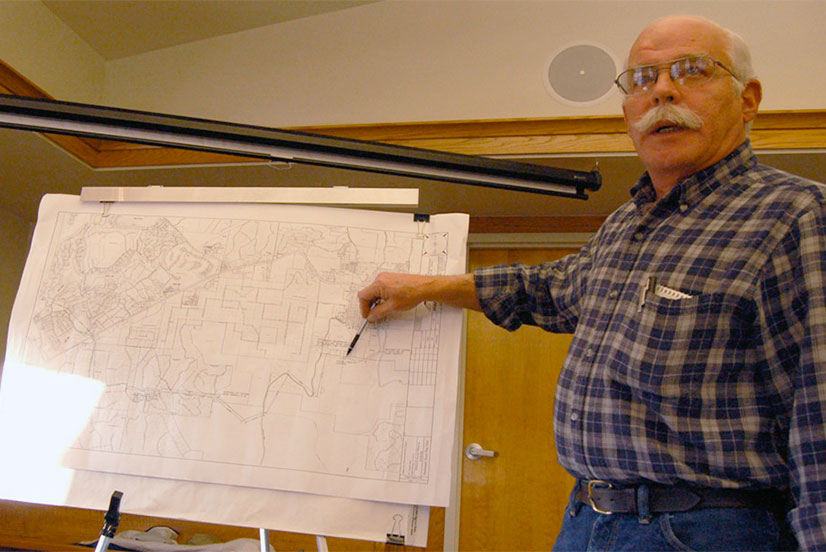
Photo: PAWSD then-project-manager Gregg Mayo points out the route of a new sewer line, leading from the Town of Pagosa Springs through several semi-rural neighborhoods to the uptown Vista Treatment Plant. November 2011.
There is no finish line for local change. A prospering community is not a project to complete; it’s a living thing, shaped and reshaped over time by the people who care for it…
— from an newsletter emailed by StrongTowns.org, June 19, 2026.
We concluded Part Two of this editorial series on Friday with a comment about the relationship between Pagosa Area Water and Sanitation District (PAWSD) and the proposed Pagosa West subdivision at the west end of town. The 100-acre Pagosa West subdivision — if it happens — will rely on PAWSD to provide drinking water and sewer treatment services.
The Pagosa Springs Planning Commission will consider a preliminary ‘Sketch Plan’ approval tomorrow, Tuesday June 23, at 5:30pm at Town Hall. This is a public hearing and members of the public can submit written comments (prior to the meeting) or oral public comments during the hearing.
The application is available for review here.
PAWSD provides drinking water to perhaps 75% of the homes and businesses in Archuleta County, and sewer treatment for a similar proportion of the community. But the sewer services can be viewed as two different types. For homes and businesses in the uptown Pagosa Lakes area, the sanitation system is a ‘direct’ connection to the Vista Wastewater Treatment Plant on Lyn Avenue.
But the area of town east of Piedra Road — including Harman Park, downtown Pagosa Springs, and some properties east of downtown — have their sewage collected by the Pagosa Springs Sanitation General Improvement District (PSSGID).
Here is where we get into the really expensive mistakes, funded by the taxpayers and sewer customers.
Disclosure: I currently serve as a volunteer on the PAWSD Board of Directors, but this editorial reflects only my own opinions, and not necessarily the opinions of the PAWSD Board and staff.
Back in about 2008, the PSSGID treatment lagoons near the Pagosa Springs High School were failing to treat sewage to the standards set by the state of Colorado, and the insufficiently-treated wastewater was flowing into the San Juan River. So the Town leadership began applying for grants to build a new state-of-the-art treatment plant at the lagoon site, and obtained a grant from USDA to help fund this new treatment facility — which as I recall would cost close to $6 million. Most of that money would need to come from customer fees.
Work on engineering and design were begun.
But the leadership at PAWSD brought the Town Council an intriguing proposal. Since the PAWSD Vista Wastewater Treatment Plant was operating at only about 1/4 capacity — we were told — the Town should built a seven-mile-long, uphill sewer pipeline and let PAWSD treat the sewage. The Town would pay only PAWSD’s actual cost for treating the wastewater, plus any expansion or upgrades that might be needed in the future.
The engineering and design work for the Town’s new state-of-the-art plant was stopped, and a series of backroom negotiations resulted in the Town Council agreeing to build the pipeline — originally priced at about $4.5 million.
In 2012, a Kansas City engineering firm called Bartlett & West — with whom PAWSD’s then-district-manager Ed Winto had a friendly relationship — was contracted to design the pumping system for the seven mile pipeline…
…a system unlike any seen anywhere in the United States, I’ve been told…
…through a landscape plagued along the route by solid rock.
The project didn’t cost $4.5 million. The final cost was closer to $9 million.
Four years later, in 2016, the sewage pumps were fired up. And the problems began.
Within a few months, the pumps specified by Barlett & West began failing, suggesting the risk of raw sewage overflowing into the San. The Town staff noted that Barlett & West had neglected to provide a storage solution for a potential pump failure, and had to build a new containment facility for $600,000. The neighbors along the pipeline route began to file complaints about unpleasant odors, and the Town spent more money addressing the smell.
New pumps were installed and also failed. The sensitive control panels within the pump houses began to fail due to the sulfuric sewer gases. New pumps were purchased and installed, and also failed. The Town began re-commissioning the abandoned downtown lagoons for emergency storage of raw sewage overflows.
Last week, at the June 16 Town Council meeting, Town Manager David Harris asked the Council to approve additional expenditures to keep the pipeline functioning.
The price tag for new repairs and upgrades? $3.9 million.
But it gets worse.
The treated water coming out of the Vista Wastewater Treatment Plant flows into Martinez Creek, which then flows into Stollsteimer Creek, which in turn flows into the Piedra River.
The Piedra River helps fill the Navajo Reservoir.
The folks at the Colorado Department of Public Safety and Environment (CDPHE) had determined that the Piedra River was a “river of concern” — meaning that it deserved special protection from pollutants such as nitrogen and phosphorus.
The addition of the Town’s wastewater at the Vista plant meant that PAWSD was now pumping over 1 million gallons per day into Martinez Creek. Because of that volume of effluent, CDPHE determined that PAWSD now had to do a better job of removing nitrogen and phosphorus from its effluent.
For the past few years, PAWSD has been designing and building additional treatment facilities to remove those pollutants. Cost? $10 million.
Under the agreement between the Pagosa Springs Sanitation General Improvement District (PSSGID) and PAWSD, the Town sanitation system customers are on the hook to pay one-quarter of that cost. So, $2.5 million just for the upgrades at the Vista plant.
Back in 2010, a state-of-the-art treatment plant near the High School was priced at about $5 million. The Town had a grant to help fund it.
But the decision by the Pagosa Springs Town Council and the PAWSD Board of Directors, to build a sewer pipeline instead of a new treatment plant downtown, has now cost well over $20 million.
Bill Hudson began sharing his opinions in the Pagosa Daily Post in 2004 and can't seem to break the habit. He claims that, in Pagosa Springs, opinions are like pickup trucks: everybody has one.