Photo courtesy U.S. Forest Service
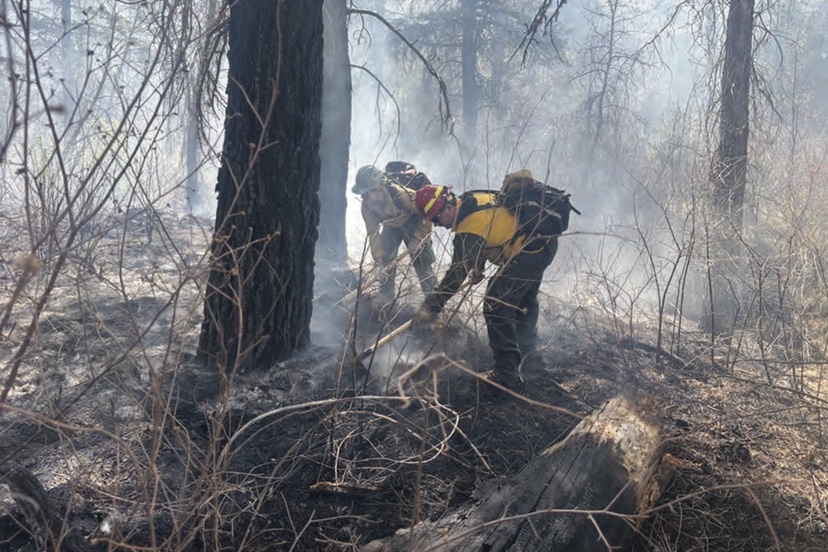
A front page story in the Pagosa Springs SUN on Thursday reported that local firefighters dealt with three wildfires along Deep Canyon Road near Chimney Rock National Monument:
According to the Archuleta County Sheriff’s Office (ACSO), area agencies responded to three separate fires along Forest Service Road 842/Southern Ute Road 152 (Deep Canyon Road) at approximately 1pm on April 28. Those resources, according to the agency, included the U.S. Forest Service, ACSO, Archuleta County Road and Bridge, Pagosa Fire Protection District, U.S. Wildland Fire Service, Southern Ute Tribal rangers, and Southern Ute Police Department.
Shortly after 5pm the San Juan National Forest reported the fires were nearing containment, “thanks to a quick response from multiple agencies.”
Some of us see ‘wildfires’ as a constant theme for our lives… here in Pagosa Springs, in 2026. Some of us may have already prepared a ‘Go Bag’ that includes essential personal items.
From the Western Fire Chiefs Association:
- 3 gallons of water per person
- 3 days’ worth of non-perishable food
- Any required prescriptions or medications
- A map including two or more evacuation routes
- Extra eyeglasses or contact lenses
- A change of clothing for each person
- Cash, credit cards, and keys
- Sanitation supplies
- First aid kit
- Battery-powered radio and flashlight
- Important documents
- Food and water for any pets evacuated
From the federal CDC website:
Know your community’s evacuation plans.
- Find several ways to leave your area.
- Drive the evacuation routes and find shelter locations.
- Have a plan for pets and livestock…
I will be writing, later this week, about a recent presentation by Wildfire Adapted Partnership at a Board of County Commissioners work session last month — but that’s only one of the recent community presentations focused on the upcoming 2026 wildfire season.
Colorado will experience wildfires this summer. No doubt about it. Where, and how devastating, remains to be seen.
This editorial series has been focused on what seemed, on April 7, to be a foregone decision by the Pagosa Springs Town Council to try and purchase at least 300 acres of forested land south of the existing Reservoir Hill Park, thanks in part to a potential $5.9 grant from the federal Forest Legacy Program. The property is currently owned by Fairway Land Trust and was once intended to be developed as a high-end residential neighborhood.
The Trust received an award in 2009, honoring its tree-thinning efforts, and would now like to sell the property to our local government as a wilderness park. The entire Council appeared in favor of spending tax money on the purchase. Possibly in excess of $8 million?
The federal grant would prohibit the construction of physical park amenities on the 300 acres, to preserve the ‘wilderness’ character of the property and would thus severely limit the future uses of the forest — presumably, to purely hiking and biking. And bird watching, perhaps?
Question: Does our Town government — as representatives and servants of our community — want to assume responsibility for permanently preserving 300 acres of flammable forest adjacent to one of the most densely-occupied neighborhoods in Archuleta County?
Like… Is it good government policy to intentionally maintain forests in the midst of residential and business neighborhoods? Can we ask that question?
During the Town Council’s April 7 work session, at which all six Council members indicated their support for what might be an $8 million purchase of purely recreational property, Council member Gary Williams made what I found to be a very curious statement. He suggested that fellow Council member Leonard Martinez “is always concerned about diversifying our economy. And I’ve said before, I think that’s a great idea.”
“I’ve worked in lots of small towns that tried to do that. And they didn’t have the resources we have here, in terms of natural resources. And so I’ve always seen diversifying our recreational opportunities as a way to diversify our economy.
“Basically, the factory we have is the tourism factory, and we turn the crank and there’s lots of things people can do here…”
Lots of things tourists can do here, in other words.
“And this [proposed purchase of Reservoir Hill property] increases that. And that’s good. With a changing climate, then there will be more things to do in town when there’s no snow… and this and that. And I can see Reservoir Hill playing a big part of that…”
As mentioned here in the Daily Post — in numerous editorials over the past 20 years — “diversifying the economy” has been a consistent cry coming from government and business leaders, as the cost of living has slowly spiraled into the ozone while our tourism economy wages have remained at ‘Third World’ levels.
“Diversifying the economy” has typically implied “bringing in better jobs that actually pay a living wage.” What Council member Williams seemed to be saying, on April 7, was that we need to expand the same tourism economy we already have, and with it, the number of low-wage, tourism industry jobs.
Maybe I completely misunderstand the way the world works, but it seems like further expanding the existing tourism industry is the complete opposite of “diversifying the economy.”
Our government and business leaders have been working overtime, for the past 20 years, subsidizing and boosting the tourism industry, and the result has been… a community where working families struggle to survive, and where the average age of our residents is approaching 55 years old instead of the Colorado average of 38.
Anyone who thinks an investment of $8 million to create a wilderness park south of Reservoir Hill Park amounts to “diversifying our economy” is completely misunderstanding the meaning of “diversification”.
Or else, they understand the meaning, but find it useful to twist words and phrases to mean what they don’t really mean.
Yes, we do, in fact, have natural resources here, and yes, we do have the opportunity to diversify our economy with a thriving forest products industry. But that diversification entails the development of an actual, sustainable industry. Not the preservation of wild forests, but rather the gathering of forest products and manufacturing them into lumber for building homes, and for other socially-useful items.
Hopefully, before the forests go up in smoke.